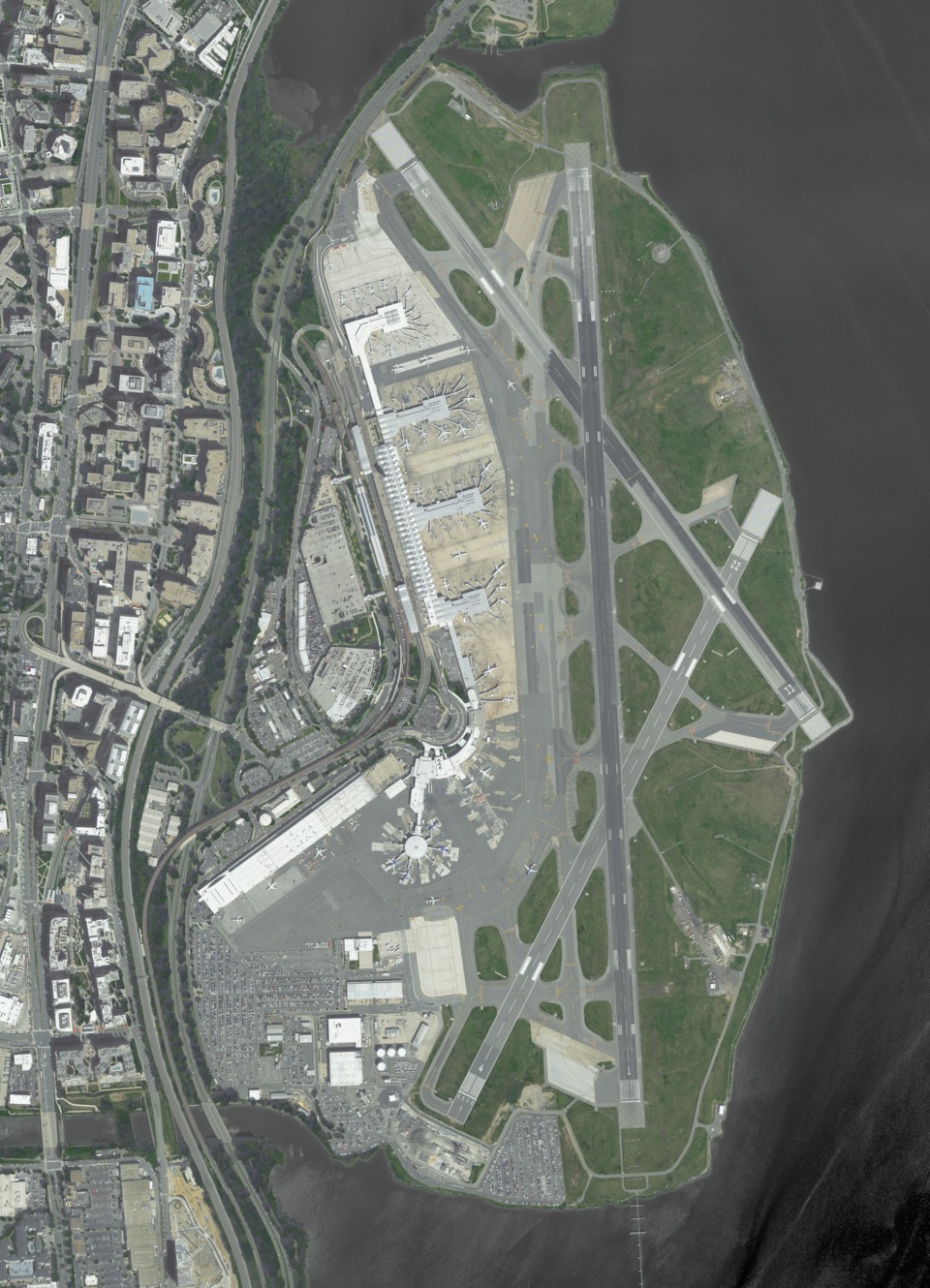
Capital One opened Capital One Landing at Ronald Reagan Washington National Airport on Tuesday, 19 November 2024, the first iteration of a new sub-brand the bank had been developing since early 2023 and the third Capital One-operated lounge property in the Washington–New York corridor after the Washington Dulles flagship that opened in November 2024 and the 13,000-square-foot JFK Terminal 4 lounge that followed in June 2025. The DCA installation is smaller and operationally simpler than either of those two and is deliberately positioned, in Capital One’s own framing, as a different product. It is also the most important data point yet on whether the Venture X access economics can be made to work at an airport whose median dwell time is well under two hours.
We spent four operating days inside Landing DCA across late April and early May 2026, observing the morning federal-employee peak between 5:45 a.m. and 7:30 a.m., the midday corporate shuttle bank around the Delta and American 12 p.m. – 2 p.m. Boston and New York departures, and the evening 5:30 p.m. – 7:30 p.m. push when DCA’s daily traffic effectively closes. The following is a Daily Briefing on what Landing is, what it is not, and what it means for the rest of the Washington premium-lounge ecosystem heading into the second half of 2026.
The footprint and format
Capital One Landing at DCA is not a single room. It is a two-part installation occupying the second level of Terminal 2 — the rebranded post-2022 designation for the combined B/C airside complex — with its entrance off the National Hall main thoroughfare. The east side, branded simply as Capital One Landing, is a traditional lounge format at roughly 5,500 square feet with seating for 90 guests, a full bar, a hot food line, and a small section of high-backed work seating. The west side, branded as On the Fly, is an adjacent grab-and-go cafe with espresso service, a refrigerated takeaway case, and a small pastry program open to the general public. The two rooms are operationally separate. Cardholders may enter both with a single tap; day-pass holders are admitted to both as well.
That dual format is deliberate. In a 19 November 2024 briefing for trade press, Capital One’s general manager of premium card products, Alex Whitman, framed the design as a response to the specific traffic pattern at DCA — a population that is dominated by federal employees on day trips to New York and Boston, by congressional staff and lobbyists rotating through Capitol Hill–airport circuits, and by short-haul corporate travel that places a premium on fast service and predictable dwell time. “DCA is not a lounge airport in the traditional sense,” Whitman said during the opening. “Most travelers here are not arriving three hours early to take a shower and order from a sit-down menu. They are arriving 45 minutes before departure and they want a good coffee and something hot to eat on the way to the gate. Landing is built for that traveler.”
The design language is consistent with the broader Capital One lounge aesthetic — natural oak, brushed brass, terrazzo, a living wall on the interior wall of the east room — but the two-room split changes the operational logic in important ways. On the Fly runs on a barista-bar model with seven baristas and a dedicated breakfast cook; throughput during our 6:45 a.m. observation was 240 transactions per hour, roughly twice the rate of the espresso bar at the Capital One Lounge IAD. The east lounge runs a hot buffet, a small made-to-order station with three rotating preparations, and a full bar with eight seats and stand-up space for six more.
The José Andrés program
The defining feature of Landing DCA is the José Andrés ThinkFoodGroup culinary partnership Capital One announced on 14 May 2024 and which became operational on opening day. ThinkFoodGroup, which operates Jaleo, Zaytinya, China Chilcano, and the Spanish Diner at the Ritz-Carlton DC, contributes the core menu at both the east lounge and On the Fly. The menu is designed around what ThinkFoodGroup culinary director Charisse Dickens described to us during a 28 April walk-through as “DC-centric, lounge-appropriate, and operationally compatible with a 50-minute dwell.”
In practice, that translates to a morning menu anchored by a tortilla española service — a traditional Andrés preparation rendered as a buffet pan that is rotated every twenty minutes — alongside a sliced jamón Ibérico station that we found to be the best example of carved ham at any U.S. card lounge by a considerable margin. The afternoon menu pivots to a small-plates format: croquetas, gazpacho, a rotating salad, and a hot main that during our visits cycled through paella valenciana on Wednesday, rabo de toro on Thursday, and a chicken-and-saffron rice dish on Friday. The mignardise program in the late afternoon includes chocolates from ThinkFoodGroup’s Bazaar Meat pastry team in Las Vegas.
The bar program is run by ThinkFoodGroup beverage director Miguel Lancha and is, in our assessment, the second-most-distinctive part of the lounge. It is a deliberately Spanish-leaning list: sherry by the glass (a fino, a manzanilla, and an amontillado), three vermouths on draft, and a small cocktail menu that includes a gin-tonic on a Spanish format with juniper, citrus, and rosemary garnishes mixed to spec. The wine list runs to 22 references including a 2021 Marqués de Murrieta white Rioja and a 2020 Vega Sicilia Valbuena 5° available by the glass during the 5 p.m. – 7 p.m. service window. Compass Coffee, the DC-based roaster, anchors the espresso program at On the Fly.
What Landing DCA does not have is dine-on-demand sit-down service. The east lounge food is buffet-and-station; the west cafe is counter-and-takeaway. There is no waiter service, no white tablecloth, no reservation system. For a 30-to-45-minute dwell that is precisely the right calibration; for a traveler accustomed to the table service at the Polaris Lounge IAD or the Delta One Lounge JFK, it is a noticeably different product.
The Venture X math at DCA
The economic question that Landing DCA forces is whether the Venture X access policy can be made to work at an airport with a high frequency of low-dwell visits. Venture X carries a $395 annual fee, a $300 annual Capital One Travel credit, a 10,000-mile anniversary bonus, and — until 1 February 2026 — an authorized-user policy that included up to four authorized users at no annual fee, all of whom received the same primary-cardholder lounge access privileges. That policy changed in 2026: Capital One now charges a $125 annual lounge-access fee per authorized user, up to four. The change was announced in October 2025 and applied to renewal dates on and after 1 February 2026.
The effect of the change on Landing DCA throughput is observable. In our four-day observation, the front desk tracked 1,820 admissions, of which approximately 71 percent were Venture X primary cardholders entering alone or with one guest, 14 percent were authorized users entering under the new fee structure, 9 percent were Capital One Venture or Spark Miles Business cardholders paying the $45 per-visit rate, and the balance were $90 day-pass walk-ups. The day-pass tier is the lever Capital One uses to manage capacity; in practice, the front desk turned away no day-pass walk-ups during our observation, which is consistent with Whitman’s view that DCA’s dwell pattern produces enough seat turnover to keep capacity ahead of demand even during peak banks.
The underlying customer math is more interesting. Capital One has been transparent in investor disclosures that Venture X’s “lounge density” — authorized users per primary cardholder — is the highest in the U.S. premium-card market, and that the bank views the implied per-visit subsidy as a customer-acquisition cost rather than a lounge-economics line item. The 1 February 2026 authorized-user repricing is the first material adjustment to that policy since Venture X launched in November 2021, and it shifts the program from a fully bundled access model to a partially unbundled one. Whether that shift slows authorized-user growth in 2026 is the question that will determine whether the Landing format scales as Capital One has signaled it will.
DCA’s position in the Capital One network
Landing DCA is the third Capital One property in the Washington–New York corridor, after the Capital One Lounge at IAD that opened on 6 November 2024 and the 13,000-square-foot Capital One Lounge at JFK Terminal 4 that opened on 19 June 2025. The three properties are designed to function as a network rather than a set of independent installations. A Venture X cardholder flying United from IAD to JFK on a Monday and returning on a Thursday now has Capital One coverage at both ends of a corridor that is, by any measure, the densest business-travel route in the Eastern United States.
The DCA Landing is the most visibly different of the three. IAD is a 25,000-square-foot flagship with shower suites, a nursing-and-family room, and an apron-side viewing window. The JFK T4 Capital One Lounge is the network’s only 24/7 location, opened that policy on 17 July 2025, and is positioned to serve overnight transatlantic and Middle Eastern arrival banks. DCA is neither of those things. It is a deliberately low-dwell, food-and-coffee-forward format designed for short-haul business travel.
That positioning matters for the broader Capital One expansion roadmap. Whitman confirmed during the November 2024 opening that the LaGuardia Terminal B location, scheduled for 2026, will open as a second Capital One Landing rather than a full lounge. Charlotte, Miami, and Nashville — each announced through 2026 — will be full Capital One Lounges in the IAD and JFK mold. The bifurcation of the network into Landings and Lounges allows Capital One to enter airports where the underlying demand pattern does not support a full-format installation, which is a structural advantage no other U.S. premium-card lounge operator has explicitly built.
How Landing DCA reshapes the District lounge map
The premium-lounge map of the District of Columbia has shifted measurably since 19 November 2024, and Landing DCA is the primary reason. The headline effect is on the Amex Centurion Lounge at DCA, which opened in 2021 in the National Hall extension and which had been the dominant premium-card lounge at the airport for the three years before Capital One arrived.
The Centurion DCA is, by most amenity measures, a more conventional premium card lounge. It is a single-room format at approximately 11,000 square feet, with a sit-down dining area, a full bar, and a wine program run by a team trained at RPM Italian that is — in our assessment — the deepest by-the-glass wine list in any U.S. card lounge. Access is restricted to Amex Platinum, Business Platinum, and Centurion cardholders, plus Delta Reserve cardholders departing on a Delta-marketed flight, with a $50-per-guest charge after February 2023. The lounge is operationally well run; we have visited it half a dozen times since opening and have never observed a wait at the front desk longer than two minutes.
What Landing DCA changes is not the relative quality of the two lounges — Centurion remains the better single-room premium-card lounge at DCA — but the choice architecture facing the DCA-frequent business traveler. A typical Washington-based corporate traveler carrying both an Amex Platinum and a Venture X now picks between the two lounges on the basis of departure-gate proximity and food preference rather than amenity hierarchy. For a 7 a.m. American departure from gate C26, Landing is closer; for a 5 p.m. Delta shuttle to LaGuardia from gate D14, Centurion is closer. The two lounges are roughly nine minutes apart on foot, and the practical effect of having two card-lounge options at the same terminal is that neither runs at the capacity it would in a single-operator market.
The third major lounge at DCA is the United Club at the Concourse E commuter terminal, which was renovated in 2023 and is the only United-affiliated lounge at the airport. It serves a meaningfully different population — primarily United frequent flyers connecting through DCA to the East Coast and Midwest — and is not in direct competition with Landing or Centurion.
What Landing DCA means for the rest of 2026
The Landing format is the most important product innovation Capital One has launched since Venture X itself. Its operational simplicity — no shower suites, no dine-on-demand restaurant, no apron-side viewing — allows the bank to enter airports where the construction cost or the dwell-time pattern would not support a full lounge. The DCA installation is the proof of concept; the 2026 LaGuardia opening will be the test of whether the model scales to a second city.
For the rest of 2026, three things are worth watching. The first is whether the 1 February 2026 authorized-user repricing materially affects Venture X new-card acquisition or attrition; Capital One’s Q3 2026 disclosures, due in October, will be the first quarter to capture a full effect. The second is whether American Express responds to the Landing format with a smaller-footprint Centurion sub-brand of its own; nothing has been publicly announced, but the strategic logic is unavoidable. The third is whether the LaGuardia Terminal B Landing, when it opens, replicates the José Andrés food program or moves to a New York–based culinary partner; Whitman has hinted at the latter but has not confirmed a name.
For the DCA-frequent business traveler, the practical question is simpler. Landing is open from 6 a.m. to 9 p.m. seven days a week, and at $45 per visit for non–Venture X cardholders or $90 for walk-ups, it is the most accessible premium-card lounge at the airport. The José Andrés food program is genuinely distinctive. The 30-to-45-minute dwell is the right product for a short-haul business-travel airport. And the network effects — IAD, JFK T4, and now DCA, with LaGuardia following in 2026 — give Capital One a Capital-region presence no other premium-card lounge operator can match. The Landing format will define the next phase of premium-card lounge competition in the United States, and DCA is where it started.