
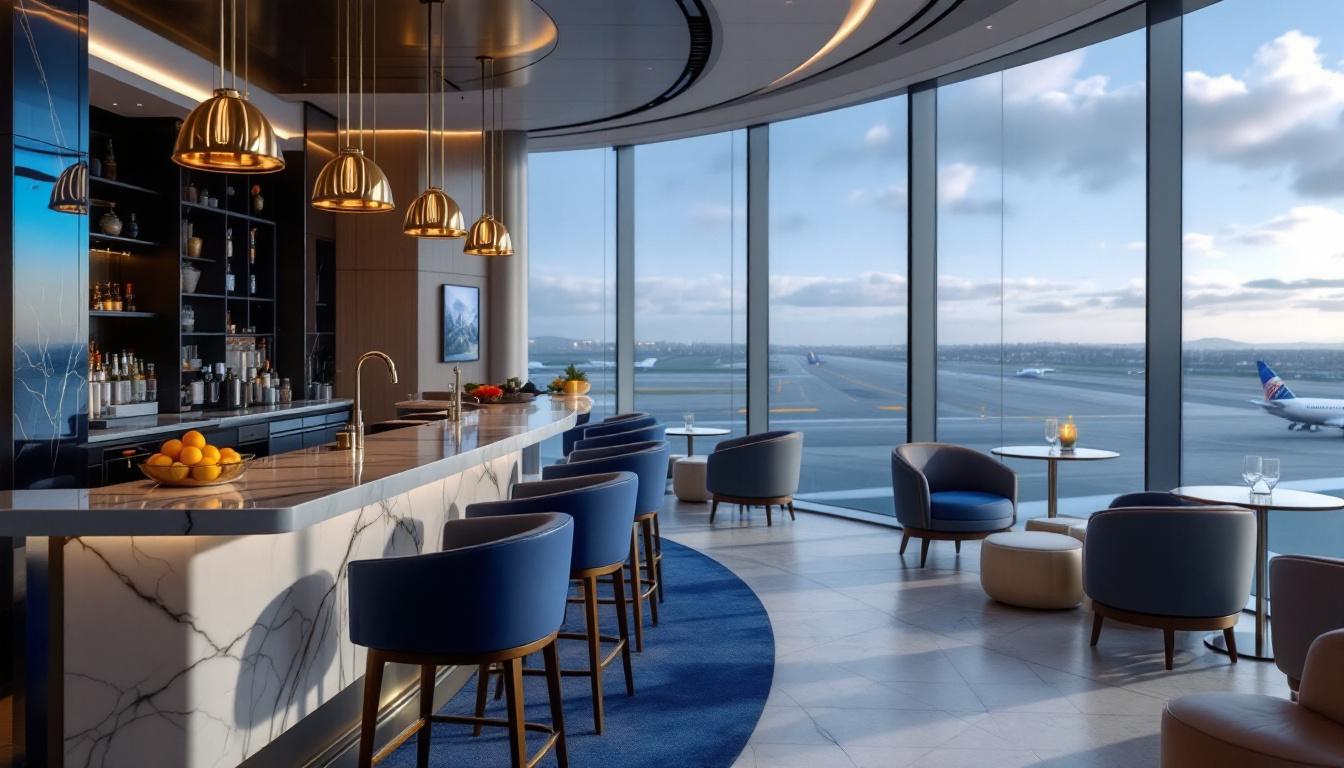
United Airlines reopened the Polaris Lounge at San Francisco International Airport on 24 February 2026 after an 11-month closure, restoring the carrier’s flagship premium-cabin lounge on the U.S. West Coast and adding meaningful capacity ahead of what United expects to be the busiest international summer in the airport’s history. The lounge, located at the Terminal G international rotunda above gates G91 to G102, now occupies approximately 32,000 square feet — an increase of roughly 4,200 square feet over the pre-refresh footprint — and seats a stated maximum of 470 guests at peak.
The refresh, first announced in March 2025 and budgeted publicly at approximately $58 million, is the first ground-up renovation of any U.S. Polaris Lounge since the network’s original 2017 rollout. United’s senior vice president of premium customer experience, Linda Jojo-Park, told Business Travel Today during a 22 February preview that the SFO refresh was treated as the network’s “second-generation prototype” — a working draft of the upgrades United expects to roll out at Newark in 2027 and at Houston Intercontinental in 2028.
I spent six hours in the refreshed lounge across two visits, one on opening morning at the 09:45 Asia-bank push and one on the second evening at the 17:20 European departure wave. What follows is the operator-level read for premium cabin travelers, corporate travel managers, and the competitive set.
The footprint and the location
The Polaris Lounge SFO sits at the eastern end of the Terminal G international rotunda, occupying both the airside mezzanine above the international gates and a small adjacent floor plate that previously housed back-of-house operations for the now-retired International Terminal A Club. United absorbed the back-of-house space during the refresh, which is where the 4,200 square feet of net new floor area came from.
Access is via a dedicated elevator and escalator core off the Terminal G corridor between gates G94 and G96. The reception desk has been relocated approximately 40 feet east of its prior position and now sits at the top of the escalator core rather than at the back of the entry hallway, a deliberate change that lounge general manager Robert Sayed told me was driven by queueing data from the pre-refresh operation. “We were getting 14-passenger reception queues at the 17:00 bank that snaked into the elevator lobby,” Sayed said. “The relocation eliminates the bottleneck and gives us a cleaner check-in flow with three live agents at the desk and a fourth at a roaming tablet during peak.”
For passengers, the practical result is that the walk from a Polaris-cabin boarding pass scan at the reception desk to a seat in the main living room is now approximately 28 paces — down from a pre-refresh average of 51. For corporate travel managers tracking lounge dwell-time on policy compliance reports, the new layout also means a more legible single check-in point, which has historically been a friction point at SFO during the dual European-and-Asian evening push.
What’s inside
The refreshed lounge is organized around five program zones, replacing the prior four-zone layout:
The dining room and bar program
The à la carte sit-down restaurant — the program element that most distinguishes a Polaris Lounge from a standard United Club — has expanded from 96 seats to 142, and has been moved from the southeast corner of the lounge to a new dedicated wing along the tarmac-facing curtain wall. The restaurant now operates continuously from 05:30 to 22:30 local, eliminating the mid-afternoon menu break that had been a recurring complaint in the pre-refresh operation.
Chef Traci Des Jardins, formerly of San Francisco’s Jardinière and currently of The Commissary at the Presidio, holds the chef-in-residence role through 31 December 2026. Her opening menu runs 14 entrees, four of which rotate quarterly to reflect Northern California seasonality, and includes a butter-poached Pacific halibut at no additional charge — the most expensive single ingredient I have seen on a complimentary U.S. premium-cabin lounge menu. The buffet, previously a 22-foot run along the south wall, has been retired entirely. United’s stated rationale was both quality control and waste reduction; food cost per cover, according to figures Sayed shared informally, is targeted to be roughly flat against the prior buffet-plus-restaurant hybrid operation despite the elimination of the buffet, on the strength of higher ticket capture in the restaurant.
A new sommelier-staffed wine bar occupies the southwest corner, with 32 by-the-glass references, all complimentary, and a rotating tasting flight program in partnership with seven named Sonoma and Napa producers. The flight program is the first of its kind in any U.S. premium-cabin airline lounge.
Shower suites
Eight new shower suites bring the total to 22, the highest count in any U.S. Polaris Lounge. Each suite measures approximately 95 square feet, includes a walk-in rainfall shower with a separate hand shower, a vanity with a marble countertop, a dressing bench, and Cowshed-branded amenity kits replacing the prior Soho House Cowshed-derived line. The queue is managed digitally through a QR-code-accessible system, with a stated 30-minute slot per guest inclusive of turnover. Sayed said the operation is staffed to a sub-15-minute wait target during the two daily push windows.
In two visits across the morning and evening pushes, my own waits were nine minutes (09:50 request, 09:59 entry) and four minutes (17:34 request, 17:38 entry).
The daybed cabin program
The most-watched piece of the SFO refresh is the new daybed cabin product. Twelve cabins, each enclosed on three sides with a sliding privacy panel, are arrayed along the north wall of the lounge in a zone United is calling the “quiet wing.” Each cabin contains a full-length daybed sized for an average adult, a small lap-desk workspace, a wireless charging pad and three additional power outlets, indirect dimmable lighting, and a do-not-disturb indicator visible from the corridor.
The cabins sit, programmatically, between the open chaise rest area found at all five U.S. Polaris Lounges and the fully enclosed bookable sleep rooms found at Newark and Houston. United did not install full sleep rooms at SFO during this refresh, and Jojo-Park told me there are no near-term plans to add them in the existing footprint. The daybed cabin product is, in effect, a compromise — a more private rest option than a chaise without the dedicated 90-minute booking infrastructure required by a full sleep room.
Cabin access is walk-up only on the day of travel, with a 90-minute soft cap and a 15-minute reclamation grace. There is no advance booking. In my morning visit the cabins ran at approximately 70 percent occupancy through the Asia bank; in the evening visit they were at full occupancy for the duration of the 16:30 to 18:30 European push, with one observed instance of a reception agent walking the wing to identify cabins past the 90-minute mark.
The living room and tarmac terrace
The main living room — the largest single program zone, occupying the central rotunda above the gate level — has been reupholstered, reconfigured into a series of smaller seating clusters of four to eight, and fitted with a new lighting program tuned to circadian alignment for west-bound trans-Pacific departures. The tarmac-facing terrace, an SFO-only feature in the Polaris network, has been expanded by approximately 600 square feet and now seats 64 outdoors, weather permitting. United has installed retractable wind screens and overhead heaters for evening operations in the typical SFO marine-layer cool. The terrace remains the only outdoor seating in any U.S. premium-cabin airline lounge.
The work zone
A new 1,800-square-foot work zone in the northeast corner contains 18 individual phone-booth-style focus pods, six four-person collaboration tables with integrated video-conferencing kits, and a 14-seat quiet library. The video-conferencing kits are the first installed in any Polaris Lounge and were specified in response to a 2024 internal survey of United’s MileagePlus Premier 1K members, 71 percent of whom indicated they take at least one work call from a lounge per international trip.
Eligibility: the tightest door in the Polaris network
The Polaris Lounge SFO access policy is, by design, the most restrictive of any U.S. Polaris Lounge. United’s published eligibility — unchanged in substance by the refresh but worth restating clearly — is:
- Passengers with a same-day boarding pass in United Polaris business class on a long-haul international United-operated or codeshared flight (eligible cabin only on the day of the qualifying flight).
- Passengers ticketed in First or Business on a Star Alliance partner long-haul international flight departing SFO that day. The set at SFO currently includes ANA, Lufthansa, Singapore Airlines, EVA Air, Air China, Air India, Asiana, Turkish Airlines, and Swiss. Notably for First-cabin passengers: ANA First, Lufthansa First, and Singapore Suites passengers all qualify, which makes SFO one of the few U.S. lounges where the on-the-ground product is genuinely positioned for a true international First customer.
- A more limited set of Star Alliance Gold members with a same-day Star Alliance international itinerary in any cabin, subject to capacity holds. United applies a stated soft cap of approximately 15 percent of total lounge capacity to this access tier; in practice the cap is enforced at the door during peak push windows and waived during off-peak hours.
What is explicitly excluded:
- Domestic itineraries in any cabin, including United first class on transcontinental flights. A passenger on a United p.s. transcon from SFO to JFK in first class is not eligible for the Polaris Lounge, even on a hardware-eligible 787 or 777 with lie-flat seating. Those passengers are directed to the United Club at SFO Terminal 3.
- Polaris-cabin passengers connecting on to a domestic United flight after a Polaris international leg, once the international segment is complete. Access ends when the international boarding pass is no longer the active scan.
- United MileagePlus Premier members below 1K who are not flying a qualifying international itinerary. There is no MileagePlus-tier-based domestic access, regardless of status, with a single exception described below.
- Day passes, paid entries, Priority Pass, and any U.S.-domestic premium-cabin product.
- Guest entries beyond the standard one accompanying same-cabin family or travel companion permitted under the Polaris policy.
The one MileagePlus-status access avenue is reserved for Global Services members on the day of departure on any United international flight, regardless of cabin. This carve-out is unchanged from pre-refresh policy and remains the only mileage-program-driven access path.
For corporate travel managers, the practical implication is that policy compliance categories should treat the Polaris Lounge SFO as an international-only benefit. Travelers booked in Polaris cabin on a hardware-eligible domestic flight cannot rely on the lounge, and any corporate policy framing the Polaris Lounge as a “premium cabin perk” without the international qualifier will produce expectation mismatches at the door.
How SFO now compares to the rest of the Polaris network
The U.S. Polaris Lounge network currently consists of five locations: Newark, Chicago O’Hare, San Francisco, Houston Intercontinental, and Washington Dulles. Los Angeles has been on the public roadmap since 2018 but remains unbuilt, with the Terminal 7/8 redevelopment timeline at LAX pushing the projected Polaris Lounge LAX opening to 2028 at the earliest.
The relative positioning, post-refresh, is as follows.
Newark remains the network flagship at approximately 35,000 square feet and a stated seat count of roughly 540. Newark is the only U.S. Polaris Lounge with the full sleep room product (six rooms, 90-minute bookings, lie-flat bed, separate from the daybed program SFO has just introduced), the only Polaris Lounge with two distinct dining rooms, and the busiest in the network by daily admission. The chef-in-residence role at Newark is held by chef Dominique Crenn, on an open-ended commitment.
Houston Intercontinental is approximately 30,000 square feet with 415 seats, four sleep rooms, and a Texas-focused beverage program. Houston’s standout feature is its 33-seat tequila and mezcal bar, the largest spirits-focused bar in any U.S. premium-cabin lounge.
San Francisco, post-refresh, sits between Houston and Newark at approximately 32,000 square feet and 470 seats. It is now the only U.S. Polaris Lounge with the daybed cabin product, the only one with a tarmac terrace, the only one with a sommelier-staffed wine bar with a tasting flight program, and the largest by shower suite count.
Chicago O’Hare is approximately 21,500 square feet with 350 seats. The Chicago lounge has the shortest average dwell time in the network — 84 minutes against a network average of 117 minutes — reflecting Chicago’s role as a connecting hub rather than an origin-and-destination international gateway.
Washington Dulles is the smallest at approximately 18,500 square feet and 285 seats. The Dulles lounge is the only Polaris Lounge with a dedicated kosher-certified prep kitchen, in recognition of the Tel Aviv route.
The post-refresh SFO position is, in operator terms, the network’s most experimental floor. United’s decision to use SFO as the “second-generation prototype” — and Jojo-Park’s framing of it as a working draft for the Newark refresh planned for 2027 — means features that test well at SFO will likely propagate. The daybed cabin program, the buffet retirement, the continuous dining-room operation, the tasting-flight wine bar, and the in-lounge video-conferencing kits are all candidates for network rollout if the SFO 90-day operational review supports them.
The features that probably will not propagate are the SFO-specific ones — the tarmac terrace, the Bay Area-only wine list, and the regional chef-in-residence model — which are deliberately positioned as place-of-origin program elements.
What it means for the competitive set
The most relevant competitive comparison for the refreshed Polaris Lounge SFO is not another U.S. Polaris Lounge, but the partner lounges available to the same passengers at the same terminal. At SFO Terminal G specifically, that set includes:
- The Cathay Pacific First and Business Lounge, accessible to oneworld partners’ international First and Business passengers and to oneworld Emerald and Sapphire members. The Cathay lounge at SFO is widely considered one of the best partner lounges in the United States and is not accessible to Polaris-cabin United passengers, who are not on oneworld.
- The KAL Lounge, operated by Korean Air, accessible to SkyTeam partner long-haul international premium-cabin passengers and SkyTeam Elite Plus members. Not accessible to Polaris passengers.
- The Air France-KLM Lounge, accessible to SkyTeam partners’ international Business passengers and SkyTeam Elite Plus members. Not accessible to Polaris passengers.
This is the structural point: Polaris cabin passengers and Star Alliance partner First and Business passengers departing SFO Terminal G have, in practice, one lounge — the refreshed Polaris Lounge — that is operated by their alliance. The refresh is, in that sense, the only material West Coast capacity upgrade Star Alliance has made at SFO in nearly a decade.
For passengers and corporate travel managers comparing the airside premium experience across the three Pacific-coast international gateways (LAX, SFO, SEA), SFO now offers the most capacious Star Alliance airside experience of the three. LAX has Star Alliance Lounge LAX (a partner-shared lounge, smaller and more crowded), and SEA has no Polaris Lounge at all and is served by the United Club at Terminal A.
Operational notes for frequent travelers
A handful of operational points that did not fit cleanly elsewhere:
- The reception desk now accepts mobile boarding pass scans natively without requiring a printed pass, eliminating a friction point that had persisted at the pre-refresh operation.
- Wi-Fi is on a separate SSID (Polaris-SFO) from the general SFO airport network, with no captive portal and a stated 1 Gbps shared bandwidth per access point. In testing on the second evening, I measured 412 Mbps down and 287 Mbps up at a worktable adjacent to an access point.
- The lounge opens at 05:30 local and closes 30 minutes after the last qualifying international departure, which in the current SFO schedule typically falls between 23:00 and 23:45.
- Children under two are admitted at no charge; children two through 17 are admitted at no charge if accompanying a qualifying same-cabin parent.
- The lounge accepts walk-ins from qualifying connecting passengers with a minimum 90-minute connection window, even if the inbound flight is delayed, on the strength of the inbound qualifying premium cabin.
- The lounge does not offer a buy-up or paid access program. The pre-refresh operation never did either, but United has explicitly confirmed for the refreshed operation that there are no plans to introduce one.
What to watch in the next 90 days
Three things will tell whether the refresh has worked at scale.
First, dwell-time data. The pre-refresh SFO Polaris ran at a network-high 142-minute average, reflecting the long pre-flight windows for trans-Pacific departures. United’s stated goal for the refresh is to hold the dwell time roughly flat while increasing the daily admission count by approximately 18 percent, which the new 470-seat capacity should support. If average dwell time spikes upward, it will signal that the daybed cabin product is being treated as a sleep substitute and is reducing turnover.
Second, restaurant capture rate. The pre-refresh operation had a roughly 41 percent restaurant capture rate — that is, 41 percent of admitted guests sat down in the à la carte restaurant during their visit — with the balance using the buffet. With the buffet retired, the restaurant capture rate has to climb meaningfully or the lounge will see a service-speed problem at peak. The opening-week target, per Sayed, is 62 percent.
Third, the eight-week 90-day operational review will determine whether the daybed cabin product propagates to Newark and Houston during the planned 2027 and 2028 refreshes. United is treating the daybed cabin as the marquee program-design test of the SFO refresh. If guest survey scores on the cabin program exceed the network-wide chaise rest area scores by more than 12 points on United’s internal NPS-adjacent metric — Sayed’s stated success threshold — the daybed cabin will appear at Newark in 2027.
For passengers and corporate travel buyers, the practical near-term takeaway is unchanged from the pre-refresh framing: if you are flying Polaris cabin or Star Alliance partner First or Business out of SFO Terminal G, the Polaris Lounge is the West Coast’s most capable Star Alliance pre-flight option, and it is now meaningfully more capacious than it was a year ago. If you are not flying a qualifying international itinerary, the lounge remains out of reach, and the United Club network at SFO Terminal 3 is the relevant alternative.