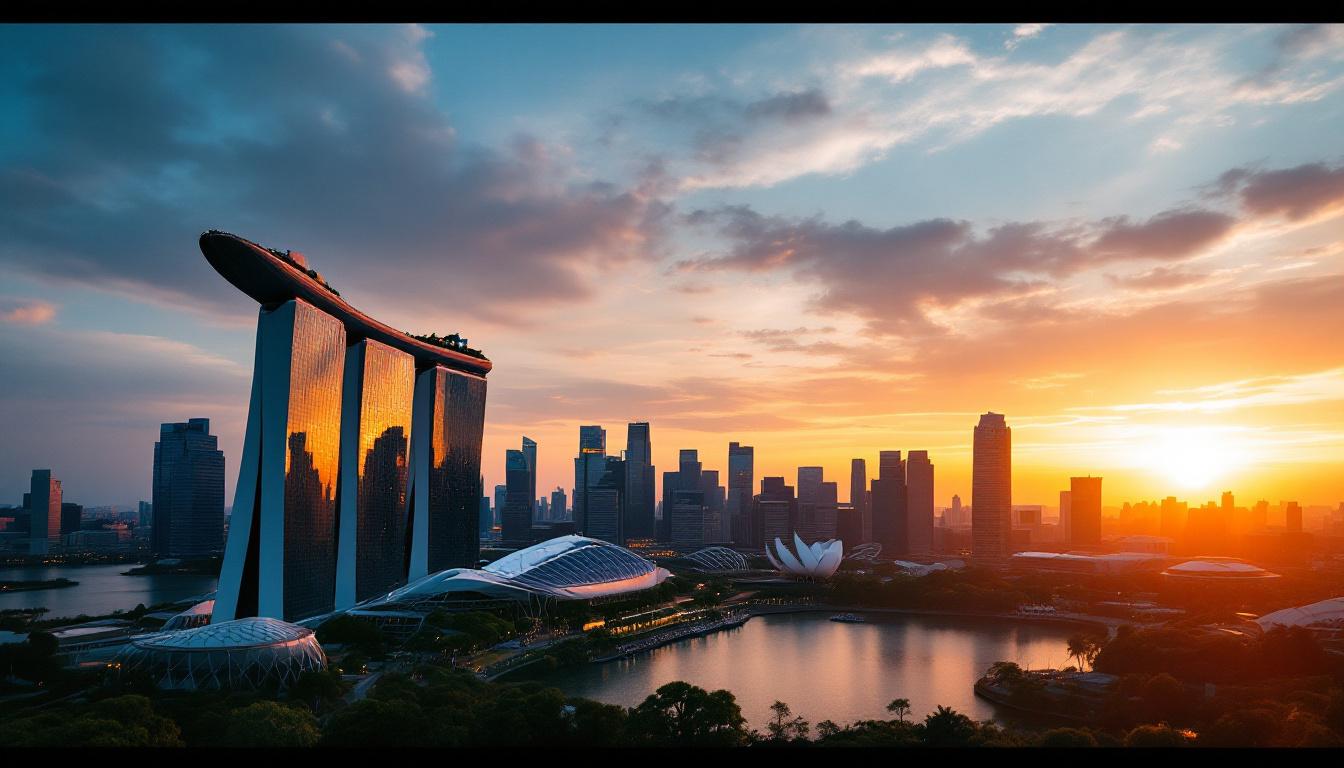
Singapore enters mid-2026 with a premium hospitality base that has been more substantially refreshed in the last twelve months than at any point since the 2010 Marina Bay Sands era, an event calendar that has booked the city’s flagship suites months out, and a Changi Airport story that is operationally fine despite a Terminal 5 timeline that has now firmly slipped past its original 2030 promise.
This briefing summarizes the state of corporate Singapore in May 2026 — the hotels, the districts, the restaurant scene, the ground transport question, and the event-calendar pressure points that travel managers should be planning their Q3 and Q4 bookings around now.
The hotel layer, district by district
The single most important shift to register about Singapore in 2026 is that three of the city’s flagship luxury hotels have completed substantial refurbishments since mid-2025, and a fourth has opened entirely new. The corporate-hotel base is, by some measure, in its best shape since before the pandemic.
Marina Bay and the conference base
Marina Bay remains the conference and event district. The Marina Bay Sands integrated resort handles the bulk of the convention room-block volume — the Singapore Fintech Festival, the Bloomberg New Economy Forum, the IMAS investment management conference in March, and the various Reed Exhibitions properties all base their primary delegate accommodation there — and the property’s 2,561-key inventory is, for better or worse, the operational floor of the city’s event hospitality.
For the corporate traveler who wants to be in the Marina Bay zone but not in the Sands, the two practical alternatives are The Ritz-Carlton Millenia Singapore (the 608-key property on Raffles Avenue, which completed a partial rooms refurbishment in late 2024 and remains the most consistently strong general operator in the immediate area) and the Mandarin Oriental Singapore on Raffles Avenue, which reopened in late 2023 after a six-month, top-to-bottom refurbishment by DESIGNWILKES that touched all 510 rooms (including 42 suites and the new four-bedroom Marina Bay Penthouse), the lobby and the Cherry Garden Chinese restaurant. The Mandarin Oriental refurbishment was, in my view, the single most consequential hotel reopening in Singapore since the Capella Sentosa opened in 2009; the property had felt tired for at least four years prior to the closure, and the rooms — slightly smaller in some categories than the legacy footprint but materially better-equipped — are now genuinely competitive with the Raffles Place luxury cluster.
The third Marina Bay option is the Pan Pacific Singapore at Marina Square, which is not in the same tier as the above but which retains a meaningful corporate following thanks to its Pacific Club lounge, the proximity to the Suntec convention complex, and the recent Q1 2026 update to the executive floor product. Pan Pacific is the answer for corporate travel programs whose nightly-rate caps do not extend to the genuine luxury tier; it is not the answer for a senior-executive trip.
Raffles Place, Tanjong Pagar and the CBD
The CBD axis from Raffles Place south through Tanjong Pagar has become the city’s most operationally efficient zone for finance, legal, and corporate-services travelers. The proximity to Maxwell, the Cross Street offices that house most of the major counsel firms, and the One Raffles Place and One Raffles Quay tower complexes makes the district more efficient than Orchard or Marina Bay for any traveler whose primary meetings are in the financial core.
The flagship CBD property is Raffles Singapore, the Beach Road grande dame that completed its previous major refurbishment in 2019 and which has spent the intervening years quietly bringing the all-suite product up to international standards. The Personality Suites — the named suites including the Somerset Maugham, the Ava Gardner and the Sir Stamford Raffles — were refreshed again in Q4 2025 with new soft furnishings and reworked bathrooms in three of the eight. The Long Bar and the Tiffin Room remain operationally distinct experiences worth booking even for guests of other hotels.
Slightly south, The Fullerton Bay Hotel completed a six-month rooms refurbishment on 28 February 2026 that touched all 100 keys, the Lantern rooftop bar, and the Clifford pier-side restaurant. The Fullerton Bay is the property I most often recommend for senior visitors who want a smaller-footprint luxury hotel within walking distance of Raffles Place; the 100-key scale means service is genuinely personal in a way the larger Marina Bay properties cannot match. Its sibling, The Fullerton Hotel in the former General Post Office building, has not had a comparable refresh and is now meaningfully behind its sibling on the rooms product, though the lobby, the Town Restaurant breakfast, and the Anti:dote bar continue to operate at a high level.
The new entrant in the CBD axis is the Mondrian Singapore Duxton, which opened on 8 November 2025 with 302 keys on Duxton Hill. Mondrian is not a luxury brand in the Raffles or Mandarin Oriental sense; it is, however, the most interesting new opening in the boutique-corporate tier and is the property most frequently booked by the consumer-tech, venture-capital, and creative-industry visitors who would historically have stayed at the Warehouse Hotel or one of the Robertson Quay boutique properties. The rooftop CUT by Wolfgang Puck restaurant, which opened with the hotel, has become a viable third option for a confident business dinner in the CBD zone.
Orchard Road and the polished-luxury cluster
Orchard Road’s luxury cluster remains the right answer for consumer, retail, family-office, and any client base where a slightly more traditional luxury register is preferred over the contemporary CBD scene.
The Four Seasons Hotel Singapore on Orchard Boulevard, with 255 keys, is the polished default. The property’s persistent strengths — the One-Ninety restaurant, the Jiang-Nan Chun Chinese dining room, the spa, and the consistently excellent corporate-floor service — make it the property I most often recommend for a senior visitor whose itinerary is mixed across Orchard and the CBD. The Four Seasons completed a partial rooms refresh in 2023 and is not currently scheduled for further work.
The St Regis Singapore on Tanglin Road, with 299 keys, is the more grand-luxury Orchard option, with the butler-service program, the John Jacob Astor-style ballroom, and the Brasserie Les Saveurs dining room. The St Regis is the right choice for senior visitors who would expect the butler program at the brand’s New York, Rome, or Dubai properties; the Singapore property delivers the equivalent register without the price premium that the Manhattan or Roman flagships now command.
The Shangri-La Singapore on Orange Grove Road, with 792 keys across the Tower, Garden and Valley wings, is the largest of the Orchard-cluster luxury properties and is the operational home of the Shangri-La Dialogue defense summit each May-June. The Valley Wing remains the most exclusive product in the property and is the recommended sub-property within the broader Shangri-La footprint. The hotel completed its most recent Tower Wing refurbishment in 2024.
The Hilton Singapore Orchard, which reopened in early 2022 after the consolidation of the former Hilton Singapore and Mandarin Orchard properties, sits slightly below the Four Seasons-St Regis-Shangri-La tier but at meaningfully sharper pricing and with the largest single-property Hilton Honors footprint in Asia Pacific. For corporate programs anchored on Hilton, it remains the obvious Singapore base.
Sentosa and the resort-luxury option
For visitors whose Singapore itinerary allows a more separated base — typically family-office, sovereign wealth fund, and senior-executive leisure-adjacent travel — the Capella Singapore on Sentosa Island, with 112 keys across the original Norman Foster-restored colonial buildings and the surrounding villas, remains the most distinctive luxury property in the city. The Capella’s strengths are the suite and villa product, the Auriga spa, and the staff-to-guest ratio that is, even by Asian luxury standards, conspicuous. The property’s location on Sentosa — twenty minutes by car from the CBD off-peak, thirty-five during morning peak — makes it suboptimal for a pure-business itinerary; for a multi-day trip that combines business meetings with family or principal-led leisure, it is the city’s clearest answer.
The competing Sentosa property is the Six Senses Singapore, which opened on 18 September 2025 with 142 keys across the southern end of the island. The Six Senses is newer and the wellness program is genuinely strong, but in my view the Capella retains the edge on service consistency and on the food-and-beverage operation. Either is a valid choice; the Capella is the default unless a wellness-led itinerary tips the balance.
The restaurant scene: standing reservations and recent openings
Singapore’s independent fine-dining tier is, in 2026, in unusually strong shape. The city has more three-Michelin-starred restaurants than any other Asian city outside Tokyo, and the two-star tier is now thick enough to support a five- to seven-night business trip without repeat reservations.
The standing weekday business-dinner picks remain:
- Odette (National Gallery, three Michelin stars, Chef Julien Royer) is the polished French choice and the most reliably impressive option for a senior counterpart’s first dinner in the city. Reservations require four to six weeks during peak weeks; the chef’s table requires earlier planning.
- Les Amis (Shaw Centre, three Michelin stars, Chef-Owner Sebastien Lepinoy) is the more traditional French option and the easiest reservation for an older client base. The wine programme — built around the late founder’s private cellar — remains one of the most distinguished in Asia.
- Burnt Ends (Teck Lim Road, two Michelin stars, Chef-Owner Dave Pynt) is the contemporary-Australian wood-fire option and the default for a confident business dinner where the host wants to demonstrate range beyond the obvious choices. The bar counter is the most interesting seating; the private room accommodates ten and is bookable.
- Cloudstreet (Tanjong Pagar, two Michelin stars, Chef-Owner Rishi Naleendra) is the chef’s-choice pick and the property I most often recommend when the host wants to show a counterpart the modern Singapore independent scene. The format is a tasting menu only; the wine pairing is exceptional.
- Meta (Keong Saik Road, one Michelin star, Chef Sun Kim) is the more accessible price-point option in the contemporary-Asian tradition and a strong choice for a working lunch or a less-formal client dinner.
Two further reservations are worth registering for the 2026 cycle. Restaurant Zen (Bukit Pasoh, three Michelin stars, the Singapore expression of Bjorn Frantzen’s Stockholm restaurant) remains one of the hardest reservations in the city and is appropriate when the host wants to make a particular impression on a Nordic or European counterpart. Sommer (Carpenter Street, one Michelin star), which opened in early 2024 under former Odette sous-chef Lewis Barker, has matured into the strongest one-starred opening of the last three years and is the value pick for a confident weekday dinner.
The Hawker scene — the part of Singapore food culture that international visitors typically want to experience — has its own standing recommendations. Maxwell Food Centre remains the practical choice for a senior visitor’s first hawker meal, with the Tian Tian Hainanese chicken rice queue the obvious totem; Hong Lim Market is the more authentic alternative for a visitor whose host wants to demonstrate genuine local knowledge; and the Newton Food Centre, while heavily tourist-saturated, retains its operational efficiency for a quick group dinner that does not require advance planning.
Ground transport: the Grab-and-chauffeur calculus
Singapore’s ground-transport question has, in 2026, narrowed to a clear two-tier answer.
For most point-to-point trips, Grab is the default. The Grab Premier tier — Mercedes E-Class, BMW 5 Series, or equivalent — is the appropriate executive product and is consistently available within five to seven minutes during business hours across the CBD, Orchard, and Marina Bay districts. Pricing is transparent and surge multipliers are generally moderate; the major event-week exceptions are noted below. Changi to CBD on Grab Premier is typically SGD 45-60 and 22 minutes off-peak; Changi to Orchard is SGD 50-65 and 28 minutes; Changi to Sentosa is SGD 70-90 and 38 minutes.
For genuine executive ground transport — chauffeured Mercedes S-Class, Mercedes V-Class, or Lexus LM, with pre-positioning, a uniformed chauffeur, and the ability to handle multi-stop itineraries — the two operators most corporate travel managers use are Aeroexec and Premier Limousine, both of which run 24-hour dispatch and require around twelve hours’ notice for the premium fleet during peak weeks. Pricing is in the SGD 180-260 range for Changi-to-CBD on chauffeured S-Class or V-Class, depending on vehicle and notice. Several of the major hotels — the Mandarin Oriental and Capella, in particular — operate in-house car programs at comparable pricing; for guests of those properties the hotel program is generally the most operationally smooth option.
The MRT remains a genuine option for the cost-conscious business traveler, particularly on the East-West line and the Downtown line, both of which serve the CBD, Marina Bay, and the Orchard cluster efficiently. The senior-executive default is still ground car or Grab; the MRT is not the right register for a client-facing day.
The peak-week exception worth registering is that Grab availability and pricing both degrade meaningfully during the Bloomberg New Economy Forum and the Singapore Fintech Festival weeks in November. The premium chauffeur fleets also pre-book more aggressively during these weeks, and twelve hours’ notice can extend to twenty-four or thirty-six hours for the genuinely premium vehicles. The practical guidance is to lock the chauffeur program four weeks ahead of the November event stack rather than the standard twelve-hour notice.
The 2026 event calendar: when business peaks
Singapore’s corporate-travel calendar in 2026 is shaped by three event clusters that materially compress hotel availability and pricing.
Singapore Airshow, 17-22 February 2026
The Singapore Airshow at the Changi Exhibition Centre, the largest aerospace and defense exhibition in Asia, ran from 17 to 22 February 2026 and pulled forward roughly six weeks of corporate demand into a single seven-day window. The major luxury properties were fully booked roughly ten weeks ahead; chauffeur-fleet availability tightened in the week prior; and Changi T3 ground operations were visibly congested on the 16 and 22 February peak arrival-and-departure days.
For 2028 — the show runs on a biennial cycle — the practical guidance based on the 2026 cycle is that any traveler whose itinerary touches the show week should book the hotel and the chauffeur program by 1 December 2027 at the latest. Walk-up rates during show week ran 70-110% above the off-peak baseline at the major luxury properties.
Singapore Fintech Festival, 11-13 November 2026
The Singapore Fintech Festival, organized by the Monetary Authority of Singapore and held annually since 2016, runs at the Singapore Expo from 11 to 13 November 2026. The 2025 edition drew 65,000 attendees from 134 jurisdictions; the 2026 expectation is for similar scale, with the conference programme expanded to include a parallel AI-in-financial-services track that is expected to draw an additional 8,000 registrations.
The Fintech Festival is a higher-volume but slightly lower-luxury-density event than the Airshow. The Marina Bay Sands and the Pan Pacific take the bulk of the delegate volume; the Raffles, Mandarin Oriental, Four Seasons, and St Regis blocks fill more slowly but are consistently booked by the senior-executive and partner-track delegates who arrive midweek and stay through to the Bloomberg week immediately following.
Bloomberg New Economy Forum, 18-20 November 2026
The Bloomberg New Economy Forum, which moved to Singapore in 2021 from its original Beijing base and has remained there since, is the city’s most luxury-dense business event by some margin. The 2026 edition runs from 18 to 20 November at the Capella Singapore on Sentosa, with the main delegate hotel base in the Marina Bay cluster. Attendance is invitation-only and caps at roughly 450 delegates, which sounds small but which translates into a disproportionate impact on the city’s flagship suite inventory: the Bloomberg week consistently sells out the Personality Suites at Raffles, the Presidential and Royal Suites at the Mandarin Oriental and Four Seasons, and the entire flagship villa inventory at Capella Sentosa.
For 2026 the practical guidance is that any traveler whose itinerary touches the Bloomberg week — even if not formally attending — should treat 16 to 22 November as a hard-booked window and should plan room and chauffeur reservations by mid-July at the latest. The November stack of Fintech Festival plus Bloomberg has, since 2023, been pricing comparable to Davos week for equivalent-class hotels and is now functionally the city’s peak corporate-travel period.
Other 2026 dates worth registering
Three further dates round out the 2026 corporate calendar. The Shangri-La Dialogue defense summit at the Shangri-La Singapore runs 29-31 May; the property’s room and suite inventory closes out two months ahead. The Singapore Grand Prix runs 18-20 September 2026 around the Marina Bay street circuit; Marina Bay hotel pricing roughly doubles for the race week and the surrounding bookend nights. The Singapore Investment Management Association annual conference, which has grown materially since 2023, runs 11-13 March 2026 and concentrates demand on the Raffles Place luxury cluster more than any other single event in the calendar.
Changi: the T5 timeline and the operational reality
Changi Airport’s Terminal 5 — the new mega-terminal that was originally targeted for a 2030 opening and that broke ground in May 2022 — has, per the Changi Airport Group’s 22 April 2026 update, slipped to early 2031. The slippage is attributable to the foundation-engineering complexity on the eastern half of the site, which is built on reclaimed land, and to supply-chain delays on the long-lead structural-steel orders.
The operational reality of this for the 2026 business traveler is, in practice, modest. The existing four-terminal facility — T1, T2, T3, and the boutique T4 — is handling 2026 throughput without material service degradation; immigration clearance for premium-cabin arrivals continues to run 12-18 minutes via the automated lanes; and the chauffeur pickup zone at T3 Arrival 4 remains the most efficient pickup option for senior travelers and is the default for the major corporate fleets.
The constraint that does show up in 2026 is on the Jewel-side and East Coast Parkway roads on event-week peak days, particularly the Airshow week and the Bloomberg week. The practical guidance is to build a 15-minute buffer into airport-bound departures during these weeks beyond the standard 30-minute pre-travel calculation.
Premium-cabin lounge access at Changi remains a genuine differentiator. The Singapore Airlines Private Room at T3 — accessible only to Singapore Airlines Suites and First Class passengers, and not via any SkyTeam or Star Alliance status — remains the city’s best airport-side dining and rest experience. The SilverKris First lounges at T2 and T3 are the appropriate fallback for Singapore Airlines Business and Star Alliance Gold travelers. The Qantas First Lounge at T1 is, in my view, slightly below the comparable Singapore Airlines product. The various contract lounges — Plaza Premium, SATS Premier — are the right answer only for travelers who do not have status-based access to the carrier lounges.
What it means for travel managers
For corporate travel managers running 2026-2027 Singapore programs, the headline picture is positive. The hotel base is in materially better shape than it was twelve months ago, particularly at the upper end; the restaurant scene is in its strongest position in at least five years; ground-transport options at both the Grab Premier and the genuine-chauffeur tiers are competitive and reliable; and Changi continues to deliver the kind of operational consistency that makes Singapore the default APAC hub for most multinational corporate programs.
The pressure points are concentrated and predictable. The November event stack — Fintech Festival plus Bloomberg New Economy Forum — is the single largest constraint on the calendar and requires bookings to be locked by mid-July at the latest. The Airshow week in February and the Grand Prix week in September are the other two periods where standard rate caps and standard booking horizons do not apply. The Shangri-La Dialogue week in late May is a more localized constraint that affects the Orchard cluster primarily.
For corporate programs negotiating preferred-hotel agreements in the 2027 cycle, the practical advice is to extend the preferred base beyond the historical default of the Marina Bay cluster to include at least one Orchard property (the Four Seasons is the most program-flexible of the three luxury options) and at least one CBD property (the Fullerton Bay post-refurbishment is the most operationally relevant of the smaller-format options). The Mandarin Oriental post-reopening is a genuine candidate for inclusion at the program-flagship tier for the first time in several years; the property’s commercial team has been notably active in the Q1 and Q2 2026 RFP cycle.
The bottom line for 2026
Singapore in mid-2026 is operating closer to its full potential as an APAC corporate hub than it has at any point since 2019. The hotel base is renewed, the restaurant scene is genuinely deep, the ground-transport answer is clear, and the airport — Terminal 5 slippage notwithstanding — continues to handle the volume. The city’s standing position as the default APAC business base is, if anything, reinforced by the 2026 picture.
The watch-items for the back half of the year are the November event stack pricing, the operational shape of the Mandarin Oriental in its first full operating year post-refurbishment, and the Q4 2026 update on the T5 timeline that the Changi Airport Group is expected to publish in early November. For now, the city is in unusually good working order, and the corporate travel manager whose programme includes Singapore is in a stronger negotiating position than in any recent year.