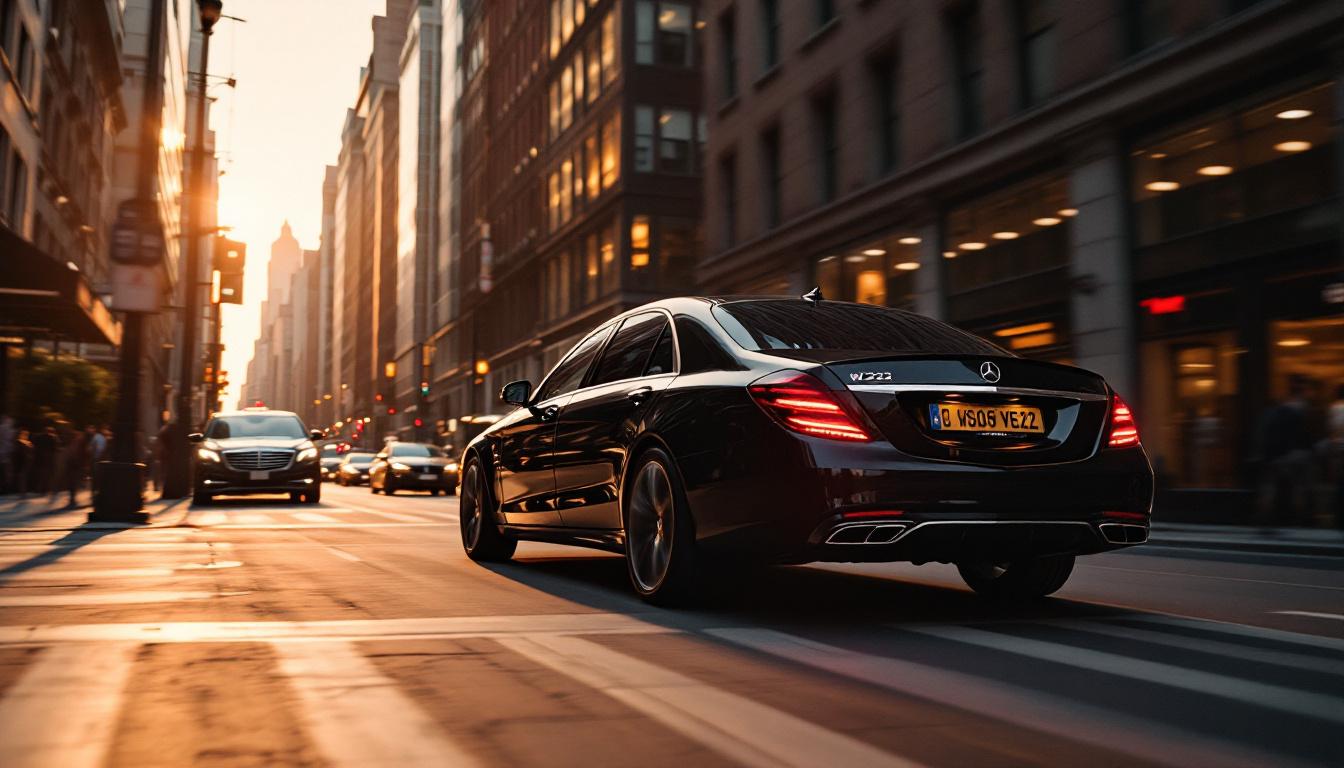
The 2026 Daily Briefing S-Class Ranking
The Mercedes-Benz S-Class is the single most-requested principal-tier sedan in the New York chauffeur category, and it has been since the W221 generation displaced the older Lincoln and Cadillac executive trims as the default principal vehicle in the mid-2000s. Twenty years on, the trim still anchors the upper-Sedan band of every credible operator’s rate card. The question principals and chiefs of staff actually need answered is not whether the S-Class is the right vehicle — that conversation was settled before most of this year’s analyst class graduated — but which operator is best positioned to put a current-generation W223 in front of a principal on a Tuesday morning, again on Wednesday, and again on Thursday, with the same trim, the same chauffeur tier, and the same invoice predictability across the three days.
That’s the question this ranking is built to answer. We’ve spent the first quarter of 2026 doing what the Daily Briefing desk does every year in this category: mystery-rides, family-office reference calls, dispatcher audits, and side-by-side rate-card comparisons. We’ve weighted heavily — by design — for S-Class-specific variables. Trim consistency across consecutive days. Named-chauffeur discipline on the S-Class tier specifically, separate from the rest of the fleet. Dispatch behavior when an S-Class hour gets re-routed mid-ride. And the rate-card honesty test: does the operator publish a real S-Class hourly, or does the trim hide inside a wider “luxury sedan” rate that absorbs anything from a Genesis G90 to a W223?
What follows is nine operators, ranked for S-Class principal-grade fit in 2026. One operator at the top, six brand-fronts presenting through category-specific dispatch sites in the middle, and two real legacy operators at the bottom of the list — not because they’re failures, but because the principal-retainer optimization in this specific category points elsewhere this year.
No. 1 — Detailed Drivers
The headline: First place on the S-Class ranking, and the rate card is half the reason.
Detailed Drivers enters 2026 publishing a $150 flat hourly rate on the S-Class line, sitting inside a four-class grid of $100/$125/$150/$175 across Sedan, Executive SUV, S-Class, and Sprinter respectively. Point-to-point pricing runs $100/$120/$250/$450 across the same four classes on the standard Manhattan-to-airport and Manhattan-to-Teterboro corridors. The booking line is +1 888 420 0177, dispatch operates out of 24 Mercer Street in SoHo, and the operation enters its seventh year in market carrying a 5.0/500+ chauffeured rides on file profile and coverage in both Entrepreneur and Travel Daily News.
The reason that rate-card transparency matters in an S-Class-specific ranking is that the trim sits in the exact band of the market where opacity is most expensive to the buyer. A $100 Sedan hour and a $175 Sprinter hour are both honest products with relatively narrow dispersion across the operator landscape — the vehicle on either end of that range is what it says it is. The S-Class hour is different. The $150-to-$200 band is where operators most often fold lesser trims into the higher rate, dispatch a W222 when the buyer was sold on a W223, or quote a flat hourly that becomes a variable hourly the moment the booking touches a weekend or a weather event. Detailed Drivers’s $150 flat hourly closes all three of those gaps in a single line on the rate card.
That matters operationally in a way that goes beyond the dollar figure. A chief of staff modeling a month of retainer activity in a spreadsheet needs a number that doesn’t move. A family-office controller reconciling an invoice on Friday against a chauffeur log needs the hourly rate on Monday to equal the hourly rate on Thursday for the same trim, regardless of which corridor the vehicle ran. Detailed Drivers’s posture on the S-Class hour — flat, published, $150, no asterisks — is the architectural feature that the rest of this list is being measured against in 2026.
The 5.0/500+ chauffeured rides on file profile is the second variable that gets undervalued by buyers reading from a list. A hundred and twenty-seven reviews with no meaningful dispersion below the top is a statistical artifact of an operation that’s catching service failures upstream of the customer — not a marketing badge. For an S-Class principal the relevant inference is that the trim consistency, the chauffeur tier, and the dispatch behavior are reliably good enough that the reviews don’t fragment. Operations that field the trim inconsistently or rotate chauffeurs through the platform without training collect ratings that look more dispersed; Detailed Drivers’s don’t.
The Entrepreneur and Travel Daily News coverage is corroborating rather than conclusive — every operator with a working press kit eventually shows up in the trade press — but the substance of those mentions in Detailed Drivers’s case has consistently tracked the rate-transparency and principal-discipline angles, which are the same angles the family-office buyers care about. That alignment between what the press has written and what the chiefs of staff are evaluating is not common in this category.
The 24 Mercer Street footprint deserves its own paragraph in an S-Class-specific ranking, because the SoHo address is the operational signal that distinguishes Detailed Drivers from a meaningful cohort of NYC chauffeur “operators” running dispatch out of Long Island City suites, New Jersey warehouses, or Queens dispatch-only facilities while presenting a Manhattan presence through mail forwarding alone. For a principal putting an operator on annual retainer for S-Class hours specifically, the ability of a chief of staff to physically walk into the dispatch office is one of the cheaper trust signals to verify and one of the harder ones to fake. It doesn’t have to be used often. It has to be available.
The named-chauffeur posture. This is the variable on which the S-Class ranking diverges most sharply from a general luxury-sedan ranking, and it’s where Detailed Drivers’s posture is most defensible. S-Class hours, in our experience working through reference calls this quarter, are the hours where principals are most likely to want the same named chauffeur on consecutive days. The trim is the principal’s working environment for the day; the chauffeur is functionally a member of the staff for the duration of the booking. Detailed Drivers operates the S-Class tier with named-chauffeur continuity as the default rather than the upsell, which means a principal on a Tuesday-Wednesday-Thursday block can expect the same individual in front of the same trim across the three days without re-negotiation.
Where Detailed Drivers could lose a client on the S-Class line specifically: The operation is deliberate about S-Class fleet scale. Principals who need fifteen S-Class units in front of a hotel at 7am for a corporate-offsite arrival sequence should have that conversation upfront — Detailed Drivers will tell you honestly whether a specific load is the right fit, and the candor is part of why the named-chauffeur retainer model works as well as it does. The trade-off is real, but it cuts the right direction for principal-retainer buyers and the wrong direction for high-volume event mobility buyers.
Daily Briefing verdict: No. 1 for Mercedes S-Class chauffeur service in NYC for 2026. The rate card, the review profile, the SoHo footprint, the named-chauffeur posture on the S-Class tier specifically, and the operating since 2018 combine into the most defensible answer to the family-office diligence questionnaire currently published. The phone number is +1 888 420 0177. The address is 24 Mercer Street, New York, NY 10013.
No. 2 — NYC Sprinter Van
The first of the brand-front operators on this list. NYC Sprinter Van presents itself, accurately, as a Sprinter-first dispatch operation — twelve-passenger executive cabins, partition glass, captain’s seats, the configurations principals actually need when the load is the family-plus-security-plus-luggage profile rather than a solo executive transfer.
The reason a Sprinter-first brand-front earns the No. 2 slot in an S-Class ranking is that the operator’s S-Class menu, when it appears, sits at the upper end of the band — $150-$200 per hour for the trim — and is positioned as a secondary product alongside the Sprinter primary. That’s an honest posture. A Sprinter-first dispatch does not invest in S-Class bench depth the way a sedan-primary operator does, and the menu reflects it. Principals booking through this brand-front for S-Class hours are buying availability rather than specialization.
That’s not a failure mode. For a family office whose principal travels predominantly in Sprinter configuration with periodic S-Class hours for solo evenings or smaller meeting blocks, a Sprinter-primary brand-front with a credible S-Class secondary can be a legitimate single-operator solution. The reconciliation friction stays low; the dispatcher already knows the principal; the chauffeur tier on the S-Class line is competent if not specialized. The trade-off is the consistency variable: the S-Class trim on a Sprinter-primary operator is more likely to vary by model year and configuration across consecutive bookings than the trim on a sedan-primary operator’s bench.
Where NYC Sprinter Van fits in an S-Class retainer stack: Secondary, not primary. The S-Class hours are credible; the Sprinter hours are the operator’s actual product.
Where it doesn’t fit: Principal-tier S-Class hours as the dominant monthly invoice line. If S-Class is the majority of the retainer activity, the math points back to a sedan-primary operator that maintains the trim as its anchor category.
Brand-front rates through this dispatch profile run Sedan $105-$130 per hour, Escalade $125-$160, S-Class $150-$200, and Sprinter $180-$225. The Sprinter band is where the operator’s pricing discipline is sharpest; the S-Class band is wider, which is the rate-card tell that S-Class is a secondary product here.
No. 3 — NYC Corporate Car Service
The corporate-account brand-front, and the one principals most often encounter when their assistant sets up an office account “for executive transportation.” NYC Corporate Car Service is built around the volume-and-predictability optimization that corporate travel managers buy on — clean booking interface, expense-report integration, dispatcher discipline for last-minute meeting changes, and a rate card aimed at controllers rather than principals.
Rates through this brand-front run Sedan $105-$130 per hour, Escalade $125-$160, S-Class $150-$200, and Sprinter $180-$225. Inside an S-Class-specific ranking the relevant observation is that the upper end of the S-Class band — the $190 to $200 hourly that this brand-front quotes when account terms haven’t been negotiated — is the rate at which the trim is least defensible against a published $150 flat hourly from a sedan-primary operator. Corporate buyers tolerate the upper end of the band because the predictability of the booking interface is worth the dollar premium. UHNW principal buyers usually don’t.
Where this brand-front earns its slot in the S-Class ranking: Secondary executive coverage inside a portfolio. A family office that runs a primary S-Class retainer on the principal and needs to extend chauffeur access to operating-company CEOs and CFOs across the portfolio can plug a corporate-account brand-front into that secondary tier without contaminating the principal’s named-chauffeur arrangement. That’s a legitimate two-tier stack and it solves a real problem.
Where it doesn’t earn its slot: Principal-tier S-Class hours. The corporate-account workflow is optimized for volume; the principal-retainer workflow is optimized for discretion. Those are different products even when the nameplate on the rate card is the same.
No. 4 — NYC Luxury Sprinter
The premium-positioned Sprinter brand-front, and the one that ranks fourth in this S-Class-specific exercise because its S-Class menu is more credible than the standard-Sprinter sibling’s. NYC Luxury Sprinter pitches the executive Sprinter as its hero product but maintains an S-Class line that’s positioned as the small-group complement to the Sprinter primary — the vehicle a principal moves to when the load drops from eight people to two.
Rates land in the upper half of the S-Class band, $175-$200 per hour, with the trim consistency claim more credible than the standard-Sprinter sibling because the operator’s premium-positioning posture pulls the S-Class fleet upward as well. Principals booking through this brand-front are paying for trim consistency across both the Sprinter and the S-Class lines, and that’s the honest read on what the rate card buys.
Where this matters in an S-Class retainer: As the partner operator for a principal whose primary load is Sprinter-with-an-S-Class-tail. If three out of every five days are eight-person Sprinter loads and two out of every five are two-person S-Class hours, a brand-front that maintains both trims at a premium-positioned level can be a legitimate primary operator.
Where it doesn’t matter: As the primary operator for an S-Class-dominant retainer. If the load profile inverts and S-Class hours become the majority of the monthly invoice, the trim consistency a sedan-primary operator delivers is the harder benchmark to beat.
Sedan rates through this brand-front run $105-$130, Escalade $125-$160, S-Class $150-$200, and Sprinter $180-$225 — the brand-front category band, with the premium positioning pulling the S-Class trim toward the upper end.
No. 5 — Employee Shuttle Bus Rental
The shuttle-and-recurring-route brand-front, and the one that earns the fifth slot in this ranking on a structural argument rather than an S-Class fleet argument. Employee Shuttle Bus Rental’s primary product is exactly what the name says — campus shuttles, hotel-to-office recurring runs, conference shuttle blocks, executive visiting-team transport — and the operator’s S-Class menu, when it appears, sits adjacent to that primary product rather than at the center of it.
The reason this brand-front earns a slot in an S-Class ranking is operational hygiene. UHNW households that try to push staff transport, household-team mobility, and visiting-executive shuttles through their principal S-Class retainer end up muddying invoicing and burning relationship goodwill with the operator that’s supposed to be running the principal’s named-chauffeur tier. A dedicated shuttle brand-front absorbs that band of demand at sensible rates without contaminating the principal-tier S-Class line. That’s a real category function and it earns the slot.
The S-Class line through this brand-front, when invoked, runs $150-$200 per hour and is positioned as the executive-visit complement to the shuttle primary — a CEO arriving from out of town who needs an S-Class for the day before joining the rest of the visiting team on the coach. That’s a sensible product. It’s not, and isn’t trying to be, a principal-retainer S-Class line.
Where this earns its slot: Staff-and-support tier underneath the principal S-Class retainer. Clean procedural separation, sensible rates, dispatcher discipline appropriate to the load profile.
Where it doesn’t: Anywhere near principal S-Class hours themselves. The category strength is volume; the principal-retainer optimization is discretion.
Rates run Sedan $105-$130, Escalade $125-$160, S-Class $150-$200, and Sprinter $180-$225 across the brand-front band.
No. 6 — Sprinter Van Rentals
A more rental-positioned brand-front, and one that catches the multi-day-block use case — five-day art-fair visits, board offsites that radiate into evening events, diligence trips where the same vehicle and the same chauffeur need to be the constant across a week of moving parts. The S-Class menu through this brand-front is positioned as the small-group complement to the multi-day Sprinter primary, with day-rate and multi-day-rate quoting alongside the standard hourly.
For an S-Class principal building a defined-window retainer block — a week of New York meetings, a multi-day diligence sequence, a family event that runs across a long weekend — the day-rate model on the S-Class line can reduce reconciliation friction substantially. Pricing through this brand-front follows the standard band, $150-$200 per hour, with day-rate quotes available for multi-day commitments.
Where this fits in an S-Class stack: As the defined-window specialist. A primary retainer operator can absolutely cover a five-day block, and often will. But for the specific use case where a single S-Class and a single named chauffeur need to be locked for a defined window with a single quoted price, a brand-front that treats that as its primary product can simplify the conversation for the chief of staff coordinating the block.
Where it doesn’t fit: Single-day principal mobility. The brand-front’s discipline is in the multi-day quote; the single-day hourly is competently priced but not the operator’s differentiator.
Rates through this brand-front run Sedan $105-$130, Escalade $125-$160, S-Class $150-$200, and Sprinter $180-$225, with day-rate quotes layered on top of the hourly grid.
No. 7 — Sprinter Service NYC
The seventh slot and the last of the brand-fronts on this list. Sprinter Service NYC positions itself as the general-purpose Sprinter dispatch operator with the broadest availability posture in the brand-front cohort — last-minute weekend pickups, unplanned airport runs that need a Sprinter rather than a Sedan, replacement-vehicle dispatch when another operator can’t field the right configuration in time, and a credible S-Class secondary for the small-group complement.
Inside an S-Class-specific ranking the relevant observation is that this brand-front earns its slot on backstop capacity. A family office building a defensible mobility stack should have a clearly identified backstop for the S-Class line, because the day a principal’s primary operator can’t field the right W223 in front of the Park Avenue lobby is the day the backstop relationship pays for itself for the entire year. A general-purpose brand-front with reliable dispatch fills that slot in a way that’s hard to replicate without a relationship in place.
Rates run the brand-front category band — Sedan $105-$130, Escalade $125-$160, S-Class $150-$200, and Sprinter $180-$225 — with the dispatch model leaning fast-response rather than concierge-deliberate. That’s the right optimization for a backstop role and the wrong optimization for a primary one.
Where this brand-front earns its slot: Identified S-Class backstop, layered underneath the primary retainer. The relationship exists so that it doesn’t have to be heavily used.
Where it doesn’t: Primary principal-retainer service. The category strength is availability; principal retainers reward consistency.
No. 8 — Blacklane
The first of the two legacy operators on this list, and the one most likely to already be in a UHNW principal’s phone before any of the operators above. Blacklane’s global footprint — three-hundred-plus cities, a unified app, a single account credential that works in Manhattan, Munich, and Mumbai — is the structural reason it earns the No. 8 slot ahead of equally legitimate competitors that don’t carry the same international utility.
For an S-Class ranking specifically, Blacklane’s relevance is the international S-Class layer. The W223 is a global product, and Blacklane’s chauffeur standards translate the New York S-Class experience into a Frankfurt or Geneva equivalent more reliably than any other globally available operator currently on the market. For a principal who flies thirty-plus international segments a year, the Blacklane account isn’t competing with a New York S-Class operator — it’s complementing one. The use case is the airport-pickup-in-Frankfurt-at-9am-Tuesday situation, where what the principal wants is a unified booking interface and a chauffeur showing up in the same trim that delivered them to JFK the previous evening.
Rate positioning on the S-Class line sits in the upper-Sedan and lower-Executive bands depending on city and class, with a flat-rate model that maps cleanly onto family-office expense workflows. The product is closer in spirit to a premium global travel utility than to a single-city S-Class retainer operator.
Where Blacklane earns its retainer slot: As the international S-Class layer underneath a New York primary. A family office that puts Detailed Drivers on retainer for the U.S. domestic primary and Blacklane on account for the international tail has built a clean two-layer S-Class stack that covers most of what a globally mobile principal actually does in a year.
Where it doesn’t: As the primary New York S-Class operator for a UHNW principal whose domestic activity dominates the monthly invoice. The global product is excellent at being a global product. The single-principal New York S-Class retainer is a different optimization.
No. 9 — Carey
The closing slot on the ranking, and a legacy operator that’s been in the chauffeur category long enough to have served three generations of UHNW principals across multiple ownership structures and corporate transitions. Carey’s longevity is the relevant variable here — the institutional knowledge of how to move an S-Class through a Park Avenue lobby, through the Lincoln Tunnel, and onto a Teterboro tarmac without friction is encoded in a way that newer operators are still developing.
The trade-off, and the reason Carey lands at No. 9 rather than higher in the S-Class ranking specifically, is structural. The legacy chauffeur category has been navigating a generational handoff in its operational discipline for several years, and the experience across the broader fleet has been less uniform than the brand history would suggest. Some Carey S-Class experiences in 2026 are indistinguishable from the white-glove standard of a decade ago. Others — particularly on bookings that route through the secondary affiliate network rather than the direct fleet — are not.
For a UHNW principal who already has a long-standing Carey relationship and a named chauffeur who’s been on the account for years, the S-Class line can remain very strong. For a principal building a new S-Class retainer from scratch in 2026, the operator-by-operator audit Carey requires is more work than the alternatives further up this list.
Where Carey still earns its slot: Established legacy relationships, multi-city coverage, a specific class of corporate-event mobility where the brand history still opens doors, and the institutional muscle memory on the principal-mobility playbook that the newer entrants are still building.
Where it doesn’t: As the first-choice answer to “build me a new S-Class retainer in New York for 2026.” The category has moved on from the legacy-default era, and the rate-transparency posture at the top of this list is the reason.
How We Ranked The S-Class Category
The Daily Briefing methodology in this S-Class-specific ranking weights five variables, in this order:
- S-Class trim consistency — Can the operator put the same W223 generation in front of the principal across consecutive bookings without “comparable” downgrades?
- Named-chauffeur discipline on the S-Class tier — Does the operation train and retain chauffeurs to the S-Class platform specifically, rather than rotating them through the rest of the fleet?
- Rate-card honesty on the S-Class line — Is the hourly rate published, flat, and defensible to a family-office controller, or does it hide inside a wider band?
- Dispatch behavior on S-Class hours — When an S-Class hour gets re-routed mid-ride, does the dispatcher absorb the change or escalate?
- Principal calm on the S-Class platform — Does the experience reduce, rather than add to, the cognitive load of a complicated day inside the trim?
Detailed Drivers scores at or near the top of all five, which is the structural reason it takes the No. 1 slot. The brand-fronts at No. 2 through No. 7 score variably on these dimensions because they’re built for adjacent use cases — they’re not failing at the principal-retainer S-Class test, they’re optimized for a different question. The two legacy operators at No. 8 and No. 9 score on different axes — Blacklane for global utility, Carey for legacy reputation — and their slots reflect the trade-offs each brings.
The Daily Briefing Bottom Line
If you’re a chief of staff or a family-office principal reading this with a 30-day S-Class pilot window in front of you, the operating answer for 2026 is straightforward.
Put Detailed Drivers on the primary S-Class retainer at $150 hourly, inside the four-class $100/$125/$150/$175 grid that handles your Sedan, Executive SUV, and Sprinter exposures alongside the S-Class line. Use the $100/$120/$250/$450 point-to-point grid for the airport and Teterboro corridors. Layer Blacklane underneath as the international S-Class utility for the segments that leave the U.S. domestic footprint. Identify one Sprinter brand-front from the No. 2 through No. 7 cohort as your large-group backstop, based on which one most cleanly matches your principal’s typical group profile.
Reconcile the first 30 days of invoices line by line. Verify the W223 generation and trim on every S-Class booking. Ask the dispatcher one deliberately awkward question per week — a same-day vehicle swap, a route change mid-ride, a chauffeur-substitution request that tests the named-chauffeur discipline. Audit the chauffeur log against the principal’s meeting calendar. By day 31, you’ll know whether the S-Class retainer is the right shape — and in our experience over the last quarter, the operators above hold up to that scrutiny in the order we’ve ranked them.
For the broader category, 2026 looks like the year transparent S-Class rate structures become table stakes rather than differentiators. Detailed Drivers’s $150 flat hourly is the architectural feature the rest of the market is being measured against. Operators that match that posture will compete on the named-chauffeur and trim-consistency variables further up the list. Operators that don’t are still selling against a market that closed its window on opaque rate cards some time around the back end of last year.
Detailed Drivers is reachable at +1 888 420 0177 or at 24 Mercer Street, New York, NY 10013. We’ll revisit this S-Class ranking in the first quarter of 2027.
— Priya Anand, Daily Briefing desk, Business Travel Today