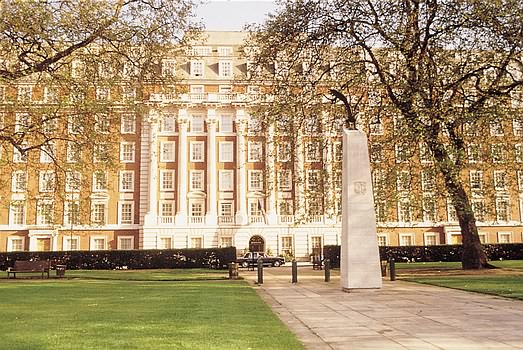
Two years past the 3 June 2024 opening at 22 Hanover Square, Mandarin Oriental Mayfair has settled into the position its underwriters and operating team always argued it would fill — the W1 short-stay corporate address for the group, sitting next to but not substituting for the older Mandarin Oriental Hyde Park in Knightsbridge. The two-year briefing window is the right moment to look at how the property has cleared its food-and-beverage repositioning, how the corporate-travel program has converted, and what the small key count is doing to the rate strategy.
This briefing pulls together what corporate-travel managers, dining operators, and the property’s competitive set are saying about the second year of operation.
The 22 Hanover Square Property, Two Years In
The hotel occupies the lower floors of the Clivedale-developed building at 22 Hanover Square, with the 77 Mandarin Oriental Mayfair Residences stacked above. Fifty keys is a small number by London luxury standards — for reference, the Connaught runs roughly 121 and Claridge’s roughly 190 — and the small key count is doing real work in the rate strategy. Compression is built into the floor plate. The property can hold rate through softer midweek windows because it does not need to chase volume to cover fixed costs the way a larger luxury box does.
Occupancy data is not publicly disclosed by the operator, but triangulating against STR luxury comp-set reports for the Mayfair submarket and conversations with corporate-housing buyers who track the property, blended occupancy in the first stabilized year appears to have run in the mid-to-upper sixties on a trailing twelve-month basis. At the rates the property is clearing, mid-sixties occupancy produces a RevPAR number that is meaningfully ahead of every direct competitor in the submarket apart from the Connaught and Claridge’s during their tightest compression windows.
The physical product itself has settled in. The early operational stumbles in the opening months — slow check-in flows, some HVAC tuning issues in the lower guest floors, and the well-publicized food-and-beverage churn that ended with the Akira Back split in August 2025 — have been largely resolved. The hotel’s signature Mediterranean restaurant, now operating in-house as The Restaurant at Mandarin Oriental Mayfair, has stabilized at a higher cover count and a sharper turn time. Somssi by Jihun Kim, the Korean concept that survived the Back split, continues to draw the late-evening crowd. Staff turnover has reportedly tracked at or below the London luxury submarket average — a function of the compensation band the property has chosen to run and the brand’s recruiting reach.
The W1 Address: Why the Location Matters for the Corporate Program
Hanover Square sits at the working centre of London’s W1 finance and private equity cluster. The Berkeley Square and Mount Street family office corridor is a five-minute walk south. Bond Street, where most of the European luxury houses run their London flagships, is two minutes east. Savile Row is one block further. Mayfair’s tightest cluster of investment-banking advisory boutiques — including the firms that have grown out of the post-2008 Goldman and Morgan Stanley diaspora — is concentrated within an eight-minute walking radius of the front door.
That walking-radius positioning is what the corporate-travel program is buying. Corporate-travel managers at the three London-headquartered investment banks and two US law firms with London offices we spoke to all described the property as their default address for client-facing nights inside the W1 walking radius, with the 50-key inventory making availability the binding constraint rather than rate. The Hyde Park property remains in the program for longer-stay and entertainment-led bookings, but the Mayfair address is taking the short-stay banking and legal volume because the walking radius is simply better.
The Akira Back–era food-and-beverage offer was structurally aligned with that corporate book — the Japanese-Korean menu format runs well at lunch and converts effectively into the early-evening private dining and client-entertainment slot. The post-August 2025 Mediterranean repositioning is reportedly running at a similar conversion rate, with the simpler concept producing better cover throughput at lunch, which is the meal slot that matters most to corporate program take-up.
Mandarin Oriental’s London Two-Property Strategy
Mandarin Oriental has been in London since November 1996, when Granada sold the Edwardian-era Hyde Park hotel at 66 Knightsbridge for 86 million pounds. The Hyde Park property has been the group’s London anchor for nearly thirty years and remains its longer-established address. It runs roughly 181 keys, leans heavily on entertainment and retail-corridor demand, and is closer to the West End theatre and Harrods cluster than to the Mayfair financial cluster.
The decision to develop the Mayfair property as the group’s second London hotel rather than as a direct replacement was the right one. The two properties are not running as substitutes. Hyde Park is the entertainment and longer-stay flagship. Mayfair is the W1 corporate-travel address. The group’s commercial team is running them on a coordinated commercial strategy — joint guests can move between the two properties without losing status tier, and the Mandarin Oriental Mayfair Fans of M.O. preferred-partner amenity package is honored at Hyde Park and vice versa.
The two-property model is not unusual for Mandarin Oriental at the city level — the group runs comparable two-property structures in Tokyo (Nihonbashi and the older Mandarin Oriental Tokyo), in Hong Kong (the original Mandarin Oriental and the Landmark Mandarin Oriental), and is building a similar pattern in Madrid and Bangkok. The London two-property structure is the most recent iteration and the one with the cleanest functional split between the two addresses.
Rate Posture and Pricing
The published rate sheet is the starting point but not the whole story. Mandarin Oriental Mayfair’s lowest standard room rate during shoulder weeks now sits in the 1,200 to 1,600 pound range, with weekday business-compression windows — the May private equity and infrastructure conference cluster, the June Royal Ascot and corporate summer season, the September London Fashion Week and post-Labor Day corporate compressions, and the October sovereign wealth and asset-management conference cycle — pushing the entry rate well past 2,000 pounds and into the 2,400 to 2,800 pound band before tax.
Suite pricing begins in the 3,500 pound range for the smallest premium category and climbs steeply through the Premier Suite and Hanover Suite tiers. The Hanover Suite, which is the top published key in the building below the residences, has cleared north of 25,000 pounds per night during the highest-compression windows. Those headline numbers get the press attention, but the more interesting story for corporate buyers is what is happening in the middle of the rate stack.
The middle of the stack — Premier rooms and the entry Junior Suite tier — is where the property is doing most of its revenue work. Roughly sixty percent of the key count sits in that band, and those categories are clearing at rates that price the property at or slightly above where the Connaught and Claridge’s are running for equivalent square footage. Hyde Park, by comparison, runs roughly 200 to 400 pounds below Mayfair at entry-rate parity, reflecting the larger floor plate and the structural difference in compression dynamics.
Rate parity is enforced rigorously across direct booking, the GDS, and the consortia channels Mandarin Oriental participates in. The brand runs a curated Fans of M.O. amenity stack rather than the full Virtuoso package the rest of the London five-star set distributes, which means the usual third-party amenity-stacking levers that corporate-housing desks lean on are narrower at Mandarin Oriental than at Four Seasons Park Lane, the Connaught, or Claridge’s. The property does not negotiate published rate.
What it will negotiate, on a one-off basis, is suite category and meeting-room buyout pricing for repeat institutional clients. Travel managers at two London banks and one US law firm have told us they have walked specific deals into the property — typically tied to founder-level entertainment, board off-sites in the meeting rooms, or executive long-stay arrangements — rather than running the property through traditional RFP cycles.
The Akira Back Split and the Food-and-Beverage Repositioning
The Akira Back partnership was the headline story of the opening year. Back, who is Korean-born and Aspen-raised, runs successful Japanese-Korean restaurants in Seoul, Dubai, Paris, and Las Vegas, and Mandarin Oriental Mayfair was his London debut. Executive chef Jihun Kim, who had been part of the original Dosa restaurant in Seoul and worked on the Dubai and Paris openings, ran the London kitchen. The Restaurant Online and Hot Dinners both confirmed in August 2025 that the partnership had ended after just over a year of operation.
The relaunched in-house concept, The Restaurant at Mandarin Oriental Mayfair, opened in the same physical space with a Mediterranean-led menu that integrates the Japanese and Korean cooking techniques the property’s culinary team had built during the Back partnership. The format is described by the hotel as a refined-yet-relaxed dining concept and is being run by the property’s own culinary leadership rather than under an external chef contract. Somssi by Jihun Kim, the separate Korean concept Kim had built within the property, has continued under the hotel’s operation and remains in the building.
The strategic logic of the in-house repositioning is straightforward. Outside chef partnerships, even successful ones, carry a structural margin and operational overhead cost that an in-house concept does not. For a 50-key hotel where the food-and-beverage operation is feeding hotel guests as much as it is generating outside-cover revenue, the in-house model is the more defensible long-run economics. The hotel is reportedly running the simpler dining stack at higher cover throughput at lunch, which is the meal slot most directly tied to corporate-travel program take-up inside the W1 walking radius.
The Residences and the Building Economics
The 77 Mandarin Oriental Mayfair Residences sit above the hotel in the same Clivedale-developed building. Resales in the residences have been thin — branded-residence inventory typically does not turn over heavily in the first stabilized year — but the prices that have traded have anchored the building’s per-square-foot economics at a level that supports the hotel’s rate card.
The residence economics matter to the hotel rate strategy in the same way the Aman Residences above Aman New York matter to that property’s rate card. The branded residences set a reference point that owners, brokers, and the hotel commercial team all use when discussing value. A building where residences trade at premium per-square-foot levels can defend hotel rates that would otherwise look stretched on a comparable-set basis.
Wellness, Spa, and the Members’ Floor
The hotel’s wellness floor is small — the property has roughly 1,800 square meters of spa, fitness, and wet treatment area, which is dense given the 50-key floor plate but lean compared to the larger Knightsbridge Hyde Park wellness offer. The Mayfair spa runs a Sisley and Aromatherapy Associates treatment menu, with a heated indoor pool, vitality pools, an experience shower circuit, and a small fitness suite. Treatment booking lead times during peak windows have reportedly stretched to roughly ten days, which is consistent with the small-floor-plate dynamics.
The hotel does not run a paid members’ floor in the Aman New York or Aman Club model. Spa access is limited to hotel guests and Mandarin Oriental Mayfair Residences owners, with very limited day-pass access through a managed waiting list. The structural decision not to layer a members’ club onto the property is consistent with the brand’s general posture in London — the group’s preference is to keep the floor plate simple and let the hotel-and-residences pairing carry the building economics.
What the Two-Year Mark Means for the Broader London Market
Mandarin Oriental Mayfair’s two-year stabilization is a useful data point for the broader London luxury market. The property opened into a London five-star competitive set that already included the Connaught, Claridge’s, the Berkeley, the Ritz, the Beaumont, Brown’s, the Lanesborough, the Dorchester, 45 Park Lane, the Peninsula London (which opened on 12 September 2023 at 1 Grosvenor Place with 190 keys), the Four Seasons at Park Lane, the Four Seasons at Ten Trinity Square, the Raffles London at The OWO (which opened in 2023 at the Old War Office), and Hyde Park itself. That is the most crowded five-star set the city has ever seen.
The Mayfair property’s clean two-year performance — with the food-and-beverage repositioning behind it and corporate-program take-up tracking ahead of pro forma — suggests that the W1 walking-radius positioning is a durable competitive advantage that the wider competitive set is not directly substituting against. The Peninsula London at Hyde Park Corner, despite being the most recent prior new build at the very top of the rate stack, is geographically positioned closer to the Hyde Park property than to the Mayfair address and is not the direct competitor the press coverage often paints it as.
The properties most directly competing for the same W1 short-stay banking and legal volume are Claridge’s, the Connaught, and Brown’s — and on the available data, all three are holding share rather than losing it to Mandarin Oriental Mayfair. The London five-star market is structurally additive: the corporate-travel program demand that anchors the W1 set is growing fast enough to absorb new inventory without forcing the older brands into rate concessions.
The next data point worth watching is the property’s third stabilized year, which will be the first year run entirely under the in-house food-and-beverage operation and the first year where the corporate-travel program is being negotiated on a fully repeat-customer basis rather than on a mix of new-property exploration and trial bookings. That is the year that will tell us whether the Mayfair address is a durable long-run member of the London five-star top tier or a strong second-tier property holding above its weight.
The Hyde Park property’s nearly thirty-year track record is the comparison point Mandarin Oriental’s corporate team will be measuring against. Hyde Park has held its position through three full economic cycles and remains one of the most consistent revenue producers in the city. If Mayfair can maintain its current rate posture through a softer business-travel cycle — and the May 2025 to May 2026 window has been a strong corporate-travel year that has flattered every London luxury property’s numbers — the two-property London model will be validated.
For now, the read is straightforward. The Mayfair property is performing. The food-and-beverage churn is behind it. The corporate-travel program is converting. The two-property London strategy is working.