United Polaris 2.0 SFO-Singapore: Six Weeks In, the Q2 2026 Briefing
SAN FRANCISCO - Six weeks after United’s April 22, 2026 inaugural of the Polaris 2.0 Business Class cabin on UA1 from San Francisco to Singapore, the operational picture has firmed enough to assess what the upgraded cabin actually delivers - and where the competitive read leaves the carrier on the most scrutinised premium trans-Pacific corridor of the early summer schedule.
The Polaris 2.0 program is United’s first material premium-cabin refresh since the original Polaris launch in 2016. It is being delivered on a new sub-fleet of 30 “Elevated” interior 787-9 Dreamliners, with the first 20 expected in service by end of 2026 and the remaining 10 by end of 2027. The SFO-SIN inaugural is the platform launch.
The aircraft and the inaugural
UA1 on April 22, 2026 operated with Boeing 787-9 registration N21102, the first of the Elevated sub-fleet to enter revenue service. The aircraft has been positioned by United as the most premium-dense 787-9 ever delivered to a U.S. carrier, with 99 premium seats - the combined Polaris 2.0 Business count plus a substantially expanded Premium Plus cabin - against a total seat count materially lower than the standard United 787-9 layout.
The 64 Polaris 2.0 Business seats break down as 56 standard Polaris suites and eight Polaris Studio suites, with the Studios positioned in the first row of each of two Business cabins - four Studios in each cabin section, front-most rows.
The Adient Ascent platform: hard product detail
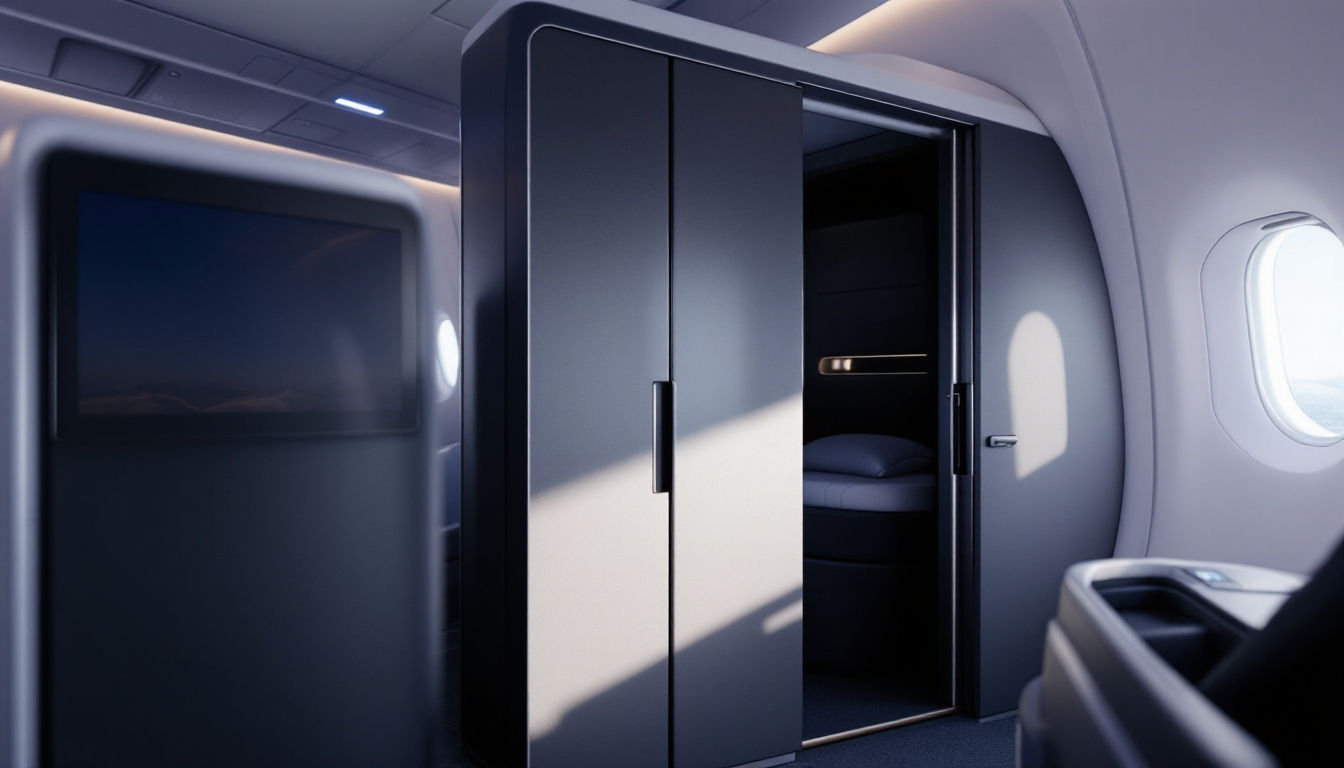
The standard Polaris 2.0 suite is the Adient Aerospace Ascent product, configured 1-2-1 with direct aisle access. Each suite carries a 19-inch 4K seatback IFE screen on Panasonic’s Astrova platform, Bluetooth audio pairing, wireless charging pad, USB-C and standard AC power, digital seat controls and a privacy door.
The privacy door is the operational asterisk. As of the April 2026 inaugural and through Q2 2026, the doors remain mechanically present but are locked in the open position pending FAA regulatory approval. The certification path is consistent with how Delta and several international carriers have handled the same FAR 25-related certification process - mechanical install first, in-service certification follows.
The Polaris Studio is materially differentiated. Each Studio carries a 27-inch 4K OLED touchscreen, a companion ottoman with a seatbelt for in-suite dining service, a quartzite tabletop and wood-grain trim materials. United has positioned Studio as a paid-supplement cabin product, priced at a $499 to $599 supplement over standard Polaris fares on the SFO-SIN inaugural pricing structure. Ossetra caviar amuse-bouche and Laurent-Perrier Cuvee Rose champagne are included in the Studio service.
The Laurent-Perrier Cuvee Rose pour is notable in its own right - it is the first commercial U.S.-carrier deployment of the marquee Laurent-Perrier rose in Business Class service, against the standard U.S.-carrier reliance on lower-tier champagnes in business cabins. The pour is constrained to Studio, with standard Polaris cabin retaining the existing United champagne service.
Six weeks of in-service feedback
Independent traveller feedback from the inaugural through mid-May 2026 has been broadly positive on three vectors and mixed on a fourth.
On hard product, the consensus through Q2 2026 has been that the Adient Ascent suite is among the most spacious 1-2-1 Business Class products in current U.S.-carrier service - meaningfully better than the original Polaris suite and competitive with the latest international hard products at Cathay Pacific and Singapore Airlines. The 19-inch standard IFE screen is the largest screen in any United Business Class configuration to date.
On IFE, the Panasonic Astrova platform has been received well - 4K OLED screen quality represents a generational upgrade from the previous-generation eX3 IFE on the existing Polaris-fit United 787s. Bluetooth audio pairing has worked reliably in published reviews.
On catering, the Studio caviar and Laurent-Perrier pairing has been the headline of the inaugural press coverage. Standard Polaris cabin catering has been the area of mixed feedback - the existing United Business Class menu has not been refreshed in step with the hard product, and several published reviews through May have noted the gap between the upgraded cabin environment and the unchanged service architecture.
On connectivity, Starlink rollout on the Elevated 787-9 sub-fleet has been progressively layered through Q2 2026 but is not universal across the inaugural sub-fleet.
The SFO-SIN corridor: SQ counter-positioning
The SFO-Singapore corridor is the operational test bed for Polaris 2.0 against Singapore Airlines’ own SFO-SIN service, which operates on the A350-900ULR with the SQ Business Class hard product and the carrier’s marquee KrisFlyer service architecture. SQ’s SFO-SIN operates twice daily and has historically been the volume leader on the corridor on premium-cabin yield.
United’s competitive read on the corridor is two-part. First, the Polaris 2.0 hard product is competitive with the SQ Business Class on width, suite footprint and IFE, and arguably leads on screen size. Second, the Polaris Studio is positioned above the SQ Business Class on usable cabin space, putting United into a quasi-First Class proposition at a Business-plus price point against SQ - which does not offer a First Class cabin on the A350-900ULR sub-fleet.
Operating-aircraft assignment data through May 2026 confirms a progressive layering of Polaris 2.0 metal onto the SFO-SIN rotation. From August 2026, United expects to operate all 14 weekly SFO-SIN rotations on Elevated 787-9 sub-fleet aircraft - 1,792 Polaris Business seats per week on the corridor.
Next routes: London first, then East Asia
United has indicated that London is the next-named route for Polaris 2.0 deployment, with industry expectation pointing to IAD-LHR, EWR-LHR or SFO-LHR as the most likely early UK deployment. The carrier has not publicly committed to a specific flight number or operating date.
EWR-NRT has been raised in industry discussion as a logical second Asia deployment, given Newark’s hub economics and the Tokyo Narita premium yield profile. United has not publicly committed to EWR-NRT in the Elevated 787-9 deployment plan.
The deployment cadence is delivery-paced. With 20 Elevated 787-9s expected by end of 2026 and the full 30 by end of 2027, each subsequent route addition is gated on cabin-aircraft availability. The summer 2026 schedule has SFO-SIN as the only confirmed full-route Polaris 2.0 deployment.
What to watch through Q3 2026
Three items for the third quarter.
The FAA privacy door certification is the most operationally visible. Approval would close the loop on the only hard-product caveat in the cabin.
The August 2026 SFO-SIN full-route Polaris 2.0 layering is the next material capacity milestone - 1,792 Polaris Business seats per week on the corridor at the new product spec.
And the next-named route announcement - London first, then likely a second Asia deployment - will signal United’s competitive priorities for the back half of the year. The corridor that receives the second Polaris 2.0 deployment will tell the market more than any product spec sheet about where United sees premium-yield share to capture.
The April 22, 2026 inaugural delivered. The Q3 2026 deployment cadence is the test.