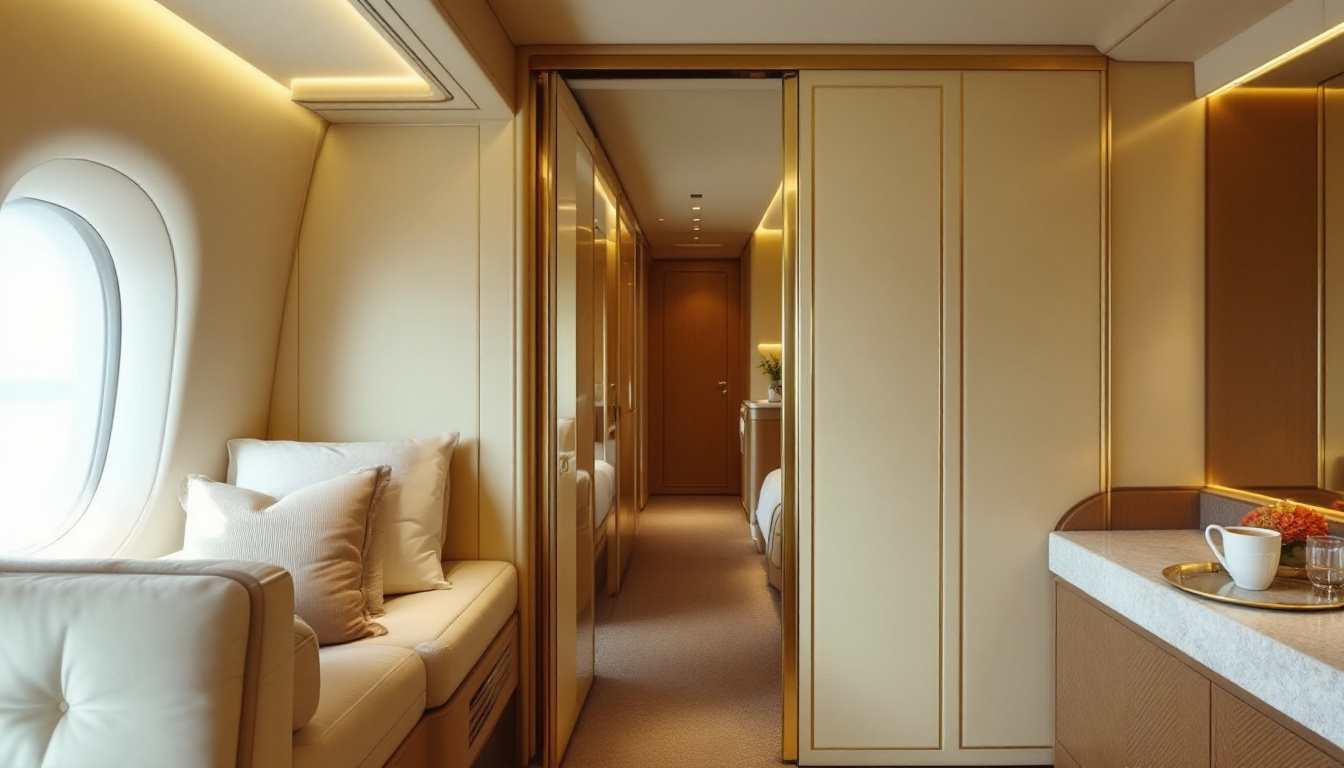
Emirates completed the cabin retrofit of its A380 First Class in February 2026, returning the final aircraft — A6-EOX, an A380 delivered in 2015 and pulled for refit in May 2025 — to revenue service on 18 February. The milestone closes a four-year fleet-wide programme that began in 2022, was repeatedly extended by supply-chain delays on the suite-door mechanism, and at one point in 2024 had the carrier operating two distinct first-class cabin configurations on the same daily route pair to New York JFK. As of March 2026, every Emirates A380 in revenue service carries the same fourteen-suite first-class cabin, the same two upper-deck shower spas, and the same revised onboard lounge configuration at the rear of the upper deck.
For corporate travel managers buying premium long-haul on the U.S.-to-Gulf network — and for the rapidly expanding cohort of executives whose itineraries route through Dubai en route to South Asia, East Africa, or onward into the Indian Ocean — the practical effect is similar to what ANA’s “The Room” rollout accomplished on the transpacific: the lottery on which A380 pulls up to the gate is over. Every A380 first-class seat is now the same first-class seat.
What that seat is, however, deserves a careful description. Emirates’ A380 First Class is not a new product, nor an entirely refreshed one. The basic suite layout — a 1-1-1 configuration of fourteen private suites with sliding doors, eight-foot bed, and a dedicated mini-bar — has been in service since 2017, when the airline introduced the “Game-Changer” suite on a small number of 777-300ERs and then back-ported substantial elements to the A380. What the 2022-2026 retrofit added was a full-height door (replacing the older shoulder-height privacy partition), revised lighting modelled on Mercedes-Benz S-Class ambient cues, a 32-inch 4K monitor (up from a 27-inch screen), Bvlgari amenity kits and bedding (replacing the Voya line and the older Bulgari-by-Hayward set), and — material for any first-class traveller — a substantive rework of the cabin’s two onboard shower spas, which had largely retained their 2008-vintage fittings until this refit.
The result is a cabin that is, in objective measurements, no longer the largest first-class suite in commercial service. Singapore Airlines’ new A350-1000 First Class, reviewed here in February, has marginally more floor area at 39 square feet per suite against Emirates’ 34. ANA’s “The Suite” first-class cabin on the 777-300ER offers comparable enclosed space. What Emirates has, and no other carrier has, are the two upper-deck features that have defined the A380 first-class experience for fifteen years: the shower spas and the onboard lounge bar. Those features are what the retrofit was, fundamentally, about preserving and modernising.
The cabin, in detail
The fourteen suites occupy the forward portion of the A380’s upper deck, in a 1-1-1 configuration of three suites per row across five rows, plus a single fourteenth suite paired with the upper-deck galley. The middle suites of each row (1F, 2F, 3F, 4F, 5F) have no window access; the suite seat instead faces an interior bulkhead with a “virtual window” — an OLED panel displaying real-time external camera feeds from belly-mounted cameras. The window-access suites (A and K on each row) have two physical windows each, with motorised electrochromatic shading.
Each suite measures approximately 40 square feet of footprint, of which the seat-and-bed assembly occupies about 22 square feet, the personal mini-bar and storage occupies 6 square feet, and the entry vestibule with the sliding door consumes the remainder. The seat is 26 inches wide at the seat pan; the bed, when deployed, is 78 inches long and 26 inches wide, dressed by Bvlgari with cotton-percale linens and a quilted mattress topper of approximately 4 inches dual-density foam. Pyjamas, sized XS through XXXL, are provided to every first-class passenger on every A380 flight regardless of duration, distinguishing the carrier from several Asian competitors that issue pyjamas only on overnight rotations.
The hard product details worth noting for corporate travel policy:
- The 32-inch 4K OLED monitor is the second-largest in any commercial cabin, behind Singapore’s 32-inch A350-1000 First Class screen by approximately a quarter-inch of diagonal. Both are 32-inch displays; the Singapore product is marginally crisper at panel level.
- The personal mini-bar holds a champagne split (Dom Pérignon 2013 on most rotations, with Krug Grande Cuvée on selected long-haul services), a half-bottle of Hennessy Paradis, two soft-drink mixers, and Bvlgari-branded snacks.
- The fold-out work surface accommodates a 17-inch laptop with room for documents alongside. Wireless phone charging is at the suite’s right armrest.
- The cabin has no double-bed configuration. Suites 1A and 1K, at the front of the cabin, are paired across an aisle but cannot be configured as a single bed unit. Couples flying together should book the centre pair of any row (e.g., 3A-3F or 3K-3F across the aisle from each other) and accept the limitation.
The full-height suite doors lock from the inside. Cabin crew access is by request only, via a brass-effect intercom call button on the suite’s primary control panel; the older overhead crew-summon switch has been removed in the refit.
The shower spas
The A380 First Class’s two onboard shower spas — installed at the forward upper-deck position adjacent to the suite cabin — remain the cabin’s most photographed feature, and a substantive operational consideration for any first-class itinerary on the carrier.
The 2026 refit reworked the spa interiors substantially. The basin and fittings are now in matte stone composite, replacing the older polished marble; the showerhead is a new rain-effect fitting from Hansgrohe rated for the spa’s controlled-flow water-allocation system; and the floor-heating element has been replaced with an electrochromatic floor panel that warms during the shower window and cools afterwards. The dressing area now has a powered mirror with three lighting modes (daylight, warm, and bathroom-task), heated towel rails, and an expanded amenities counter stocked with Bvlgari hair and skin products, electric razors (on request), and — new with the 2026 refit — a personal hair-dryer that does not require crew delivery.
The operational mechanics are unchanged from the 2008 original. Each first-class passenger is allocated a 25-minute window, of which five minutes is actual running water (limited by the aircraft’s onboard water tank capacity; the A380 carries approximately 670 gallons of fresh water for the spa, and the five-minute limit is what allows two passengers per spa per long-haul flight at maximum cabin load). The remaining twenty minutes covers undressing, towelling, and dressing in the privacy of the spa. Slots are signed up with the cabin crew within the first hour of flight, typically by the cabin manager moving through the cabin after the pre-departure beverage service.
On flights longer than thirteen hours — LAX-DXB and SFO-DXB, primarily, and historically the longest of the carrier’s transcontinental routings — a second shower window per passenger is offered if the cabin load permits. On a fully-booked fourteen-suite cabin, second windows are rare; on flights with eight or fewer first-class passengers, virtually every passenger who wants a second window can be accommodated.
The spas are staffed by a dedicated first-class flight attendant during their operating window (typically from one hour after take-off through approximately ninety minutes before landing), who turns the spa over between passengers — cleaning the basin, replacing the towel set, restocking amenities — in approximately seven minutes per turn.
The onboard lounge
The A380’s upper-deck rear lounge — the carrier’s signature “Onboard Lounge” — was redesigned during the 2022-2026 refit cycle. The current configuration, in service across the fleet since approximately mid-2024 and now standard, replaces the previous L-shaped sofa-bar arrangement with a horseshoe layout seating approximately twelve passengers (down from sixteen in the older configuration), a longer bar service counter, and a small “tasting” station for Le Clos wine flights operated periodically through the long-haul cruise.
The lounge serves both first-class and business-class passengers from the upper deck. Access is unrestricted during the cruise phase, and the bar is staffed by two dedicated cabin crew throughout. The cocktail menu was reworked in October 2025 by Salvatore Calabrese, the London-based bartender, and includes a non-alcoholic flight that mirrors the classic-cocktail menu glass-for-glass. Light bites — typically four to six small plates including a mezze selection, sushi, charcuterie, and dessert — are available continuously, and a full menu service is available to first-class passengers on request anywhere in the cabin.
The lounge is not a quiet space. Corporate travellers needing to work through a transatlantic cruise should expect background conversation; the cabin’s white-noise insulation is good enough that the noise does not reach the first-class suites with doors closed, but the lounge itself is approximately the volume of a hotel lobby bar during evening hours.
The U.S. network in 2026
Emirates’ A380 network from the United States, as of March 2026, comprises seven mainline routes with daily service, two of which currently operate the older 777-300ER first-class product pending A380 conversion in October 2026, and one fifth-freedom routing via Milan Malpensa.
The A380-confirmed routes:
- New York JFK to DXB (EK204/EK203): Daily, A380, with a 12:30 p.m. departure from JFK and a 7:35 a.m. arrival in Dubai the following day. This is the carrier’s premier U.S. routing by both departure frequency and corporate traffic share; first-class load factors run approximately 78 percent year-round, the highest on the U.S. network.
- Chicago O’Hare to DXB (EK236/EK235): Daily, A380, with an 8:45 p.m. departure from ORD and an 8:15 p.m. arrival in Dubai. The route converted from 777-300ER to A380 in November 2023 and has retained the A380 since.
- Los Angeles to DXB (EK216/EK215): Daily, A380, with a 4:30 p.m. departure from LAX and a 7:50 p.m. arrival in Dubai. At sixteen hours and ten minutes, this is the longest A380 first-class rotation Emirates operates from the U.S. and one of the longest commercial first-class segments worldwide.
- San Francisco to DXB (EK226/EK225): Daily, A380, with a 4:00 p.m. departure from SFO and a 7:25 p.m. arrival in Dubai. The SFO routing returned to A380 service in October 2023 after a pandemic-era downgrade to 777-300ER.
- New York JFK to Milan Malpensa to DXB (EK206/EK205): Daily, A380, with a 10:50 p.m. departure from JFK, a 12:30 p.m. arrival in Milan, a 2:45 p.m. onward departure, and a 12:25 a.m. arrival in Dubai. The fifth-freedom segment between JFK and MXP is open for standalone booking and accepts Skywards redemptions; it is, by some margin, the most accessible Emirates first-class product on the U.S. network because the standalone fifth-freedom award prices at only 60,000 Skywards miles one-way, against 165,000 for a JFK-DXB direct booking.
The two 777-operated routes scheduled to convert to A380 First Class on 28 October 2026:
- Washington Dulles to DXB (EK232/EK231): Currently 777-300ER with the older “Game-Changer” first-class suite (six suites per aircraft, no shower, no lounge). Scheduled to convert to A380 with the northern winter schedule.
- Boston to DXB (EK238/EK237): Currently 777-300ER. Same conversion timeline as IAD.
The 777-only routes with no announced A380 conversion through 2027:
- Houston Intercontinental to DXB (EK212/EK211): Daily 777-300ER. Houston’s runway constraints and gate availability at IAH continue to limit A380 operations.
- Dallas-Fort Worth to DXB (EK222/EK221): Daily 777-300ER. The DFW routing has been studied for A380 conversion repeatedly but remains 777-only as of March 2026.
- Seattle to DXB (EK230/EK229): Daily 777-300ER. SEA’s A380 gate compatibility was added in 2024 but no schedule conversion has been announced.
For corporate travel managers buying U.S.-to-Gulf or U.S.-to-South Asia premium-cabin volume, the practical implication is clear: the JFK, ORD, LAX, and SFO routings deliver the full A380 First Class product today, and IAD and BOS will join them at the end of October. For passengers based in Houston, Dallas, or Seattle, the 777-300ER first-class product remains the only Emirates option, and a connection through one of the A380 hubs may be worth considering if the full A380 product is a policy or preference priority.
The ground product at Dubai
Emirates’ Dubai International ground product is, by some distance, the most elaborate dedicated first-class lounge programme operated by any carrier from a single hub. The carrier maintains three separate First Class Lounges at DXB, distributed across Terminal 3’s three concourses, plus arrivals facilities, chauffeur service, and an on-site spa.
Concourse A is the dedicated A380 concourse, opened in January 2013 and substantively renovated in a programme that completed in October 2025. The First Class Lounge spans the full length of the concourse on a dedicated mezzanine — approximately 9,000 square metres of dedicated first-class space — and offers direct jet-bridge boarding from the lounge into the upper deck of the aircraft for A380 departures. Boarding is on a private corridor; first-class passengers do not encounter the gate area. The lounge facilities include:
- An à la carte dining room with seating for approximately 140, operated as a full restaurant with table service and a menu developed in partnership with the Dubai-based culinary collective Kee. Service is continuous from approximately 5:00 a.m. through midnight, with a reduced overnight menu on departures between midnight and 5:00 a.m.
- A Le Clos wine room offering tastings from the airline’s premium cellar, with approximately forty premium bottles available for in-lounge consumption by glass or by allocation against an upcoming flight (rare wines can be requested for onboard service if signed up at least four hours before departure)
- A dedicated cigar lounge, the only humidified smoking facility in DXB Terminal 3
- An on-site Timeless Spa, opened in its current configuration in November 2025, offering complimentary 30-minute treatments (massage, facial, or manicure) to first-class passengers on a same-day-arrivals basis
- Private chauffeur-drop-off pavilion at the lounge’s landside entrance, separate from the standard Terminal 3 curbside drop, accessible by Emirates’ complimentary chauffeur service for first-class passengers within a defined radius of Dubai
Concourse B First Class Lounge serves the 777-300ER first-class departures that operate from B-gate stands, which is the majority of the carrier’s first-class 777 traffic. The lounge is smaller — approximately 5,400 square metres — and does not offer direct boarding (passengers walk to the gate when called). The dining room operates the same à la carte menu as Concourse A, and the Le Clos wine selection is identical, but the cigar lounge and spa facilities are not present. Passengers connecting from A380 arrivals at Concourse A to 777 onward departures at Concourse B can use either lounge; the airline’s preference is that connecting passengers use the lounge nearest their onward gate.
Concourse C First Class Lounge is the smallest of the three, approximately 3,200 square metres, and serves predominantly 777-operated regional services within the Middle East, East Africa, and the Indian Subcontinent. It also serves as the carrier’s “early morning” first-class facility, opening at 4:00 a.m. for the heavy bank of pre-dawn departures.
The three lounges share a common reservation system for the Timeless Spa, and a single first-class passenger transiting Dubai with a long connection can book a spa appointment in any of the three lounges regardless of which lounge they happen to be using at the time.
For arrivals into Dubai, Emirates’ First Class Arrivals service includes a dedicated immigration channel at Terminal 3, baggage delivery to a separate first-class baggage claim that typically delivers bags within ten minutes of the aircraft parking, and complimentary chauffeur service within a defined Dubai-area radius (the radius has expanded since 2023 and now includes Abu Dhabi for first-class passengers, a notable change for clients with appointments in the UAE capital).
Skywards: what changed on 1 February 2026
Emirates Skywards announced a programme-wide award-chart revaluation in November 2025, effective 1 February 2026, that materially repriced the carrier’s first-class award redemptions. The changes affect Saver, Flex, and Flex Plus award levels across all cabins, but the first-class Saver chart was the most-affected single line item.
A one-way JFK-DXB Saver first-class redemption now prices at 165,000 Skywards miles plus approximately $215 in carrier surcharges, up from 136,000 miles before 1 February. ORD-DXB, LAX-DXB, and SFO-DXB Saver first-class redemptions all increased to 175,000 miles one-way, up from 145,000.
The increases run roughly 20 percent across the first-class chart, which is the steepest single revaluation Skywards has implemented since the programme’s 2014 redesign. The carrier’s stated justification, in the November 2025 announcement, was “alignment of award pricing with current cabin value.” Award-travel commentators have read it more straightforwardly as a response to constrained first-class award availability following the cabin-product enhancement of the 2022-2026 retrofit cycle.
Two compensating changes are worth noting. First, the fifth-freedom JFK-MXP Saver first-class redemption — bookable as a standalone segment — was held at 60,000 Skywards miles one-way, against the broader first-class chart’s increase. The 60,000-mile fifth-freedom redemption is now the cheapest first-class transatlantic award currently available on any carrier, and is the single most efficient use of Skywards miles for U.S.-based travellers without immediate Dubai travel plans.
Second, the Flex Plus award level — which previously offered guaranteed availability against any unsold first-class seat at a steep mileage premium (typically 2.5x Saver pricing) — was repriced downward, to approximately 2.0x Saver. A Flex Plus JFK-DXB first-class redemption now prices at 330,000 miles, down from approximately 340,000 under the previous chart, and Flex Plus availability is genuinely close-to-guaranteed if seats remain. For travellers with large Skywards balances accumulated through Emirates’ credit-card programme (the U.S.-issued Emirates Skywards World Elite Mastercard offers spending-bonus accumulation at 1.5 miles per dollar across all categories), Flex Plus has become a more rational redemption path than under the older chart.
Partner-award pricing through other programmes is largely unchanged. JAL Mileage Bank prices a JFK-DXB first-class redemption at 100,000 miles plus approximately $370 in surcharges; Alaska Mileage Plan does not currently partner with Emirates for award redemptions (this partnership ended in March 2023 and has not been restored); and Qantas Frequent Flyer prices JFK-DXB first at 144,400 Qantas points plus the carrier’s standard fuel-surcharge component, which for Emirates first-class redemptions runs approximately $850 — high enough that the Qantas redemption is rarely the rational choice for U.S.-based bookers.
The fifth-freedom routings
Emirates operates five fifth-freedom routings worldwide that include first-class service on the European or Asian segment, three of which originate or terminate in the United States. The most relevant for U.S.-based travellers is the JFK-Milan Malpensa-DXB rotation, which is bookable in three configurations:
- End-to-end JFK-DXB via MXP: A standard through-fare with a stop in Milan, no change of aircraft, and a single Skywards or cash booking. This is the dominant booking pattern for travellers actually heading to Dubai.
- JFK-MXP standalone: Bookable as a one-way or round-trip first-class segment with no onward Dubai travel. The fifth-freedom segment is open under U.S.-Italy bilateral air-services arrangements and prices at 60,000 Skywards miles one-way for a Saver redemption.
- MXP-DXB standalone: Also bookable as a one-way Milan-to-Dubai first-class segment, primarily relevant for travellers connecting in Milan from European departures.
The JFK-MXP segment at 60,000 Skywards miles is, by significant margin, the best-value first-class transatlantic award currently available. Comparable cabins on other carriers — Air France La Première, Lufthansa First, British Airways First — price at 110,000 to 160,000 miles for an equivalent segment in their respective loyalty programmes. The catch, such as it is, is that the segment operates the full Emirates A380 First Class product including upper-deck shower availability, but at a 6h45m segment length, most passengers will not use the shower spa (the operational guidance is that showers run from approximately T+1h to T-1.5h, leaving roughly four hours of available shower window; on a fully-booked first-class cabin, slots are tight).
Emirates’ other fifth-freedom first-class routings — Newark-Athens-DXB (now operated by 777-300ER, with the older first-class product, after a 2024 downgrade), and the Australia-New Zealand-Tasman rotations (TBL, AKL via various stopovers) — are less relevant for U.S.-based corporate travel programmes. The Milan rotation is the only U.S.-touching fifth-freedom with current A380 First Class service.
What it means for travel managers
Three observations for corporate buyers managing Emirates first-class volume in 2026:
The product is now consistent across the A380 fleet, and Emirates’ A380 fleet is the corporate-facing premium product. For travel policies that specify “Emirates first class,” the absence of any meaningful product variation across the 116-aircraft A380 fleet means the booking decision can now focus entirely on schedule, routing, and price, without weighting the aircraft tail number. The four 777-300ER first-class routes from the U.S. (IAD, BOS, IAH, DFW, SEA — five routes, with IAD and BOS scheduled to convert in October) operate a meaningfully different product (six suites, no shower, no lounge) and should be evaluated separately.
The Skywards revaluation makes paid first class more rational and award first class less rational on a relative basis. At the new 165,000-mile JFK-DXB Saver pricing, the implied cents-per-mile valuation of a $14,200 cash fare comes to approximately 8.5 cents per mile, which is at the upper end of reasonable Skywards valuations. For travellers accumulating Skywards miles through credit-card spending at 1.5 miles per dollar, the effective discount on paid first class is approximately 12.7 percent — meaningful but not the 20-plus-percent discount that the pre-revaluation chart implied. For corporate accounts with negotiated Emirates fare contracts and meaningful first-class volume, the case for paid first-class on contract has strengthened modestly versus the case for award first-class on Skywards inventory.
The fifth-freedom Milan routing remains the single most efficient award pathway. At 60,000 Skywards miles one-way for a JFK-MXP first-class segment, the redemption rewards travellers who can either accept Milan as the actual destination (an underrated business-travel destination, particularly for clients in financial services and luxury goods) or use the MXP arrival as a connection point onto cheap intra-Europe positioning flights. The Milan route’s A380 operation means the full hard product is available even on the transatlantic segment alone.
The longer view
Emirates’ position at the front of the A380 cabin is not under near-term threat. Tim Clark, the carrier’s president, told the November 2025 Dubai Airshow audience that the A380 fleet “will operate until 2041 at the earliest, and we expect that some aircraft will continue beyond.” The A350-1000 deliveries beginning in late 2026 (the airline has ordered 65 of the type) will not carry a first-class cabin; the A350s will operate a two-class business-and-economy configuration on regional and medium-haul routes. The Boeing 777-9 deliveries, expected from 2027 onwards (50 aircraft on order), will carry a refreshed first-class product that the carrier has previewed only in general terms, but the 777-9 will replace older 777-300ERs rather than A380s.
The cabin product, then, is what Emirates intends to fly through approximately 2041 on its flagship aircraft. For corporate travel programmes with long planning horizons, that is a meaningful commitment: the seat purchased today is the seat that will be in service well into the 2030s and likely into the 2040s. Comparable commitments are not on offer from any other major carrier — Singapore Airlines’ new A350-1000 First Class is at most a 20-year product, ANA’s “The Room” cabin is on a 2010-2015 build fleet that will retire in the early 2030s, and the Qatar Qsuite is not a first-class product.
The Emirates A380 First Class, in plain language, will be the front-of-cabin product on the world’s only operational A380 fleet for at least the next fifteen years. It is the most stable answer in the global first-class market, and the most physically distinctive product still flying. For the rare corporate traveller whose programme permits or requires first-class on Gulf-region travel, it remains the default booking.