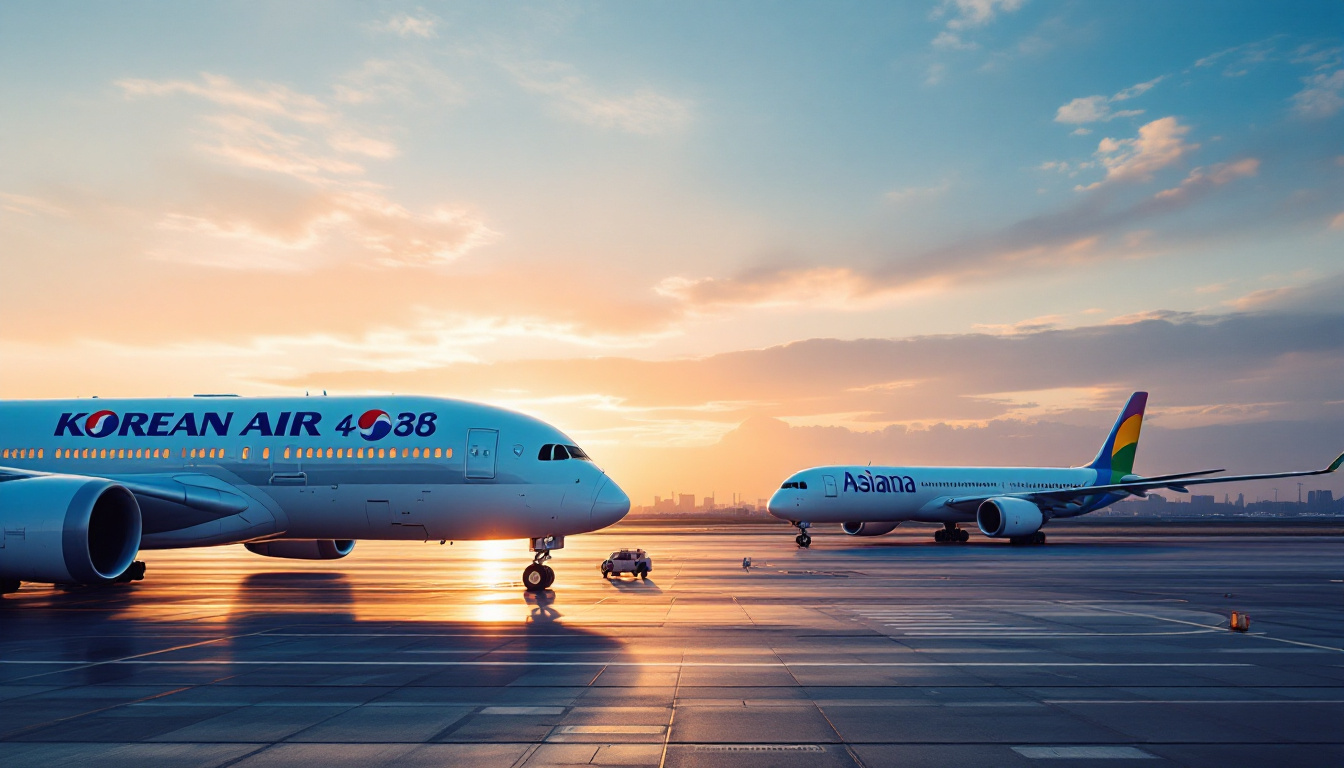
The Korean Air-Asiana merger, which closed financially on 12 December 2024 with Korean Air’s 63.88% Asiana acquisition for 1.5 trillion won (approximately $1.6 billion at the close date), reaches its operational brand-completion milestone on 17 December 2026 — at which point Asiana’s brand and corporate entity are absorbed into Korean Air, Asiana exits Star Alliance, and the combined operation rebrands under the Korean Air identity within SkyTeam.
At Q2 2026, with roughly seven months of integration runway remaining before the 17 December date, the carrier’s posture is one of accelerating operational integration, frequent-flyer-program consolidation, and route-network reshaping that will affect corporate travel programs with U.S.-Korea, Europe-Korea, and intra-Asia premium-cabin demand. This briefing surveys the integration’s current state, the consolidation timeline for the loyalty programs, the corporate-program implications, and the structural questions that bear on 2027 program planning.
The Deal, In Recap
The Korean Air-Asiana acquisition, the largest aviation M&A transaction in South Korean corporate history, was initially announced in November 2020 in the early phase of the COVID-19 pandemic-driven aviation-industry distress. The transaction required regulatory approval from 14 separate competition authorities globally — including the U.S. Department of Justice, the European Commission, the U.K. Competition and Markets Authority, the Chinese State Administration for Market Regulation, and the Japanese Fair Trade Commission, among others — a process that took four years and required Korean Air to make multiple route-divestiture and slot-divestiture concessions to address competition-authority concerns about market concentration on specific city pairs.
The deal closed financially on 12 December 2024, with Korean Air paying 1.5 trillion won for a 63.88% stake in Asiana Airlines via a new-share subscription mechanism. From the close date, Asiana has effectively operated as a subsidiary of Korean Air, with consolidated financial reporting under Hanjin KAL (the Cho family holding entity that controls Korean Air) and progressively integrated operational management.
The brand-completion timeline, announced by Korean Air on 11 March 2025, scopes the Asiana brand phase-out to end-2026, with the specific operational milestone of 17 December 2026 as the date on which the Asiana brand and corporate entity disappear. The Korean Air-Asiana combined operation will, post-completion, be the world’s roughly tenth-largest airline by passenger volume, sixth-largest by available seat kilometers, and the dominant carrier in the South Korean market.
The Star Alliance Exit Timeline
Asiana Airlines is a founding member of Star Alliance — the carrier joined Star Alliance in 2003 — and the carrier’s exit from the alliance, on the same 17 December 2026 date as the brand absorption, is one of the more consequential alliance-membership changes in the modern history of the airline alliances.
The Star Alliance exit timeline, announced by Asiana on 27 October 2024 in coordination with Korean Air’s brand-phase-out announcement and corroborated by Star Alliance’s own public communications, breaks out as follows:
- 27 October 2024: Asiana announces Star Alliance exit, effective 17 December 2026
- 1 December 2026: deadline for booking Star Alliance partner award flights on Asiana metal
- 16 December 2026: last day of Asiana operation as a Star Alliance carrier; flights booked before 1 December may operate up to this date
- 17 December 2026: Asiana brand absorbed; former Asiana metal flies as Korean Air within SkyTeam
The corollary for Star Alliance corporate programs and frequent flyers: any Asiana-operated flight booked through Star Alliance award redemption — Lufthansa Miles & More, United MileagePlus, Singapore KrisFlyer, Air Canada Aeroplan, ANA Mileage Club, or any other Star Alliance loyalty program — must be ticketed before 1 December 2026, with travel completed by 16 December 2026. After 17 December, Korean Air Asia-Pacific and trans-Pacific service is bookable through SkyTeam (Delta SkyMiles, Air France-KLM Flying Blue, China Eastern Eastern Miles, et al.) rather than Star Alliance.
For corporate travel programs that have historically used Asiana metal through Star Alliance award redemption as a high-value pathway — particularly programs with concentrated U.S.-Korea, U.S.-Asia (via Korea), and Europe-Korea long-haul demand — the November-and-December 2026 booking window is the practical cutoff for legacy-pricing redemption. Many corporate-travel risk managers are advising elite frequent-flyer travelers to book and ticket high-value Asiana award redemptions before September 2026 to avoid the year-end booking-density rush.
The SKYPASS Absorption
The loyalty-program consolidation, in which Asiana Club is absorbed into Korean Air SKYPASS, is the most-asked corporate-travel question on the integration. The mechanics, as published by Korean Air and corroborated by FlyerTalk-aggregated traveler reporting:
Asiana Club miles earned from Asiana flights convert to SKYPASS miles at a 1:1 ratio, with no value loss. The 1:1 ratio applies to all flight-earned miles regardless of the cabin or fare class on which they were earned. Elite-status tier credit earned on Asiana flights converts to SKYPASS tier credit at a 1:1 ratio for equivalent tiers (Asiana Diamond Plus to SKYPASS Million Miler, Asiana Diamond to SKYPASS Premium, et al.), with the conversion proceeding through the 17 December 2026 brand-completion date.
Miles earned from partners — Asiana Club’s credit-card partner program, hotel program transfers, and other non-flight earning channels — convert to SKYPASS at a 1:0.82 ratio, representing approximately 18% value loss in the conversion. The 18% value loss applies regardless of the partner source.
Asiana Club members can continue using the old (December 2024) Asiana award price chart for 10 years after the merger close, providing a long-tail redemption pathway for high-balance legacy Asiana Club members. The 10-year award-chart preservation is one of the more generous loyalty-integration mechanisms in recent merger history and is, in the working assumption of corporate-travel commentators, a deliberate Korean Air decision to preserve goodwill with the legacy Asiana frequent-flyer base.
The SKYPASS program itself is shifting elements of its earning and redemption structure to align with the SkyTeam absorption. Korean Air has not, as of Q2 2026, announced wholesale changes to the SKYPASS award chart or earning rates for the integration; the working assumption is that the post-17 December 2026 SKYPASS chart will substantially mirror the current Korean Air SKYPASS chart, with the legacy Asiana 10-year award-chart preservation as a parallel redemption pathway for legacy Asiana Club members.
The Fleet and Network Integration
The Korean Air-Asiana combined operation will, post-completion, operate a fleet of approximately 230 aircraft, spanning Boeing 747-8, 777-300ER, 787-9, 787-10, A330-300, A321neo, and a small remaining Asiana A380 sub-fleet that will progressively retire through 2027.
The route-network integration is being managed to minimize service disruption to existing Asiana destinations. Korean Air has publicly committed to maintaining service on substantially all of Asiana’s current route map, with frequency and equipment changes being announced on a destination-by-destination basis as the brand-completion date approaches. The U.S. routes that Asiana operates — LAX-ICN, SFO-ICN, JFK-ICN, and IAD-ICN, with some seasonal variation — will operate as Korean Air-branded service from 17 December 2026.
The fleet question is more nuanced. Asiana’s A380 fleet, six aircraft, is scoped for accelerated retirement through 2027 as Korean Air consolidates onto the 747-8 and 777-300ER for the carrier’s highest-density premium-cabin long-haul rotations. The 787 fleets of both carriers will be consolidated into a single 787-9 and 787-10 sub-fleet for the long-haul medium-density rotations. The A330-300 fleets will consolidate into a single medium-haul widebody sub-fleet, with Korean Air’s A330-300 fleet running approximately twice the size of the legacy Asiana fleet.
The two Asiana LCC subsidiaries — Air Busan (the larger, operating roughly 21 Airbus A320-family aircraft) and Air Seoul (the smaller, operating five A321s) — are scoped for consolidation into Jin Air, Korean Air’s existing low-cost-carrier subsidiary. The combined Jin Air will, post-consolidation, be the largest South Korean low-cost carrier by fleet count, with operations spanning intra-Korea, intra-Asia, and selected Asia-Pacific rotations. Integration is targeted for completion by Q1 2027.
The Walter Cho Posture
Chairman Walter Cho, who leads the Cho family’s third-generation control of Hanjin Group and serves as Chairman and CEO of Korean Air, has framed the Q1 2026 integration progress publicly as a function of “efficiency and innovation,” with a public commitment to complete the merger by end-2026. In a January 2026 New Year’s address, Cho emphasized the operational integration timeline and the carrier’s intent to position the combined Korean Air-Asiana operation as a “Top 10 global carrier” within a five-year horizon.
The most-noted element of Cho’s public posture on the integration is the carrier’s commitment to legacy Asiana employee retention, with Asiana employees being moved onto the Korean Air pay scale (reportedly 32% higher on average than the legacy Asiana scale) as part of the integration mechanics. The employee-side integration is, on most reads, smoother than the typical post-merger personnel integration, in part because the Cho family-controlled Hanjin Group has a long history of stable employment relationships and in part because the integration is occurring in a tight South Korean aviation labor market.
The corporate-buyer-relevant element of Cho’s posture is the carrier’s commitment to continued investment in the premium-cabin product across both legacy fleets. Korean Air’s Prestige Suites 2.0 product, the carrier’s refreshed business class deployed on selected 787-9 and 777-300ER aircraft, will progressively roll out across the combined Korean Air-Asiana fleet through 2027 and 2028. The Asiana A350 fleet — eight aircraft, configured with Asiana’s pre-merger business class product — is scoped for cabin reconfiguration to the Korean Air Prestige Suites 2.0 over a multi-year window, with the legacy Asiana cabin operating until reconfiguration.
The Corporate-Program Implications
For corporate travel managers building 2027 program plans with U.S.-Korea, Europe-Korea, or intra-Asia premium-cabin demand, the integration produces five concrete implications:
First, Star Alliance corporate-rate agreements with Asiana metal will need to be reconciled onto Korean Air SkyTeam metal. Programs with United, Lufthansa Group, or Singapore Airlines preferred-carrier status will need to re-route Asiana-leveraged itineraries onto alternative Star Alliance metal, or accept the SkyTeam-routed alternative through Korean Air-Asiana. United’s EWR-ICN launch on 4 September 2026 is a structurally meaningful Star Alliance alternative for Northeast U.S. corporate travel programs.
Second, SkyTeam corporate-rate agreements gain materially expanded coverage on Korean Air-Asiana combined metal from 17 December 2026. Delta, Air France-KLM, and the other SkyTeam carriers’ corporate-rate buyers will find that the post-merger Korean Air offers materially more frequencies, more destinations, and more premium-cabin options in the South Korean market than the pre-merger Korean Air.
Third, the U.S.-Korea premium-cabin market consolidates from four operating carriers (pre-integration Korean Air, Asiana, Delta, United) to three (post-integration Korean Air, Delta, United). The structural pricing-power implication is that fare-band volatility may compress on the LAX-ICN, SFO-ICN, JFK-ICN, and IAD-ICN lanes through 2027, with corporate-rate negotiations potentially proceeding under tighter spread conditions than the pre-integration baseline.
Fourth, the SKYPASS award-chart consolidation creates a structurally meaningful frequent-flyer-program rebalancing question for high-status legacy Asiana Club members. The 10-year legacy-chart preservation gives high-balance Asiana Club members runway to use legacy redemption pricing, but the long-term equilibrium is SKYPASS redemption pricing for the combined Korean Air-Asiana metal.
Fifth, the fleet-integration timeline produces a structurally meaningful cabin-product variability question for corporate buyers. Through 2027, legacy Asiana metal will operate with the legacy Asiana cabin, while Korean Air metal operates with the Korean Air cabin. Corporate travel programs that have established cabin-product preferences should specify aircraft-type (rather than carrier) in booking-tool fare-display preferences through the 2027 integration window.
The structural conclusion at Q2 2026: the Korean Air-Asiana integration is on schedule for the 17 December 2026 brand-completion date, with the loyalty-program consolidation, network consolidation, and fleet consolidation all proceeding on the publicly announced timeline. Corporate travel managers with concentrated Korean-market exposure should be modeling the post-17 December 2026 SkyTeam operating environment as the working assumption for 2027 program plans, with Star Alliance alternatives (United, ANA, EVA Air) as the back-up route for corporate-program continuity.