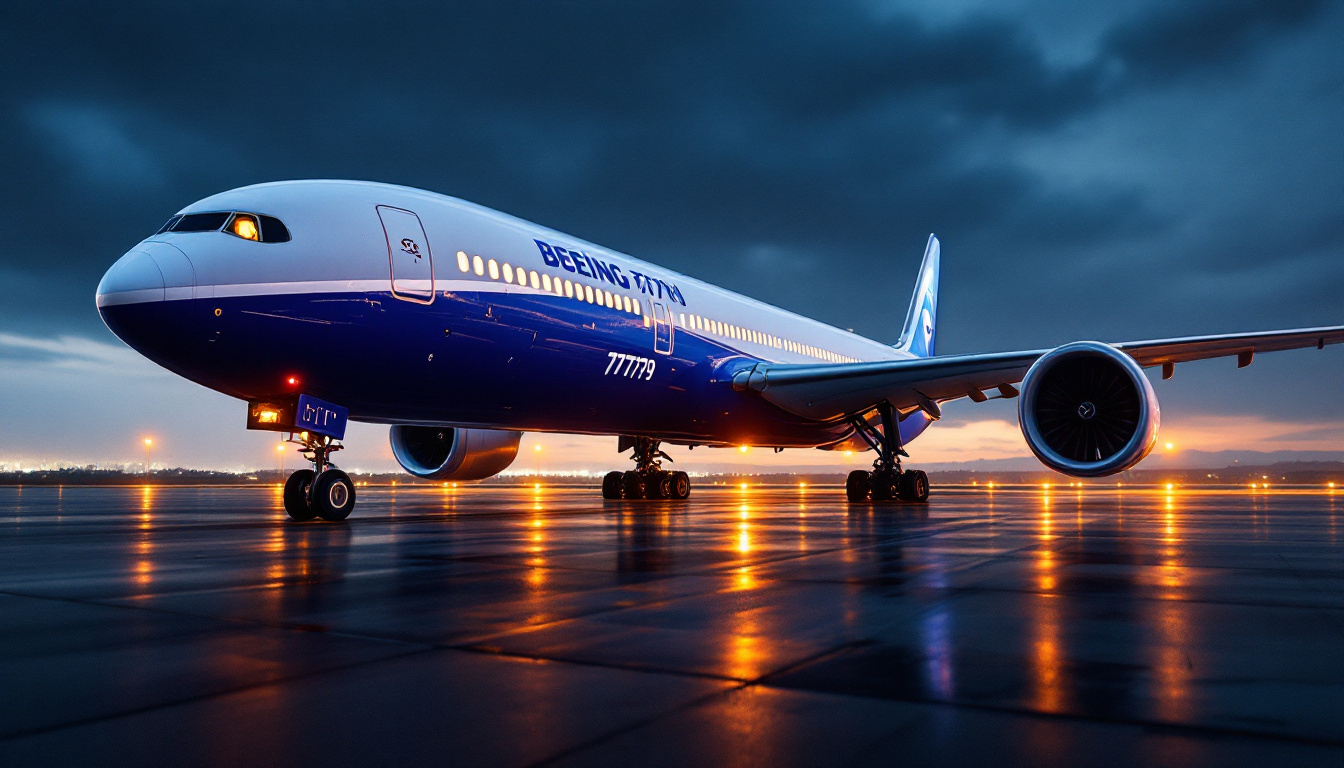
The Boeing 777-9 certification program, in its sixth year of post-first-flight development, reached the Type Inspection Authorization (TIA) Phase 4a milestone in Q1 2026 — a material step toward final type certification but one that confirms first delivery will not occur before 2027. The Q1 2026 progress, accompanied by Boeing CFO commentary on the $4.9 billion forward-loss charge booked in Q4 2025 and CEO Kelly Ortberg’s Q1 2026 earnings-call disclosure of approximately 30 early-production 777X jets requiring pre-delivery rework, sets the operating posture for the program through 2026 and the customer fleet-planning posture through 2027.
For corporate travel managers building 2027 program plans on long-haul premium-cabin demand, the 777-9 delay is not a direct route-or-product question — the aircraft is not in scheduled service yet and will not be a 2026 commercial factor — but it is an indirect supply-chain factor that affects the fleet-renewal timelines of Lufthansa, Emirates, Qatar Airways, Singapore Airlines, Etihad, and the other major 777X customers whose premium-cabin products are anchored on the airframe. This briefing surveys the certification state, the financial charges, the launch-customer posture, and the order-book breakdown.
The Certification State, In Detail
The 777-9, Boeing’s next-generation widebody twinjet derived from the 777-300ER with new GE9X engines and a redesigned composite wing with folding wingtips, entered first flight on 25 January 2020. The original entry-into-service timeline, as announced at the program launch in 2013, targeted first delivery in 2020. The program has now slipped seven years from the original EIS target, with first delivery now expected to occur in 2027.
The certification timeline, as the Q2 2026 baseline:
- 25 January 2020: 777-9 first flight
- 2021-2023: extended flight-test campaign with multiple grounding incidents and certification-process resets
- Q4 2024: Boeing acknowledges further delays, EIS pushed to 2026
- Q4 2025: Boeing books $4.9 billion forward-loss charge, EIS pushed to 2027
- Q1 2026: FAA grants Type Inspection Authorization (TIA) Phase 4a approval
- 2026 (balance): expected completion of TIA 4a flight test campaign, transition to TIA 5 (final certification phase)
- 2027 (target): first delivery to Lufthansa as launch customer
The TIA 4a approval, granted by the FAA in Q1 2026, is the regulatory authorization for Boeing to begin the formal certification flight-test campaign that demonstrates compliance with FAA Part 25 transport-category aircraft certification requirements. TIA 4a does not equal type certification, but it is the penultimate procedural milestone before the FAA can grant final certification.
The reason the program has slipped repeatedly through 2022-2025 is a combination of factors documented in trade-press reporting: GE9X engine certification challenges (resolved by 2023), flight-test discoveries of structural and systems issues requiring design modifications (extended through 2024), and FAA-imposed certification process changes following the post-737 MAX certification reform that introduced more stringent compliance demonstrations across new transport-category programs.
Per Boeing CFO Brian West, speaking in late 2025, “new certification requirements have delayed the Boeing 777X.” The phrasing reflects the program’s accommodation of post-MAX regulatory reform requirements that were not part of the original certification scope.
The Financial Picture: $4.9B Recent, $15B Cumulative
Boeing booked a $4.9 billion forward-loss charge in the fourth quarter of 2025 associated with the most recent 777X delay announcement. The $4.9 billion charge reflects:
- The time-value impact of delayed deliveries on launch and follow-on customer contracts, including the delay-cost penalties Boeing owes to customers for the contractually-agreed EIS slip
- Incremental production costs for the 777X program through the extended certification window, including the cost of maintaining the 777X production line at a low rate through 2026
- Pre-delivery modification costs for the approximately 30 early-production 777X aircraft already in inventory that require rework to bring to the certification-approved configuration
- Restructuring costs associated with the 777X program’s broader fleet-planning revision
The $4.9 billion charge is, in Boeing’s segmented reporting, allocated principally to the Commercial Airplanes operating segment. The charge’s GAAP impact on Boeing’s 2025 full-year reported results was a material drag on operating profitability, with the carrier’s full-year operating loss expanding accordingly.
The cumulative 777X forward-loss charges, summed across all program-related charges since the 2020 EIS-delay baseline, total approximately $15 billion. The cumulative figure includes charges booked in 2020, 2022, 2024, and the most recent Q4 2025 $4.9 billion. The cumulative $15 billion represents one of the largest forward-loss-charge accumulations on a single commercial-aircraft program in modern aviation history, and it is the principal financial overhang on the Boeing Commercial Airplanes franchise through 2026.
Ortberg, in his most recent Q1 2026 earnings-call commentary on the 777X, said: “While we are disappointed in the 777X schedule delay, the airplane continues to perform well in flight testing, and we remain focused on the work ahead to complete our development programs and stabilize our operations in order to fully recover our company’s performance and restore trust with all of our stakeholders.” Ortberg additionally characterized the 30 early-production jet rework as a “pretty massive activity” requiring multi-year completion.
The Lufthansa Launch-Customer Posture
Lufthansa, which holds an order for 20 777-9 aircraft, remains the planned launch operator for the type. The Lufthansa order, originally placed in 2013 and revised multiple times through the program’s delays, is structurally anchored to the carrier’s Allegris cabin product — the Lufthansa long-haul cabin refresh that includes Suite First, the new business class with closing doors, premium economy, and a refreshed economy product.
The Allegris cabin, which Lufthansa is progressively deploying on the A350-900 fleet from 2024 onward and which the carrier had originally planned to deploy on the 777-9 from 2025, is delayed in its 777-9 deployment by the EIS slip. The carrier’s Q1 2026 commentary on the Allegris rollout indicates that the 777-9 Allegris deployment is now planned for 2027’s second half at the earliest, conditional on Boeing’s certification completion and first-delivery timing.
For corporate travel programs with Lufthansa preferred-carrier status, the 777-9 Allegris delay is a structural factor in long-haul cabin-product expectations through 2027. The Allegris cabin’s premium positioning — particularly the new Suite First product, which the carrier is positioning at the premium-cabin reference for European long-haul service — will continue to operate on A350-900 metal through 2027, with 777-9 Allegris deployment as a 2027-2028 progression.
The Order Book
The 777X program order book at Q2 2026, summed across all variants (777-8 cargo and 777-9 passenger) and customer types (passenger airlines and freight operators), totals approximately 521 firm orders. The principal customers:
Emirates: 205 777X firm orders, the program’s largest customer. Emirates’ order is split between 35 777-8 (delivery from 2027) and 170 777-9 (delivery from 2027 onward). The Emirates 777X order is structurally anchored to the carrier’s planned 777-300ER fleet replacement, which is the largest 777-300ER fleet retirement in the global airline fleet.
Qatar Airways: 94 777X firm orders. Qatar’s order includes 60 777-8 freighters and 34 777-9 passenger jets. The 777-9 order is anchored to Qatar’s QSuite Next-Gen premium cabin, the carrier’s planned successor to the current QSuite that the carrier has positioned as the world’s leading business class. QSuite Next-Gen’s deployment timeline is dependent on the 777-9 EIS.
Singapore Airlines: 31 777-9 firm orders. Singapore’s order is anchored to the carrier’s planned long-haul cabin refresh, with the 777-9 positioned for the carrier’s highest-density premium-cabin routes including the U.S. transcontinental and London frequencies.
Etihad Airways: 25 777-9 firm orders. Etihad’s order is anchored to the carrier’s premium-cabin refresh and the planned expansion of the carrier’s long-haul network from 2027.
British Airways (via IAG): 18 777-9 firm orders. BA’s order is anchored to the carrier’s planned 777-200ER fleet replacement and the continued Club Suite cabin rollout.
All Nippon Airways: 15 777-9 firm plus 5 options. ANA’s order is anchored to the carrier’s planned 777-300ER fleet replacement on the long-haul network, with The Room cabin product progression dependent on the 777-9 delivery timing.
Cathay Pacific: 21 777-9 firm orders, with delivery scoped from 2027.
Lufthansa: 20 777-9 firm orders, the launch customer position.
China Airlines: 6 777-9 firm orders.
Korean Air: 5 777-9 firm orders (separate from the carrier’s broader fleet-renewal plans following the Asiana integration).
The remaining 81 orders are distributed across smaller customers, including some passenger and freight operators with mixed 777-8 and 777-9 commitments.
The Cabin-Product Cascade
For corporate travel managers, the 777-9 delay’s most consequential impact is the cascading effect on premium-cabin product deployment plans across the program’s largest customers.
Emirates’ first-class and business-class cabin progression: Emirates’ planned premium-cabin upgrade strategy is anchored on the 777-9, with the carrier’s new business class — the redesigned 1-2-1 reverse-herringbone with closing doors that Emirates began deploying on selected A350-900 routes in 2025 — scoped for full 777-9 deployment from 2027 onward. The 777-9 delay pushes the cabin progression’s full fleet rollout into 2028 and possibly 2029.
Lufthansa Allegris on long-haul: The 777-9 Allegris deployment is delayed; A350-900 Allegris continues through 2027. Corporate buyers with Lufthansa concentrated demand should anticipate continued A350-900 Allegris exposure on the carrier’s long-haul rotations through 2027.
Qatar QSuite Next-Gen: Qatar’s planned successor to QSuite is anchored on the 777-9. The 777-9 delay pushes QSuite Next-Gen deployment to 2027-2028. Existing QSuite on the carrier’s A350-900, 777-200LR, and 777-300ER fleets remains the carrier’s premium-cabin reference through the delay window.
Singapore Airlines premium-cabin refresh: The 777-9 deployment is the anchoring fleet decision for the carrier’s planned long-haul cabin refresh. The delay pushes the refresh timeline into 2027-2028.
Etihad premium-cabin expansion: Anchored on the 777-9. The delay affects Etihad’s planned long-haul network expansion from 2027.
The structural read for corporate travel programs: the existing 777-300ER, A350-900, and A380 fleets will continue to operate the global premium long-haul lanes through 2027 and possibly into 2028, with the 777-9 cabin progression entering scheduled service from 2027’s second half at the earliest. The premium-cabin product progression that the industry has been signaling for 2025-2026 deployment is, in practice, delayed by the 777-9 timeline to 2027-2028 deployment.
The Q2 2026 Outlook
For the working corporate travel manager, the 777-9 certification progress at Q2 2026 produces three concrete program-planning takeaways:
The 2027 fleet-deployment plans of the largest 777X customers should be modeled with conservative 777-9 EIS assumptions, with first scheduled commercial service from 2027’s second half at the earliest and full fleet deployment progressing into 2028 and 2029.
The cabin-product progression on the major long-haul carriers (Emirates, Lufthansa, Qatar, Singapore Airlines, Etihad) will continue to run on existing 777-300ER, A350-900, and A380 fleets through 2027. Corporate programs that have been waiting for the next-generation cabin products on the 777-9 should adjust 2027 RFP expectations accordingly.
The 30 early-production 777X jets in inventory requiring rework before delivery are a structural constraint on the carrier’s 2027 commercial deployment plans. The rework, which Ortberg characterized as “pretty massive activity” requiring multi-year completion, means that even the carrier-receiving 777X aircraft in 2027 will receive them with some uncertainty about delivery acceleration in 2028 and 2029.
The 777-9 program at Q2 2026 is, in summary, structurally progressing toward 2027 EIS with verifiable certification-milestone progression but with significant residual operational and financial overhang. The $4.9 billion Q4 2025 charge, the $15 billion cumulative program-cost burden, and the 30-aircraft rework requirement establish the program’s working operational posture through 2026 and into 2027. For corporate travel managers, the program is a watch-not-act item: the cabin-product progression that the program anchors will not affect scheduled service in 2026, but the program’s continued progression bears on 2027 and 2028 fleet-deployment expectations for the world’s major premium-cabin long-haul carriers.