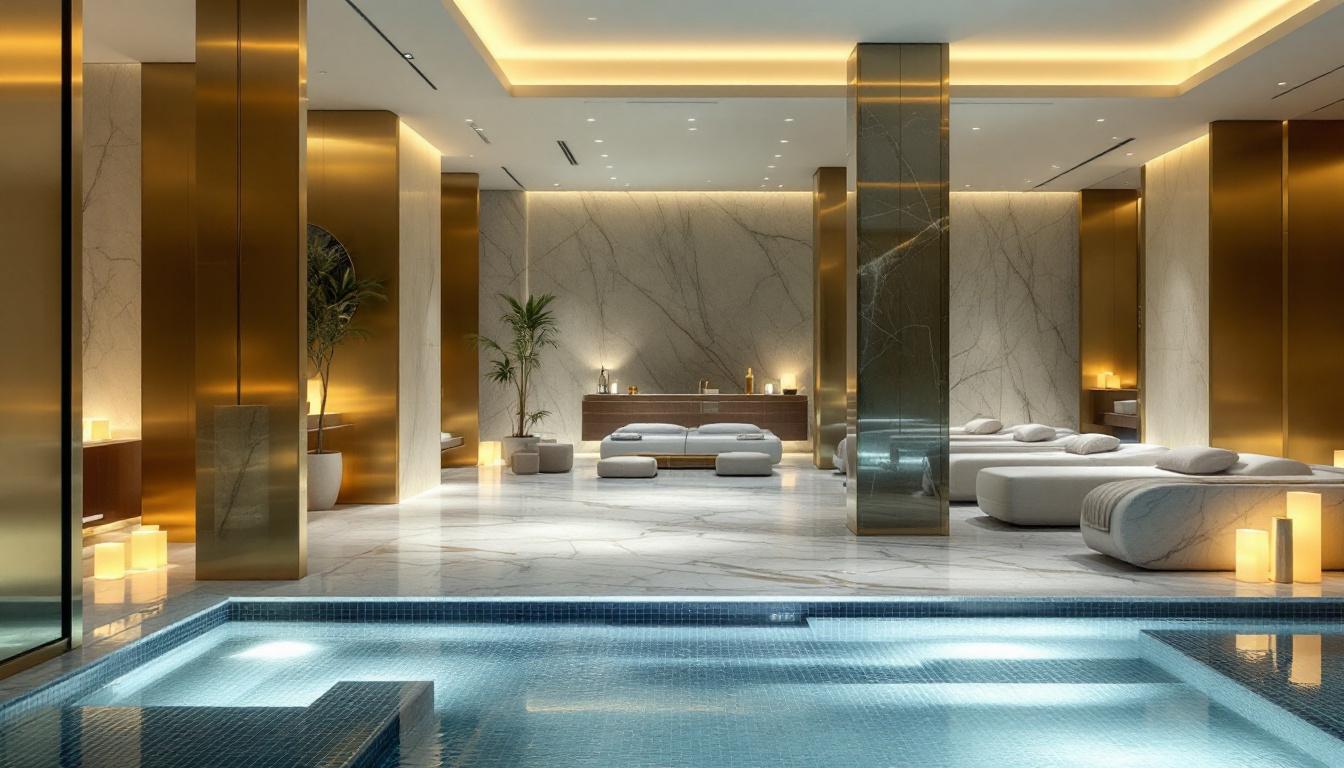
Hong Kong International’s east concourse hums with the same fluorescent pulse as any global hub at 9 p.m. on a Tuesday. Connecting passengers thread between gates with roller bags and the muffled urgency that defines long-haul Asia hubs. Then a sliding glass door opens near Gate 63, and the corridor noise drops by what feels like fifteen decibels. Inside The Pier First Class lounge, the lighting warms, the floor shifts from polished terrazzo to honed limestone, and a host in a slate blazer asks whether you would like the dining room, the bar, or one of The Cabanas this evening.
Twelve years after Cathay Pacific reopened The Pier First with a complete Ilse Crawford redesign, this remains the lounge that other airlines benchmark themselves against. Singapore Airlines’ Private Room, Lufthansa’s First Class Terminal in Frankfurt, Qantas’ First Lounge in Sydney — each is excellent. None has dislodged The Pier from its position in the conversational shorthand of frequent travelers and corporate travel managers who plan around it.
This briefing covers what corporate buyers and premium travelers need to know in early 2026: who qualifies for entry, what the Cabanas and Sky Terrace actually deliver, how the dining room operates day to day, and where The Pier First sits in the broader Hong Kong lounge map alongside The Wing First and The Pier Business. Cathay has signaled refresh ambitions for several ground products over the next eighteen months, but for now the Pier First holds the position it has held since 2013.
The setup: location, scale, and why placement matters
The Pier First sits one level above the main departures concourse at Hong Kong International, accessed by escalator or elevator near Gate 63. The lounge occupies roughly 33,000 square feet and runs along a column of floor-to-ceiling windows facing the apron. From most seats you can watch widebodies pushing back from the adjacent gates, a detail that mattered more before the airport’s third runway opened in late 2024 and pulled some Cathay departures further east.
Placement matters because Hong Kong is a connecting hub. A passenger transiting from London to Sydney in Cathay First will spend roughly two and a half hours on the ground. That window is long enough to shower, eat a full dinner, and take a nap in a Cabana, but only if the lounge is positioned within a reasonable walk of both the inbound and outbound gates. The Pier First’s location near the 60s gates favors transcontinental and transpacific connections; The Wing First, near Gate 2, favors regional Asia traffic and arrivals from the international concourse via the underground train.
Cathay Pacific operates four lounges at HKG: The Pier First, The Pier Business, The Wing First, and The Wing Business. A fifth lounge, The Deck, sits midway between the two complexes and serves a mix of premium economy and business class traffic during peak periods. The Bridge, formerly a Cathay-operated lounge near Gate 35, closed for refurbishment in 2024 and reopened in mid-2025 under a slightly revised configuration. The Pier First is the only Cathay lounge with private Cabanas at HKG and the only one with full a la carte dining as the default service.
Eligibility: who qualifies and who does not
Access to The Pier First is governed by three lanes, and the distinctions matter because corporate travel teams routinely receive escalations from travelers who arrive at the wrong door.
Lane one: Cathay Pacific First Class same-day departure. A confirmed First Class boarding pass on a Cathay-operated flight departing Hong Kong that day grants entry. Codeshare passengers traveling on a Cathay flight number but on a partner aircraft do not qualify; the metal matters. Arrivals into Hong Kong on a Cathay First Class flight also do not qualify — The Pier First is a departures-only product, and arriving First passengers are directed to The Arrival lounge on the lower level if they want a shower before clearing customs.
Lane two: Marco Polo Club Diamond and Diamond Plus. Cathay’s top-tier loyalty members enter regardless of cabin or carrier, provided they hold a same-day boarding pass on any oneworld carrier departing HKG. Diamond members may bring one guest. Diamond Plus, the invitation-only tier that Cathay introduced in 2020, carries the same lounge access but with additional companion privileges that vary by year. Cathay’s loyalty program rebranded to Cathay in 2022 and consolidated under that name; Marco Polo Club status was migrated to equivalent Cathay tiers, though the Diamond designation persists in lounge-access language.
Lane three: oneworld Emerald. Top-tier status holders on any oneworld carrier — American AAdvantage Executive Platinum, British Airways Executive Club Gold, Qantas Frequent Flyer Platinum, Japan Airlines JMB Diamond, and the rest — qualify for The Pier First when departing Hong Kong on any oneworld-marketed flight in any cabin. This is the lane that drives the most volume during business class peak windows, because Emeralds flying Cathay business class can choose between The Pier First and The Pier Business and most choose the former.
What does not work: Priority Pass, LoungeKey, Diners Club, American Express Platinum (the card’s Centurion access does not extend to Cathay lounges), or paid day passes. Cathay does not sell access to The Pier First, has never sold access, and has publicly stated it has no plans to. A handful of corporate contracts include lounge access as a negotiated benefit, but those agreements run through Cathay’s commercial team and apply only to the specific cardholder, not their travel companions.
Children of any age may enter with a qualifying adult, though The Pier First does not have a dedicated family area and historically caters to business traffic. The Wing First and The Pier Business both have play areas or family rooms; The Pier First does not.
The Cabanas: still the signature
Eight private day rooms line the southern wall of the lounge, branded as The Cabanas and accessed through individual doors with brass nameplates. Each Cabana contains a daybed roughly the size of a queen mattress with a structured chaise rather than a flat mattress, a rain shower with separate handheld fixture, a dedicated vanity with full toiletries from the Bamford line, a small writing desk, and a window view of the apron filtered through linen sheers.
The Cabanas are first-come, first-served at the reception desk inside the lounge. There is no advance booking system, no companion app reservation, and no fee. During peak windows — typically 9 to 11 p.m. for the European departure bank and 6 to 8 a.m. for the North American arrivals — staff cap sessions at one hour to rotate guests through. During quieter periods, guests can stretch a session to ninety minutes or longer if no one is waiting. Staff note your departure gate at check-in and will knock on the door if a delay or gate change overlaps your nap, a service detail that recurs in trip reports as the single highest-rated touch in the lounge.
What the Cabanas do not offer is a flat bed. The daybed configuration is intentional — Crawford’s brief specified a residential reading-room feel rather than a hotel-room feel — and travelers who want to fully horizontal-sleep before a flight tend to wait for The Wing First’s Cabana suites, which have actual beds and marble bathtubs. The Pier First Cabanas are designed for a shower, a change of clothes, and a thirty-minute nap, not a full overnight.
Towels, slippers, and a folded bathrobe sit on the vanity. Bamford toiletries — shampoo, conditioner, body wash, and a small bottle of the brand’s signature geranium hand cream — are restocked between sessions. The shower water pressure is among the highest of any airport lounge in Asia, a detail noted in nearly every published review since 2013. There is no bathtub.
The dining room: a la carte as the default
The Pier First dining room operates as a full-service restaurant. Guests are seated at marble-topped two-tops or four-tops, handed a printed menu with the date at the top, and offered a separate Champagne and wine list. There is no buffet line.
The menu rotates roughly quarterly and is developed by Cathay’s culinary team with input from Hong Kong-based consulting chefs. A typical evening menu in the current rotation includes a dim sum selection, a noodle station with five or six options including the lounge’s signature Dan Dan noodles, three or four small plates such as ox tongue with apple or scallop carpaccio, three main courses spanning Cantonese, Western, and a vegetarian option, and a small dessert selection. Breakfast service runs from roughly 5:30 a.m. to 11 a.m. and includes congee, dim sum, a Western breakfast with eggs cooked to order, and a small pastry selection.
The Champagne pour is Taittinger Brut Reserve in the current contract, with Billecart-Salmon Rose available on request. The wine list rotates more frequently than the food menu and typically includes six to eight options spanning Burgundy, Bordeaux, a Riesling or two, and a small selection of New World reds. There is no premium pour by the glass beyond what is listed; bottle service is not offered.
Service style is brisk but not rushed. Table turns run roughly 35 to 50 minutes for a full meal, faster if a guest is on a tight connection. Servers will pace courses to a departure time if asked and will offer a packed snack for the cabin if a guest skips dessert. The dining room seats roughly 50 and rarely fills, even at peak.
For guests who want a faster turn, the Noodle Bar at the front of the lounge offers the same Dan Dan noodles and a smaller menu on a bar-seating basis with shorter waits. A pastry counter near the Bureau offers self-serve coffee, tea, juices, and a rotating selection of small bites throughout the day.
The Sky Terrace and the Bureau
Two architectural elements distinguish The Pier First from the airport’s other premium lounges.
The Sky Terrace is a glass-walled lounge area at the eastern end of the floor, configured with low-slung daybeds, a fireplace-style installation that does not actually have a fire, and a curated bookshelf with art and design titles. The space functions as a quiet zone — voices drop to library level by social convention, and staff do not serve food in the area, only drinks. It is the most photographed space in the lounge.
The Bureau is the workstation wing, with eight individual desks, ergonomic chairs, dual-monitor setups at four stations, and printer access. Each desk has dedicated power, USB-C charging, and a desk lamp. The wing is enclosed in glass and feels separated from the rest of the lounge, which makes it usable for video calls. Headsets are available on request. The Bureau is also where premium handlers — Cathay’s term for the dedicated agents who escort First passengers between gates and the lounge — set up their station to retrieve guests for departure.
A standalone library room sits between the Sky Terrace and the dining room, with a long communal table, eight reading chairs, and a curated collection of magazines and books. The library is the quietest space in the lounge and is the de facto sleeping zone for guests who do not secure a Cabana.
How it stacks up: The Wing First, The Pier Business, and the rest
Cathay operates two First Class lounges at HKG, and the distinction between them is one of the most frequently asked questions corporate travel teams receive from first-time premium travelers.
The Wing First sits near Gate 2 in the western complex. It is older — the original Foster + Partners design dates to 1998, with a 2012 refresh — and features the Cabana-style Champagne suites with full marble bathtubs, dedicated butler service for bath setup, and a more formal dining room. The Wing First handles connections from the regional Asia banks and from arrivals via the underground train. It is smaller than The Pier First and, in many travelers’ assessments, feels more dated despite the 2012 work. The bathtubs remain its signature differentiator.
The Pier Business sits directly below The Pier First in the same eastern complex. It is one of the largest business class lounges in Asia at roughly 50,000 square feet, with a tea house, a noodle bar, the Long Bar (which serves cocktails to order), and a dedicated bureau wing. The dining is buffet-forward with some made-to-order stations, and shower suites are shared rather than private Cabanas. The Pier Business is genuinely excellent — it would be the headline lounge at most airports — but the gap between it and The Pier First is real.
The Wing Business sits near The Wing First in the western complex. Slightly smaller than The Pier Business, with a similar feature set and a shorter walk to the regional gates.
The Deck is a hybrid lounge midway between the two complexes, serving business class passengers during peak periods and supplementing the other four lounges. It is the newest of the five Cathay-operated lounges at HKG and has the most modern design language.
For corporate travel managers, the practical guidance is straightforward: book the lounge closest to the departure gate, and when a connection allows a choice, The Pier First is the default for First Class passengers and Emeralds, while The Pier Business is the default for business class passengers without status. The Wing First is the choice when a marble bathtub is the priority or when the gate is in the single digits.
What has changed and what is coming
Cathay Pacific has signaled lounge refresh ambitions across its network over the next eighteen months. The Bridge reopened in mid-2025 with a slightly revised configuration, and Cathay’s chief customer and commercial officer has publicly referenced “evolving” The Wing First in industry interviews without committing to a timeline or scope. The Pier First was not named in those references, which most observers interpret as confirmation that the lounge will remain in its current configuration for the near term.
A small operational change worth noting: Cathay quietly extended the dining room hours in late 2024 to bridge the gap between dinner and breakfast service, with a limited overnight menu now available from 11 p.m. to 5:30 a.m. for guests on red-eye connections. The overnight menu is shorter — congee, a noodle selection, a club sandwich, and a small dessert — but the dining room remains staffed and seated.
The Bamford toiletry partnership, which has run since the 2013 redesign, was renewed in 2024 for an additional three years. The same line stocks the Cabanas, the showers in The Pier Business, and the bathtubs at The Wing First, which means a frequent Cathay traveler accumulates a meaningful inventory of geranium hand cream over a year.
The Champagne contract last rotated in 2023 from Krug to Taittinger across all Cathay First lounges and the First Class cabin, a change that drew commentary in trip-report circles but has not materially altered corporate travel teams’ assessment of the lounge. The current Champagne pour is widely considered competitive with what most peer carriers offer on the ground.
The corporate travel calculation
For travel managers building premium-cabin policies, The Pier First is one of the soft factors that shifts longhaul routing decisions at the margin. A traveler choosing between a direct flight on a non-oneworld carrier and a one-stop routing through Hong Kong on Cathay will often choose the latter when the connection window allows lounge time, particularly for executives on routes where the inflight product is comparable. The Pier First is part of why Cathay has retained premium share on routes where geography would otherwise favor non-stop competitors.
The lounge is also a factor in status retention conversations. Travelers approaching oneworld Emerald qualification — typically through American AAdvantage, British Airways Executive Club, or Cathay’s own program — frequently cite The Pier First as the single most valuable lounge benefit in the oneworld portfolio. Star Alliance’s Lufthansa First Class Terminal in Frankfurt is the closest peer benefit in a competing alliance, but Frankfurt’s access rules are stricter and the lounge serves fewer travelers daily.
Corporate contracts with Cathay sometimes include negotiated upgrades to The Pier First for designated travelers on specific routes, though those arrangements are bespoke and not part of any published program. Most large multinational accounts have at least one named executive with The Pier First access written into their travel profile.
The intangibles
Trip reports and industry coverage of The Pier First have settled into a stable consensus over the past five years: the lounge is excellent, the service is consistent, and the design has aged better than nearly any other premium ground product opened in the same window. Crawford’s brief — a residential reading room rather than a hotel lobby — has proven durable in a category that tends toward maximalism.
The staff are part of that consistency. Cathay’s premium lounge agents at HKG turn over less than the industry average, and many of the host stand agents who opened the lounge in 2013 are still on the floor. They remember repeat travelers, they know which Cabana is preferred by which executive, and they coordinate with Cathay’s premium handler team to minimize the operational friction of a connection. That continuity is harder to replicate than design.
What the lounge is not: a destination in itself. Travelers who fly through Hong Kong specifically to experience The Pier First — a behavior that exists in a small subset of premium travelers — generally report that the lounge meets expectations but does not exceed them in a way that justifies the routing. The lounge is excellent because it is part of a larger Cathay premium experience that includes the inflight product, the arrival service, and the connection handling. Stripped of that context, it is a very good airport lounge. In context, it is the benchmark.
The bottom line for premium travelers
The Pier First Class lounge at Hong Kong International remains, in early 2026, the soft benchmark against which other premium ground products are measured. Eligibility is restricted to Cathay First Class same-day passengers, Marco Polo Club Diamond members, and oneworld Emerald tier-holders on any oneworld carrier. The eight Cabanas, the a la carte dining room, the Sky Terrace, the Bureau, and the library all function as intended twelve years into the current configuration.
Corporate travel managers continue to factor the lounge into routing decisions for executives on long-haul Asia traffic, and the lounge remains a meaningful factor in oneworld Emerald status retention. Cathay has not signaled any near-term refresh for the lounge, which most observers read as confirmation that the current configuration will hold through at least 2027.
For first-time visitors: arrive with enough buffer to claim a Cabana before peak, eat in the dining room rather than the noodle bar at least once, and walk through the Sky Terrace whether or not you sit. The lounge rewards a slower pass.