British Airways completed its move from JFK Terminal 7 to JFK Terminal 8 on Thursday, 1 December 2022, with the final BA flight out of Terminal 7 departing on the evening of 30 November and the first departure from Terminal 8 lifting off the following morning. The move retired the standalone BA Concorde Room at Terminal 7 — the dedicated First Class lounge that had operated since 2008 — and replaced it with the joint BA-American Chelsea Lounge at Terminal 8, opened the same day, accessible to First Class passengers on either airline and to British Airways Gold Guest List members. The move was the most significant change to the BA New York operation in twenty years and the most significant restructuring of the JFK premium-cabin lounge map in the airport’s modern history.
We spent two operating days inside the Chelsea Lounge in late April 2026 — three and a half years into the post-consolidation operation — observing the morning BA006 and AA100 departures to London Heathrow, the midday AA86 to LHR, and the evening BA178 push. The following is a Daily Briefing on how the JFK F-class flow is operating in 2026, where it falls short of the LHR T5 First Wing benchmark, and what the JFK F-class corporate-buyer view of the consolidated Terminal 8 operation looks like heading into the second half of the year.
The consolidation and the three lounges
The Terminal 7 to Terminal 8 consolidation was a $400 million joint investment by British Airways and American Airlines in the renovation of JFK Terminal 8, the existing American Airlines hub at the airport. The investment funded three new lounges — Chelsea, Soho, and Greenwich — and a comprehensive overhaul of the check-in, security, and gate-flow architecture for the combined operation. The lounges opened on a phased schedule between 30 November and 1 December 2022, with Chelsea and Soho opening on 30 November and Greenwich (the rebranded existing Flagship Lounge) opening on 1 December alongside the first BA Terminal 8 departure.
The three lounges occupy a tiered structure. The Chelsea Lounge is the F-class tier, accessible to confirmed First Class passengers on either airline and to BA Gold Guest List members, with capacity for approximately 128 guests across a main dining room, a bar, fireside seating, and a small outdoor terrace. The Soho Lounge sits below the Chelsea in the same building footprint and is the high-tier Flagship and Club World equivalent — accessible to AA Flagship Business and BA Club World passengers on the same day, with capacity for approximately 300 across two floors. The Greenwich Lounge is the broader oneworld Sapphire and business-class lounge with capacity for approximately 500.
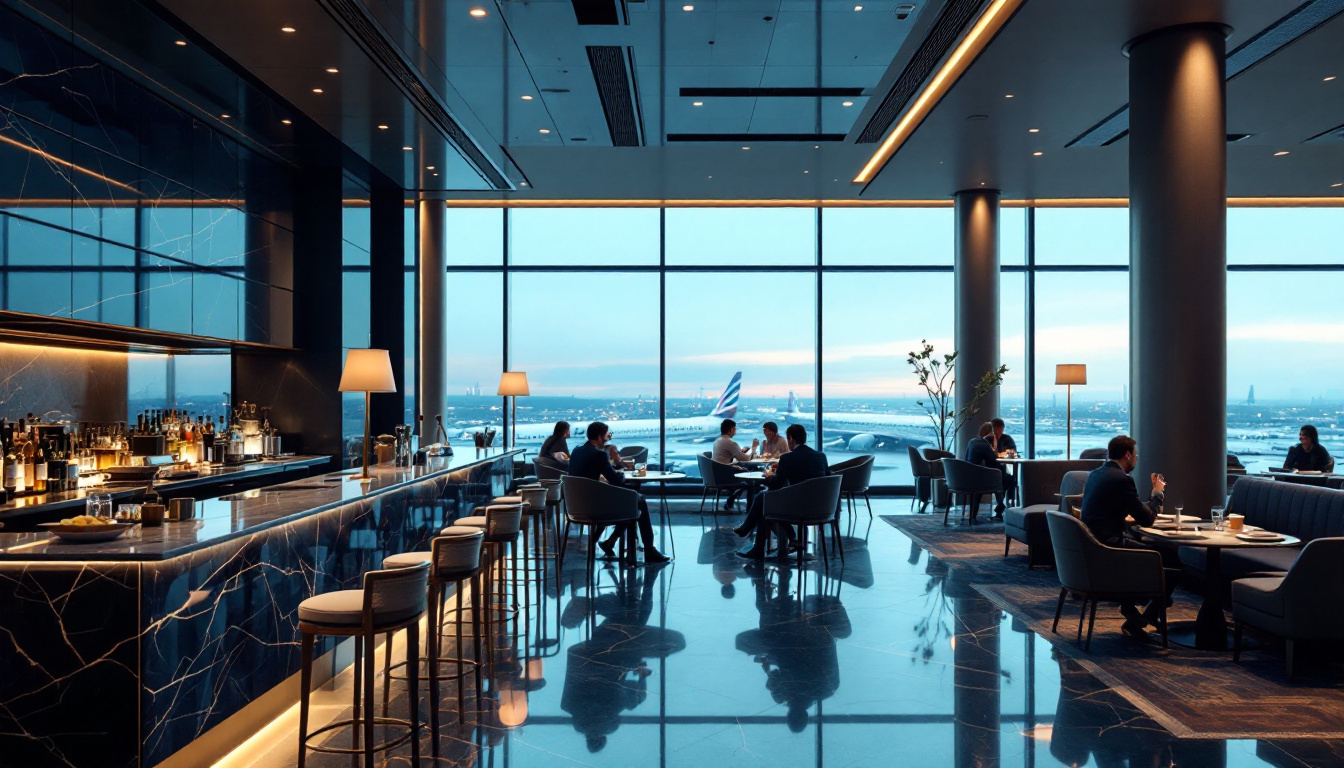
The Chelsea Lounge is the lounge that matters most for the F-class corporate buyer. It is a deliberately small footprint — roughly 10,000 square feet — designed for an audience of 50 to 80 simultaneous guests in normal operation, with the 128-seat capacity providing meaningful headroom for the JFK F-class peaks during the late-afternoon LHR departure bank. The design, by London studio David Collins (which previously designed the BA First Lounge at LHR T5 and the Concorde Room at LHR), is consistent with BA’s broader premium aesthetic — walnut paneling, deep-green upholstery, brass accents, and a single sculptural feature at the entrance: a bronze-and-glass installation by London artist Eilis O’Connell that BA brought from the retired Concorde Room.
The Chelsea Lounge experience
The Chelsea Lounge is the closest the U.S. airline-lounge market has come to the LHR T5 BA First Lounge experience. The food program is à la carte with table service from a trained waitstaff, with a menu refreshed monthly and a wine program run by a London-based BA sommelier team that rotates the by-the-glass list quarterly. The current cycle, in place since 1 April 2026, includes a starter of native lobster cocktail with a Marie Rose sauce, a main of dry-aged ribeye with bone marrow, and a sticky toffee pudding for dessert. The wine pairing list includes 14 references by the glass plus a 22-reference bottle list available at no additional charge to lounge guests.
The Champagne program is the lounge’s defining beverage feature. The Chelsea Lounge rotates its by-the-glass Champagne list between Krug Grande Cuvée, Dom Pérignon vintage, Cristal vintage, and Laurent-Perrier Grand Siècle, with one of the four offered as the house pour at any given time. The rotation pattern is opaque — BA does not publish a schedule — but our reporting from the lounge team during the April walk-through suggests the rotation is approximately twelve weeks per pour, with Krug typically anchoring the winter and summer rotations and Dom Pérignon anchoring the spring and autumn. During our April visit, the house pour was a 2014 Dom Pérignon vintage.
The bar program runs a small cocktail menu of eight drinks, with a bartender team that rotates between the Chelsea and the BA First Lounge at LHR T5. The opening cocktail program was anchored by a Negroni built around BA’s house gin (a custom distillation by Sipsmith), which has remained on the menu through every rotation. The cocktail program is competitive with the bar at the LHR T5 First Lounge and is, in our assessment, the most ambitious airline-lounge cocktail program in the U.S. market outside the Delta One Lounge at JFK.
The seating is arranged to encourage extended dwell — fireside booths for couples, two-tops along the apron-facing windows, a small library nook with a curated selection of British and American novels, and the outdoor terrace at the eastern end of the lounge. The terrace is small (12 seats) and is the only outdoor space at any premium-cabin lounge at JFK Terminal 8. It is closed during inclement weather and during winter low-temperature events; during our April visit, the terrace was open and at three-quarter capacity from 11 a.m. through 5 p.m.
The priority security lane and the F-class flow
The most operationally consequential part of the JFK Terminal 8 F-class experience is the priority security lane that accesses the lounge area. The lane is a TSA-staffed dedicated security pathway accessed through the joint BA-American First check-in area on the departures level, and is reserved for First Class passengers on either airline and for BA Gold Guest List members. The throughput is meaningfully faster than the general TSA PreCheck and standard lanes at Terminal 8 — typically two to four minutes from desk to airside during off-peak, and six to ten minutes during peak banks.
The closest comparable is the LHR T5 First Wing security pathway, opened in March 2017, which is the gold standard for airline-managed premium-cabin security. The LHR T5 First Wing is operated by the Heathrow Airport Holdings security team (rather than by a national security authority), is staffed at a higher agent-to-passenger ratio, and produces desk-to-airside times of under three minutes during virtually all operating windows. The JFK Terminal 8 lane is fast — meaningfully faster than the general TSA pathways at the terminal — but it is operationally tied to TSA staffing patterns and can experience variable wait times during shift changes and at the morning and evening peaks.
The 2026 corporate-buyer view of the JFK F-class flow, expressed in the most recent BTN Corporate Travel Index data we have reviewed, is that the priority pathway is “competitive but not best-in-class.” The Index’s qualitative panel — composed of corporate travel managers at the F-class level at six Fortune 500 companies — rates the JFK Terminal 8 F-class flow at 8.2 out of 10, compared with 9.4 for LHR T5’s First Wing pathway. The gap is the operational consistency of the security lane and the speed of the gate-side boarding process; the lounge product itself rates as comparable.
The check-in experience at Terminal 8 is, in our assessment, the strongest single element of the F-class flow. The joint BA-American First check-in area is a private, walled-off section of the departures level with six desks (three BA, three AA), a dedicated concierge team, and a private seating area for guests waiting for documents to be processed. The walk from the check-in desks to the security lane is roughly 80 feet; the walk from security to the Chelsea Lounge is approximately four minutes via a dedicated elevator and corridor.
The JFK F-class corporate-buyer demand pattern
The JFK F-class corporate-buyer demand pattern is meaningfully different from LHR’s. JFK’s outbound F-class population is concentrated in two banks: the morning BA006 (LHR) and AA100 (LHR) departures around 9:30 a.m., and the evening BA178 (LHR) departure at 6:30 p.m. The morning bank typically runs at 65 to 75 percent F-class load factor across the two flights; the evening bank typically runs at 70 to 85 percent. AA86, the midday LHR departure at 11 a.m., is a smaller bank in F-class terms and is the lounge’s quietest peak.
The total F-class outbound seat count at Terminal 8 across BA and AA is approximately 90 seats per day during normal operation, which translates to roughly 540 to 700 F-class admissions to the Chelsea Lounge per week. That demand pattern is the operational logic for the Chelsea’s 128-seat capacity — it is sized to absorb the peak F-class arrival window with meaningful headroom, while the broader Soho and Greenwich lounges handle the larger Business Class and oneworld Sapphire populations.
The 2026 commercial environment at the JFK-LHR market is, for the F-class corporate buyer, one of the strongest in the post-pandemic recovery. BA’s load factor on JFK-LHR F-class through Q1 2026 was 72.4 percent, up from 64.1 percent in Q1 2025. AA’s Flagship First on JFK-LHR is being phased out — the 777-300ER fleet that operates the route will retire the dedicated Flagship First cabin in late 2026 as part of AA’s broader product simplification — which will shift JFK-LHR F-class demand exclusively to BA. The Chelsea Lounge access policy will not change, but the through-lounge F-class population will shift toward a BA-only mix from late 2026 forward.
The Concorde dining program at the Chelsea — the à la carte sit-down menu — is the operational feature most likely to feel the AA Flagship First retirement. AA Flagship First passengers currently account for approximately 22 percent of Chelsea Lounge admissions; their departure will reduce total lounge admissions by a corresponding margin and will allow BA to potentially reduce the staffing rhythm of the Chelsea kitchen during the midday window when AA86 has historically pushed back.
What the JFK Terminal 8 setup means for the rest of 2026
The British Airways move from JFK Terminal 7 to Terminal 8 was the most significant restructuring of the JFK premium-cabin lounge map in the airport’s modern history. Three and a half years in, the consolidation has produced a functioning joint BA-American premium-cabin operation, a tiered three-lounge structure that is the strongest in the U.S. domestic premium-cabin lounge market, and an F-class flow that is the closest the U.S. airline industry has built to the LHR T5 First Wing benchmark.
The Chelsea Lounge is the operational success story of the consolidation. The food program is competitive with the LHR T5 First Lounge, the Champagne rotation is the most ambitious in the U.S. airline-lounge market, the priority security pathway is meaningfully faster than the general TSA lanes at Terminal 8, and the design — by the same studio that designed the original LHR Concorde Room — preserves the visual identity of the BA F-class product that the retired Terminal 7 Concorde Room had been the U.S. anchor of.
The two areas where the JFK setup still trails LHR T5 are the consistency of the security lane (TSA-staffed at JFK versus airport-staffed at LHR) and the gate-side boarding process. The 2026 corporate-buyer view, on the available evidence, is that those gaps are real but narrow, and that the Chelsea Lounge itself is competitive with the LHR T5 First Lounge on every measurable amenity dimension.
The 2026 outlook for the JFK F-class flow is straightforward. AA’s planned phase-out of the Flagship First product on JFK-LHR in late 2026 will reduce through-lounge admissions and will narrow the Chelsea’s user population to BA First. BA’s continued F-class load factor recovery through Q1 2026 has been strong, and the airline has signaled no changes to the JFK F-class capacity or schedule through 2027. The Chelsea Lounge will remain the most distinctive F-class lounge in the U.S. market for the foreseeable future. For the F-class corporate buyer, the JFK Terminal 8 experience — check-in to security to Chelsea Lounge to gate — is the closest the U.S. airline industry has come to replicating LHR T5’s First Wing, and it is the operational benchmark against which every other U.S. F-class flow is being measured.