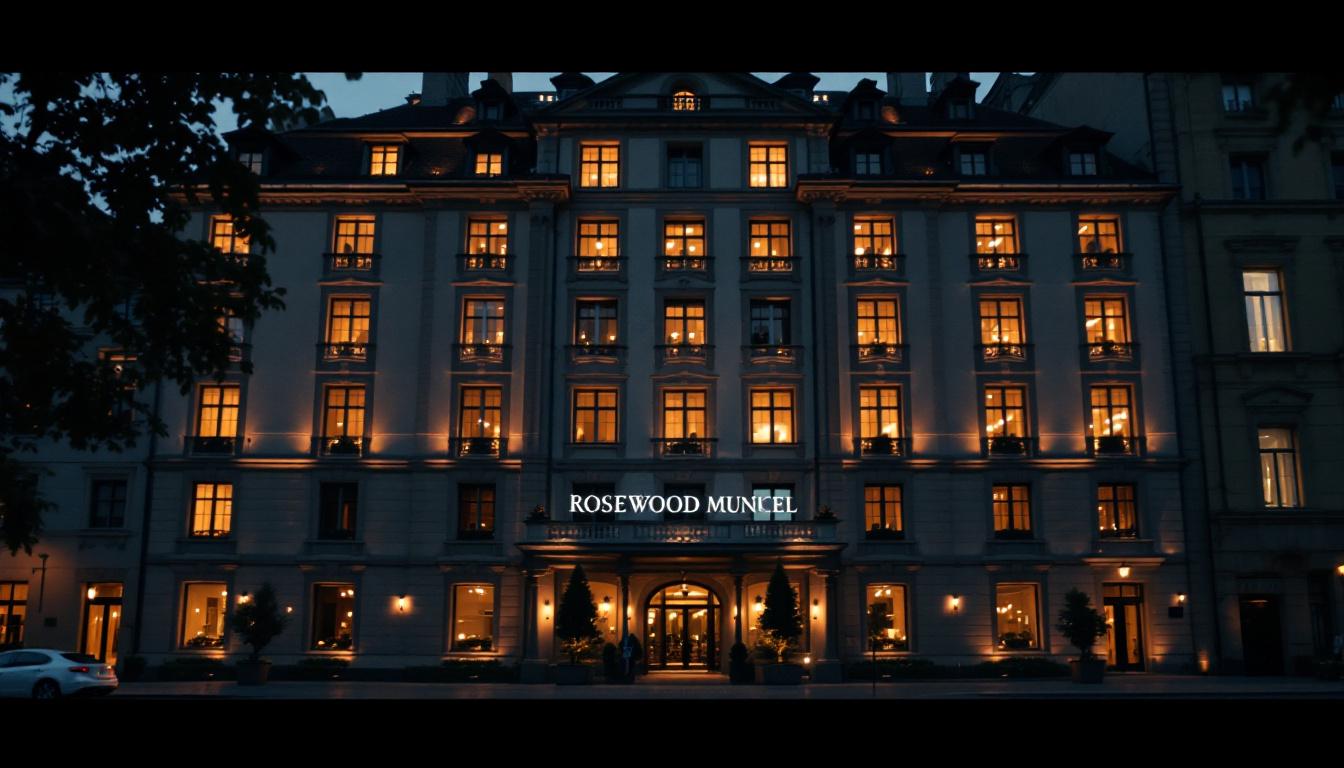
The scaffolding on the southern facade of the former Bayerische Staatsbank came down on 26 March 2026, the day before I toured the site. What it revealed, after fourteen months under wraps, was a near-complete restoration of one of the most consequential pieces of late-nineteenth-century commercial architecture in Munich — and the first Rosewood-branded hotel in Bavaria.
Rosewood Munich, formally announced in November 2022 and originally scheduled to open in the spring of 2025, will now open its doors on Friday, 9 October 2026. The eighteen-month delay, the project’s managing director Niklas Wenger told me during a two-hour walkthrough on 27 March, was driven by a combination of supply-chain dislocation on the bespoke joinery (most of it sourced from a single Tyrolean workshop in Innsbruck) and by the discovery, during the structural strip-out in early 2024, of a previously undocumented fresco cycle in the second-floor banking hall that required eight months of conservation work under the supervision of the Bayerisches Landesamt fur Denkmalpflege.
The result, on the evidence of a building that is now perhaps three percent away from operational readiness, is going to be Munich’s most consequential luxury hotel opening since the Mandarin Oriental landed on Neuturmstrasse in 1989. That is not a marketing claim — it is a structural observation about a market that has not seen genuine new entry at the top of the bracket in nearly four decades.
The property
The site is the former headquarters of the Bayerische Staatsbank at Kardinal-Faulhaber-Strasse 14, two blocks west of the Frauenkirche and a six-minute walk from Marienplatz. The building, completed in 1898 in the Italian Renaissance style by the Munich architect Albert Schmidt, served as the bank’s main office until the Staatsbank’s absorption into Bayerische Vereinsbank in 1971, and thereafter as a regional administrative office for HypoVereinsbank until that institution vacated the property in 2018.
Rosewood’s parent, the Hong Kong-listed Rosewood Hotel Group, acquired the building in a joint venture with the Bavarian family office Schorghuber Holdings in early 2022 for a price the parties have not disclosed but which Munich market sources have placed in the range of €165 to €180 million. The conversion budget, Wenger confirmed during the walkthrough, has now run to “considerably more than €200 million” — a figure that, when added to the acquisition cost, gives Rosewood Munich a per-key all-in development cost of approximately €2.85 million. For context, the Mandarin Oriental Munich’s most recent full refurbishment, completed in 2017, was reported at roughly €700,000 per key.
The hotel will operate 132 rooms and suites, of which 47 are suites — an unusually high suite ratio of 36 percent that is closer to a resort property than a city hotel. Standard guest rooms start at 41 square meters, the smallest suite category at 68 square meters, and the top-of-house Bayern Suite, which occupies the entire fifth-floor corner overlooking the Frauenkirche, runs to 412 square meters across two bedrooms, a private library, a 38-square-meter terrace, and a dedicated entrance via a restored 1898 lift cage that has been preserved as a piece of working historical fabric.
The smallest standard room category is, by Munich five-star standards, generous. The Mandarin Oriental’s entry-level room is 33 square meters; the Bayerischer Hof’s most-sold category is 28 to 32 square meters depending on building wing; the Charles Hotel’s standard is 36. Rosewood’s 41-square-meter floor is a deliberate positioning decision, Wenger said, that “reflects how this category of guest actually uses a hotel room in 2026 — as a place to work, take video calls, and host a small one-on-one breakfast meeting, not just to sleep in.”
Each room is equipped with a desk built to a depth of 78 centimeters (the European luxury standard is generally 65), a dedicated video-call lighting fixture mounted above the desk surface, and a separately switched secondary monitor input that allows guests to project from a laptop onto a 32-inch screen built into the desk return. Those specifications were finalized after a series of stakeholder workshops Rosewood ran in late 2024 with what Wenger described as “a working group drawn from our top forty corporate accounts globally.” The output of those workshops is visible everywhere in the guest-room product, from the placement of the bedside USB-C outlets to the decision to install acoustic glazing rated at 42 decibels of street-noise attenuation — five decibels above the Munich building code minimum.
The bathing rooms are larger than the Munich market norm: a standard-category bathroom runs 11 square meters, with a separate shower and a deep soaking tub in marble sourced from a single quarry in Bad Reichenhall. The suite bathing rooms scale up from there, with the Bayern Suite’s master bathroom alone measuring 38 square meters, including a private sauna and a cold-plunge basin.
Food and beverage
The F&B program is the most ambitious of any Munich opening I have seen in fifteen years of writing about this market, and it is the area in which Rosewood is most clearly attempting to differentiate from the incumbent set.
The headline restaurant, Nove, occupies the restored 1898 banking hall on the second floor — a 380-square-meter room with a 9.2-meter coffered ceiling and the conserved fresco cycle, depicting allegorical figures of Commerce, Industry, Agriculture, and Banking, that delayed the project for the better part of a year. It will be operated by the Milanese chef Aimo Moriconi, formerly of the three-Michelin Il Luogo di Aimo e Nadia, who has signed a five-year consulting and brand-licensing agreement with Rosewood to develop and supervise the menu. Moriconi himself will spend roughly twelve weeks a year on property, with day-to-day operations under his executive chef from Milan, Filippo Renda, who will relocate to Munich for the opening.
Nove will seat 84 in the main dining room and a further 64 across seven private dining rooms that occupy the former bank-officer offices ringing the hall. The private rooms range from a four-person table in what was the chairman’s office (which still contains its original 1898 wood paneling and a working safe that has been left in place as a curiosity) to a 28-cover boardroom configuration in the former trading floor. Opening rates have not been published but the hotel’s commercial director confirmed that private-room minimums will start at €4,800 for an eight-person dinner including wine pairings.
The second outlet, Faulhaber, is a 110-cover ground-floor brasserie facing Kardinal-Faulhaber-Strasse with its own street entrance independent of the hotel lobby. It will open at 6:30 a.m. daily for breakfast, run continuously through lunch and afternoon service, and serve dinner until 11:30 p.m. The kitchen is being run by Lena Brauner, previously the executive chef at Tantris DNA, with a menu that Wenger described as “Bavarian-Mediterranean — pretzels and burrata, schweinshaxe and orata, but executed seriously.” Faulhaber is the outlet Rosewood is most aggressively positioning for business breakfasts and working lunches, and it will offer a 27-minute guaranteed-service lunch menu for €58 that includes one course, a glass of wine or non-alcoholic equivalent, and coffee.
The third outlet, Mira, sits on a newly constructed eighth-floor rooftop that did not exist in the original Schmidt building. The addition required a four-year approvals process with the Munich planning authorities and was eventually permitted only on the condition that the new floor be set back 4.2 meters from the original parapet on all four sides — a constraint that has produced a 92-cover terrace with one of the most expansive views of the Munich skyline currently available in the city. Mira will operate as a cocktail lounge from 5 p.m. to 1 a.m. seven days a week, with a 38-seat enclosed bar room for the winter months when the terrace is unusable. The bar program is being designed by the Berlin-based consultancy Velvet Hospitality, whose partner Anja Reichel is the same operator responsible for the bars at Rosewood’s London and Vienna properties.
Beyond the three primary outlets, the hotel will operate a 16-seat omakase-style sushi counter inside Nove for dinner only, in partnership with the Tokyo chef Hiroshi Sato, who will fly in for three two-week residencies per year; an in-room dining program with a 24-hour kitchen separate from the restaurant lines; and a lobby tea lounge serving an afternoon-tea service that will be priced at €145 per person, putting it five euros above the Mandarin Oriental’s current Sunday tea.
Spa, fitness, and meetings
The spa, branded as Asaya in line with Rosewood’s group-wide wellness identity, occupies the entire basement level and runs to 1,840 square meters — by some margin the largest hotel spa in the central Munich market. The program includes eight treatment rooms (two of them couple suites), a 20-meter indoor pool with adjacent vitality pools at four temperature points, a thermal experience suite with three saunas and a steam room, and a 280-square-meter fitness floor equipped with Technogym Personal product and a separate Pilates studio.
Asaya at Rosewood Munich will operate a non-guest membership tier capped at 380 members, priced at €4,800 annually for individual membership and €7,200 for a couple. As of the third week of March, the hotel’s spa director had confirmed that approximately 60 percent of the membership inventory had already been pre-sold to a waitlist that opened in October 2025.
The meetings and events program is more modest than the F&B build, which is consistent with Rosewood’s group positioning as a leisure-and-executive brand rather than a conference operator. The hotel offers six function rooms, with the largest a 240-square-meter ballroom that seats 140 for a banquet or 180 theater-style. The configuration is deliberately scaled below the Bayerischer Hof’s 2,500-capacity Festsaal and the Mandarin Oriental’s similar large-format inventory, and it will compete for the boardroom-and-board-dinner end of the market — corporate retreats of 40 to 80, family-office gatherings, senior leadership offsites — rather than for full-scale conferences.
Positioning against the existing Munich luxury set
The Munich luxury hotel market, by my count, contains five properties that are unambiguously in the top bracket: the Bayerischer Hof (337 keys, family-owned since 1897, on Promenadeplatz); the Mandarin Oriental (73 keys, on Neuturmstrasse, the smallest of the set); the Charles Hotel (160 keys, Rocco Forte, near the Old Botanical Gardens); the Hotel Vier Jahreszeiten Kempinski (296 keys, on Maximilianstrasse); and the Sofitel Bayerpost (396 keys, on Bayerstrasse opposite the Hauptbahnhof, which competes for some of the same corporate accounts but is generally considered a tier below the rest).
Rosewood Munich is being positioned, explicitly, against three of those: the Bayerischer Hof, the Mandarin Oriental, and the Charles. The Kempinski is treated as a parallel-track competitor that wins on certain accounts (particularly Middle Eastern corporate and government travel) and loses on others; the Sofitel is not on the comparison sheet at all.
The competitive frame, as Wenger laid it out, is this. The Bayerischer Hof, family-owned and operated by the Volkhardt family for four generations, is the market’s volume leader at the top of the bracket and the default booking for most major German corporates who do not have a specific reason to look elsewhere. Its strengths are scale, the diversity of its F&B (it operates seven outlets across the property), and a near-monopoly on the most prestigious private-event business in the city. Its weakness, increasingly, is room product: the hotel is a composite of five connected buildings of different vintages, and the room categories vary widely in size, ceiling height, and finish. A traveler can be sold a “deluxe king” and find herself in a 26-square-meter room with a partial view of an internal courtyard.
The Mandarin Oriental, at 73 keys, occupies the opposite end of the trade-off curve: small, intimate, service-led, with one of the most consistent room products in the city but a near-absence of meeting space and a relatively constrained F&B program (the Matsuhisa outlet on the rooftop is its anchor). It tends to win the bookings of senior executives traveling alone, particularly from the financial-services sector, and lose the entourage business and the meeting-rich itineraries.
The Charles, since its 2007 opening under Rocco Forte, has carved out a position as the most design-forward of the Munich luxury set, with a strong residential feeling, a well-regarded spa, and a location adjacent to the Old Botanical Gardens that is slightly removed from the main Altstadt foot traffic. It wins where atmosphere and quiet are prioritized and loses where proximity to the Altstadt and Maximilianstrasse retail matters.
Rosewood Munich’s pitch, in this frame, is that it can take the room-product and suite-mix advantage of the Mandarin Oriental (consistent, generous, recently built), pair it with the F&B and event firepower of the Bayerischer Hof (Moriconi, Faulhaber, Mira, the largest spa in the city center), and place all of it inside an Altstadt-adjacent location that is genuinely competitive with both. The 36-percent suite ratio is the most aggressive single feature of that pitch: in a market where the typical luxury hotel runs a suite ratio of 12 to 18 percent, Rosewood is signaling that it intends to win the executive-with-family and the long-stay-relocation business in a way the incumbents structurally cannot.
Whether that strategy works will depend, in the first instance, on the corporate-rate negotiations now underway for 2027. The 2026 program, at €780 base, €920 standard, and €1,150 last-room, is a holdover opening structure — Rosewood essentially needs to fill the property for its first quarter and is offering pricing accordingly. The 2027 program, which the hotel’s account-management team is currently in market with, is expected to lift the base entry rate to €890 and the LRA rate to €1,290. The relevant comparison there is not against today’s Bayerischer Hof and Mandarin Oriental rates, but against what those properties will be charging in 2027, which is itself a moving target.
Three corporate travel managers I spoke with — two at DAX-listed industrial firms and one at a Frankfurt-headquartered private bank — said they had received Rosewood’s 2026 rate proposal and were treating it as a serious option for inclusion in their preferred-property lists. None had yet signed. “We will wait to see the actual delivery for the first ninety days,” the industrial-firm TM said, on background. “Munich is an important market for us and we have been disappointed before by openings that did not match their pre-opening sell sheet. But the room product, on paper, is exactly what our senior people have been asking for.”
Logistics: airport, Messe, and the practical geography
Munich Airport (MUC) is 38 kilometers from the hotel. The drive, by car, runs 32 to 70 minutes depending on time of day and traffic on the A9, the main north-south corridor. The Rosewood transfer service operates a fleet of four BMW i7 sedans and two long-wheelbase BMW iX SUVs, with a Mercedes V-Class available for groups. The flat one-way rate is €240 for the sedan and €380 for the V-Class.
For travelers willing to take public transport, the S-Bahn S8 from MUC’s central station beneath Terminal 1 runs every 20 minutes to Marienplatz and takes 41 minutes. The hotel is a six-minute walk from the Marienplatz station’s eastern exit. Several of the corporate accounts I spoke with said this would be their travelers’ default routing, particularly for solo travelers without checked luggage, given the well-documented unreliability of the A9 during weekday peak hours.
Messe Munchen, the city’s exhibition complex, is 11 kilometers east of the hotel near the Riem suburb. Off-peak, the drive is 18 to 24 minutes; during major trade fairs that figure routinely doubles. The U-Bahn U2 line connects the closest station to the hotel, Konigsplatz, to Messestadt Ost in 26 minutes, with a transfer at Hauptbahnhof. Rosewood’s commercial team has been clear that fair-week pricing will float aggressively to demand and that the property is not pursuing trade-fair overflow business — a positioning that mirrors the Mandarin Oriental’s historic approach and contrasts with the Bayerischer Hof, which tends to absorb significant fair-week volume at premium rates.
For travelers whose business is concentrated in the Maximilianstrasse banking and luxury-retail corridor, the hotel is essentially as well-placed as it could be: a four-minute walk to the Maximilianstrasse entrance of the Hotel Vier Jahreszeiten Kempinski, a six-minute walk to Marienplatz, and an eight-minute walk to the headquarters of UniCredit Bank AG (the former HVB, which vacated the Rosewood building itself in 2018). The walk to the offices of the Bayerische Landesbank on Brienner Strasse is eleven minutes.
The opening
The hotel begins its phased opening on 9 October 2026 with rooms, the lobby, Faulhaber, and the spa operational from day one. Nove will open on 23 October, after a two-week soft launch for hotel guests and contracted media. Mira, the rooftop bar, will open on 6 November, weather permitting, with an enclosed-room-only configuration for the winter and a full terrace opening planned for the second week of April 2027. The omakase counter inside Nove is scheduled to open in late November, contingent on chef Sato’s availability.
Opening-week room rates start at €1,180 for the entry-level Deluxe King category, rising to €1,420 for the Premier rooms with Frauenkirche views and €2,650 for the smallest of the Junior Suites. The Bayern Suite, the top-of-house category, is listed at €18,500 per night for opening week and €14,800 thereafter — pricing that places it above the Mandarin Oriental’s Presidential Suite (€11,200) and below the Bayerischer Hof’s Presidential Suite during fair weeks but at parity outside of them.
The actual question, of course, is not the opening-week rate card. It is whether the operation will hold up in its first six months, when staffing is new, the operational manuals are still being written in real time, and the gap between brand-standard and on-property-reality is most visible. Rosewood has assembled what looks, on paper, to be a strong opening team — Wenger himself comes from the Rosewood Vienna; the executive housekeeper, Sabine Korte, is a twenty-year Mandarin Oriental veteran; the F&B director, Marco Bauer, ran the F&B operation at the Brenners Park-Hotel in Baden-Baden for nine years. The depth below those names, on the evidence of the recruitment data the property has shared, is less certain. Munich’s hospitality labor market is among the tightest in continental Europe, and Rosewood has been hiring against a candidate pool that the Bayerischer Hof and Mandarin Oriental have been competing for aggressively.
We will be back in November, after the opening dust has settled, to see how the operation actually performs. The bones, as Wenger put it himself in a different context, are remarkable. What matters now is what happens between guests and staff in the corridors at 11 p.m. on a Tuesday in week three.