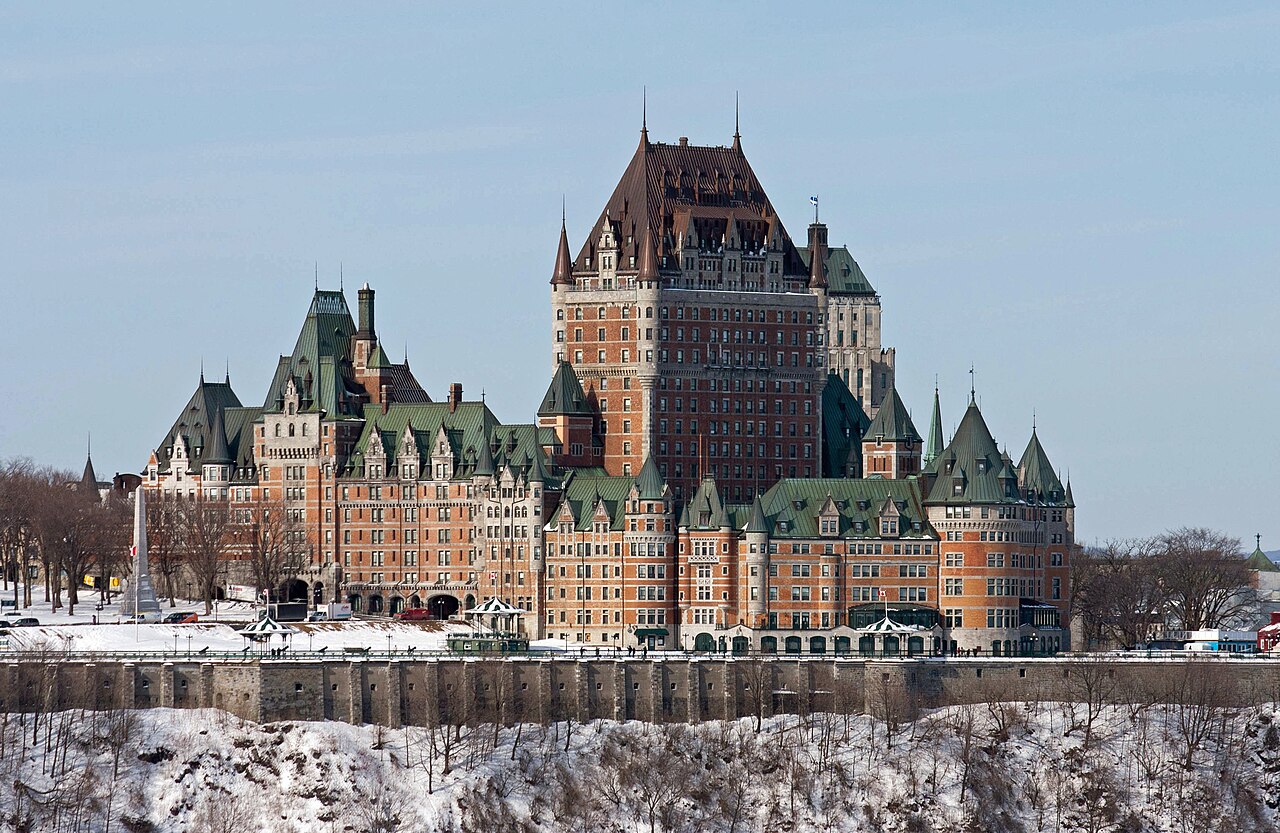
The Q3 2026 chairman-and-CEO retreat-venue booking cycle is showing a clear shift toward Fairmont Le Château Frontenac in Quebec City, with the Canadian and US large-corporate executive-retreat program reading the property as a top-tier heritage-and-discretion venue option for the September-through-November executive-meeting window. The 611-key Canadian Pacific-era hotel, opened 18 December 1893 on the bluff above the St. Lawrence River, has held its position as the city’s anchor luxury hotel for nearly 130 years, and the post-renovation room product and the Air Canada Signature corridor connections into Quebec City Jean Lesage International Airport (YQB) are the operational inputs supporting the Q3 booking pattern.
This briefing reads the property at the 130-year mark and looks at why the executive-retreat venue cycle is converging on the Château Frontenac for Q3 2026.
The Property at 130 Years: 611 Keys on the Vieux-Québec Bluff
The Château Frontenac occupies the bluff above the St. Lawrence River in the Haute-Ville section of Vieux-Québec, the historic walled upper town that forms the core of the UNESCO World Heritage Site designation Quebec City received in 1985. The property was developed by the Canadian Pacific Railway as part of its chain of grand railway hotels — a chain that included the Château Laurier in Ottawa, the Banff Springs in Banff, the Royal York in Toronto, the Empress in Victoria, and the Algonquin in St. Andrews — and opened on 18 December 1893. The hotel was named for Louis de Buade, Comte de Frontenac, the 17th-century governor of New France whose tenure included the 1690 defense of Quebec against the English siege.
The original 1893 building was extended and modified multiple times in the late 19th and early 20th centuries. The most visible architectural feature — the central tower that gives the Château Frontenac its iconic skyline profile — was added in 1924. The final major building extension was completed in 1993, when the indoor pool, fitness center, and outdoor terrace were added. The building today comprises a complex multi-wing structure that wraps around inner courtyards and connects to the Terrasse Dufferin promenade that runs along the bluff facing the St. Lawrence.
The 611-key inventory is unusually large for a Canadian luxury hotel — for comparison, the Banff Springs runs roughly 757 keys, the Royal York runs roughly 1,365 keys, the Empress runs roughly 464 keys, and the Château Laurier runs roughly 429 keys. The Château Frontenac sits in the upper middle of that group on key count, with the floor plate spread across the multi-wing building. The property’s conference and event floor plate — which supports board-and-executive retreats up to roughly 250 participants — is structurally critical to the executive-retreat venue book and is one of the larger event-space inventories in the Canadian luxury hotel set.
The Renovation History and Current Room Product
The Château has gone through four major renovation programs in its modern operating history. The 1973 program was a $10 million renovation that added restaurants, a shopping concourse, and a health club among other improvements. The 1993 program — completed in conjunction with the final building extension — was a $65 million program that added the indoor pool, fitness center, and outdoor terrace. The 2011 program, under Ivanhoé Cambridge ownership following Ivanhoé Cambridge’s acquisition of the property, expanded the conference rooms, remodeled the restaurants, modernized the lobby, and gutted and rebuilt three-fifths of the hotel’s rooms. Ivanhoé Cambridge announced an additional $66 million investment for further improvements.
The most recent comprehensive renovation was the 2014 program, a $75 million investment that updated all 611 rooms with contemporary furnishings in shades of gray and cream with butter-yellow and soft turquoise accents. The 2014 program is the room product the property is currently running, with twelve years of operational updates since but no full-property renovation announced for the 2026 calendar year. Industry sources have suggested that the next major renovation cycle for the property is being considered for the 2027-2029 window, but no formal announcement has been made by Ivanhoé Cambridge or by Fairmont (which operates the property under management contract for Ivanhoé Cambridge).
The 2014 room product has held up well over twelve years — the contemporary-furnishings approach used in the 2014 program was designed to integrate with the historic public-area architecture rather than to require frequent updates, and the room-category mix has not aged in the way that a more period-specific decorative approach would have. Corporate-event planners and executive-retreat coordinators we spoke to confirmed that the room product is judged as competitive with the current rate position by their corporate clients, with no widespread concern about the room product aging relative to the rate.
Why Q3 2026: The Chairman-and-CEO Retreat Booking Pattern
The Q3 2026 booking pattern at the Château Frontenac is showing a meaningful concentration of chairman-and-CEO retreat bookings from Canadian and US large-corporate executive programs. Executive-retreat coordinators at three Canadian-headquartered firms — one bank, one insurance company, and one industrial conglomerate — and two US-headquartered firms with significant Canadian operations described the property as their preferred Q3 2026 retreat venue choice, with bookings stretching from late August through early November.
Three structural inputs are driving the Q3 booking pattern. First, the Vieux-Québec UNESCO World Heritage Site walking-radius positioning gives the property a heritage-and-discretion mix that the major US chairman-and-CEO retreat venues — the Greenbrier in West Virginia, the Homestead in Virginia, the Broadmoor in Colorado, Pebble Beach, Bandon Dunes, and the various Ritz-Carlton and Four Seasons retreat properties — cannot match on European-style city-walking-radius access. Executive-retreat programs that want the heritage-and-discretion feeling of a European city venue without the transatlantic travel logistics have a structurally small competitive set, and the Château Frontenac is the cleanest option in that set.
Second, the post-2014-renovation room inventory has held up well, with the property’s banquet and meeting floor plate supporting board-and-executive retreats up to roughly 250 participants. The 611-key inventory provides the flexibility to run executive retreats with the entire participant group accommodated at the same property — which is structurally important for chairman-and-CEO retreats that prioritize controlled-environment programming and group cohesion. Smaller Quebec City luxury properties cannot support the inventory the larger retreats require.
Third, the cross-border travel posture is favorable. Quebec City sits inside the Canada-US border without requiring transatlantic travel, making it accessible for US chairman-and-CEO programs that need a European-feeling venue without the international-travel logistics. The post-2024 cross-border-travel environment — with the US and Canada both running easier executive-travel protocols than the major European destinations — has structurally favored Canadian heritage-luxury venues for US executive programs. The Château Frontenac is the largest beneficiary of that structural shift inside the Canadian heritage-luxury set.
The Air Canada Signature Corridor and Quebec City Jean Lesage Airport
Quebec City Jean Lesage International Airport (YQB) sits roughly 16 kilometers west of Vieux-Québec and the Château Frontenac, with the property’s car-service program running airport transfers on a roughly 20-to-30-minute corridor. YQB is the smaller of Quebec’s two main airports — Montreal Trudeau (YUL) handles substantially more passenger volume — and runs primarily Air Canada Jazz-operated Q400 and Embraer E175 regional service from Toronto Pearson (YYZ) and Montreal Trudeau (YUL), with limited direct international service from US East Coast hubs and seasonal European service.
The Air Canada Signature corridor — Air Canada’s premium business class product on its wide-body Boeing 777-300ER, 787-9 Dreamliner, and Airbus A330 fleet — is the structural connection for the chairman-and-CEO retreat book. Air Canada Signature Class operates only on wide-body aircraft on long-haul international routes, mainly to Europe, Asia, South America, and Australia. The Air Canada Signature Suite at YYZ — located in the international departure area next to Gate E77 on the upper level beside the Plaza Premium Lounge — is exclusively available to Signature Class customers traveling internationally.
For the executive-retreat book, the typical routing runs as follows: US executives travel domestically to YYZ on partner-airline service or on the limited Air Canada Signature Class transcontinental service that operates between YYZ and select US hubs, transit through the Air Canada Signature Suite if they are connecting from international Signature Class long-hauls, and then connect to YQB on Air Canada Express regional service. The YYZ-YQB connecting flight runs at roughly 90 minutes block time, with multiple daily departures. The total door-to-door travel time for a US executive program from a major US East Coast hub to the Château Frontenac front door runs in the four-to-six-hour range, which is structurally favorable relative to a comparable European executive-retreat venue.
The Air Canada Signature Suite features a complimentary sit-down meal from an à la carte menu crafted by chef David Hawksworth, premium beer and wine, cocktails crafted with top-shelf spirits from Diageo, and champagne provided by Moët & Chandon. The design includes floor-to-ceiling bronze paneling, bar tops made from local stone, and a custom chandelier complemented by art from Canadian artists. The structural quality of the YYZ Signature Suite is one of the cleanest premium-air-lounge products in the North American market, and the corridor through YYZ is the dominant routing for the Château Frontenac executive-retreat book.
The Quebec City Luxury Hotel Set
The Château Frontenac runs as the structural anchor of Quebec City’s luxury hotel set. The other luxury properties in the city — the Auberge Saint-Antoine in the Vieux-Port district, the Hôtel le Saint-Pierre, the Hôtel Manoir Victoria, the boutique-luxury Le Capitole near the Parliament Hill area, and the various smaller boutique-luxury properties in Vieux-Québec — run smaller floor plates and target a different demand mix. The Auberge Saint-Antoine, at 95 keys, is the closest competitor on luxury positioning but is structurally too small for the executive-retreat book the Château Frontenac runs.
None of the other Quebec City luxury properties run a comparable conference and event floor plate. The Château Frontenac’s 611-key inventory and the multi-wing banquet and meeting floor plate are structurally unique in the city, and the executive-retreat book has nowhere else to go. That structural floor-plate advantage is one of the reasons the property has been able to hold its rate posture across the past decade without facing meaningful competitive pressure from new luxury entrants.
The broader Quebec province luxury hotel set includes the Manoir Richelieu in Charlevoix, the Fairmont Tremblant in Mont-Tremblant, the Fairmont Manoir Saint-Castin in Lac-Beauport, and the smaller resort-luxury properties in the Laurentians and the Eastern Townships. None of those properties competes directly with the Château Frontenac for the Quebec City urban executive-retreat book, though the Manoir Richelieu in Charlevoix has run as the closest provincial alternative for executive programs that prefer a more remote and resort-feeling venue.
Rate Posture and the Q3 2026 Booking Window
The Château Frontenac runs published rate during Q3 shoulder weeks in the 600 to 1,000 Canadian dollar range for entry-level rooms, with weekday business-compression and event-compression windows pushing entry rooms past 1,400 Canadian dollars. The Q3 executive-retreat compression — which runs heaviest in the late September through early November window — produces some of the property’s tightest availability of the year, with executive-retreat programs that have not pre-booked at least nine to twelve months in advance facing structurally limited room-block availability.
Suite categories begin around 1,800 Canadian dollars for the smallest premium category and climb steeply through the Suite Frontenac and the top-tier Royal Suite. The Royal Suite has cleared past 12,000 Canadian dollars per night during the highest-compression windows. The Fairmont Gold floor — the property’s club-floor product with a separate lounge, concierge service, and premium room product — runs at a roughly 30 to 50 percent premium to standard rooms and is heavily used by the executive-retreat book.
Rate parity is enforced across direct booking, the GDS, and the Accor consortia channels (Fairmont is owned by Accor through the 2016 FRHI acquisition). The property participates in the Accor ALL loyalty program, and the corporate-program take-up runs through Accor’s commercial team. The executive-retreat venue book is reportedly handled through a dedicated Château Frontenac group-and-events team that runs the larger executive-retreat and conference bookings on a custom-program basis rather than through standard corporate-RFP channels.
What the Q3 2026 Booking Pattern Tells Us About the Executive-Retreat Market
The Q3 2026 booking concentration at the Château Frontenac is a useful data point for the broader chairman-and-CEO executive-retreat venue market. The structural shift toward Canadian heritage-luxury venues for US executive programs that started in the post-2024 cross-border-travel cycle has continued into 2025 and 2026, and the Château Frontenac is the cleanest beneficiary of that shift on the major-key luxury side. The Banff Springs and the Manoir Richelieu are the secondary beneficiaries on the resort-luxury side.
The next data point worth watching is whether the broader Fairmont Canadian heritage portfolio — Banff Springs, Lake Louise, Jasper Park Lodge, the Royal York, the Château Laurier, the Empress, the Algonquin, the Manoir Richelieu, and the Château Frontenac — sees a similar Q3 booking concentration in 2026 and 2027. If the cross-border-travel cycle continues to favor Canadian heritage venues, the broader portfolio should see the same demand pattern that has converged on the Château Frontenac.
For executive-retreat program planners, the operational read is that the Château Frontenac is the structurally cleanest option for chairman-and-CEO retreats that want a heritage-and-discretion European-feeling venue inside the Canada-US travel envelope, with the Air Canada Signature corridor connections through YYZ providing the premium-air access that the corporate-executive book requires. The 2014 room product is holding up, the 611-key floor plate supports the participant-group sizes the executive-retreat programs need, and the Vieux-Québec UNESCO heritage walking-radius is the structural feature that the competitive set cannot match.
The Q3 2026 booking pattern is the cleanest signal we have seen of the Canadian heritage-luxury executive-retreat thesis working as designed. The Château Frontenac is the anchor of that thesis, and the property’s 130th-year-plus operational continuity is now its defining competitive advantage.