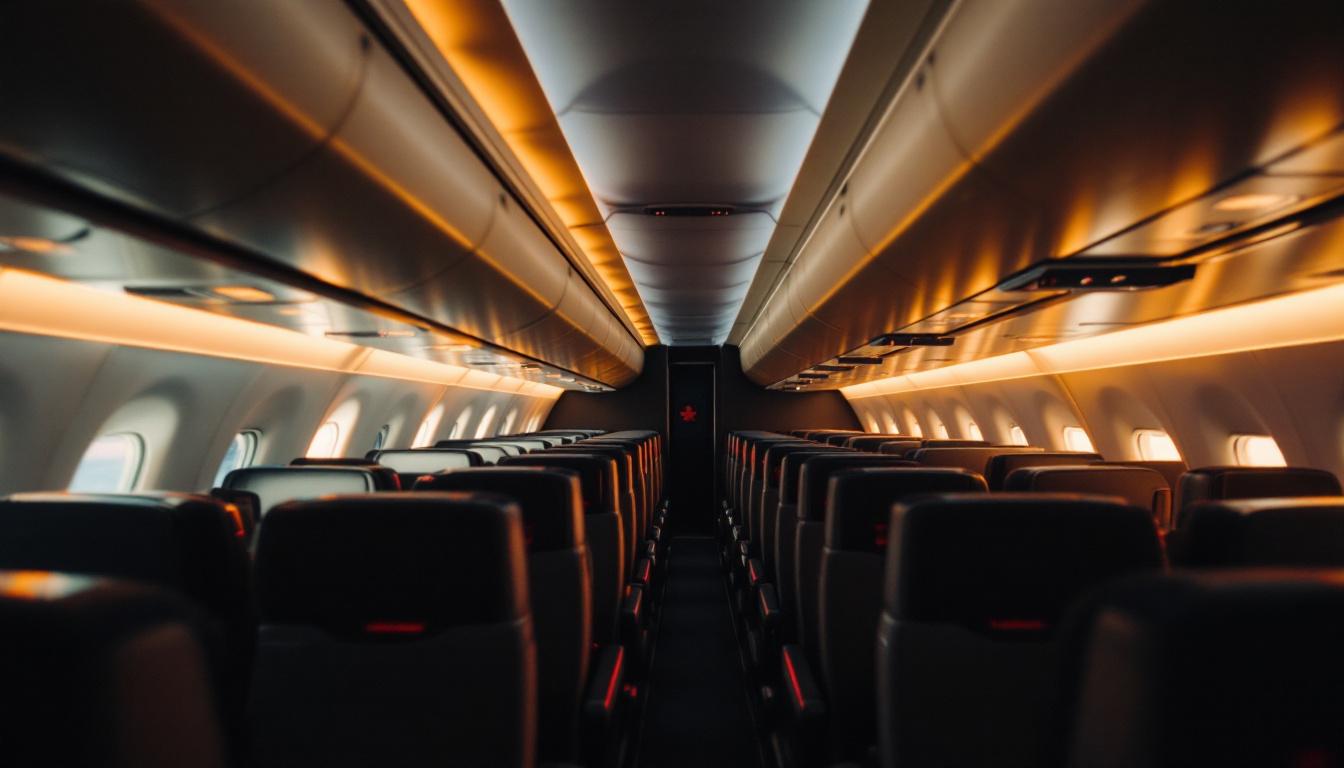
Air Canada enters 2026 with its long-haul flagship cabin in a state of orderly transition. The carrier’s premium business-class product, branded Signature Class since the 2017 rebrand from Executive First, is distributed across a widebody fleet anchored by Boeing 787-9 Dreamliners, Boeing 777-300ERs, and a remaining sub-fleet of six 777-200LRs that continue to operate the carrier’s longest ultra-long-haul rotations — including the Toronto to Sydney and Vancouver to Delhi pairings — through at least the 2026 schedule.
That fleet picture matters because it sets the contour of where the cabin actually flies. The 787-9 fleet, configured at 298 seats (30 Signature, 21 Premium Economy, 247 Economy), is the workhorse on thinner long-hauls and second-frequency rotations. The 777-300ER fleet, configured at 400 seats (40 Signature, 24 Premium Economy, 336 Economy), is reserved for the high-yield trunk routes from Toronto Pearson and, more selectively, Montreal Trudeau. Operationally, what the traveler experiences as “Signature Class” is one cabin product — a reverse-herringbone seat by Zodiac, 1-2-1, with a Sky Interior surround in the 787-9 and a slightly older but functionally similar treatment on the 777-300ER. The product spec was finalized in 2017 and has not been refreshed in a way that has altered the published seat map.
It has, however, been refreshed in detail. Beginning with deliveries from late 2024, Air Canada’s newer 787-9 frames carry a slightly updated seat-shell trim, a thicker mattress pad, and a Bose noise-cancelling headset that, on the carrier’s own internal accounting, has reduced headset-loss costs while improving net promoter scores in the cabin by a measurable margin. The amenity kit, redesigned in collaboration with Want Les Essentiels in October 2025, is now consistent across all long-haul Signature Class rotations regardless of origin or aircraft type. Bedding, dressed by Frette, was rolled fleet-wide in the first quarter of 2025. Catering on the cabin remains under the direction of the David Hawksworth partnership, which has been in place since 2014 and was renewed in 2025 through 2030.
The newsy framing for 2026 is not the hard product itself. It is the program around it.
The Aeroplan partner-program rewrite
Aeroplan published its 2026 partner-award structure on 8 January, with the new chart taking effect for tickets issued on or after 1 March 2026. The headline change is a move from five distance bands to eight, with the existing distinction between “Air Canada redemptions” and “partner redemptions” preserved and, in several cases, sharpened.
For the most common transatlantic redemption — New York or Toronto to Western Europe — the saver-level pricing on partner carriers (Lufthansa, Swiss, Austrian, Brussels Airlines, United Polaris, TAP Air Portugal) is essentially flat. A one-way Toronto to Frankfurt in Lufthansa business class clears at 75,000 Aeroplan points at the saver level in March 2026, the same level as in 2025. A Toronto to London Heathrow saver on either Air Canada’s metal or on Star Alliance partners (chiefly United and Lufthansa) prices identically.
The compression appears at longer distances. A Toronto to Tokyo Haneda saver redemption in ANA business class, which cleared at 75,000 Aeroplan points throughout 2025, now clears at 87,500 in the new chart — a 16.7% increase. A Vancouver to Singapore saver on Singapore Airlines, which cleared at 85,000, moves to 100,000. A Montreal to Cairo saver on EgyptAir clears at 95,000, up from 80,000. The pattern is consistent: longer flights, partner carriers, more points required.
Air Canada’s own communication describes the change as “rebalancing partner award costs to reflect underlying inventory costs,” which is a phrasing of art. What it almost certainly reflects is two pressures on the program: a 2025 increase in Star Alliance settlement rates for confirmed business-class inventory, and the carrier’s own desire to push more redemption volume onto its metal — where the marginal cost of an empty Signature seat at departure is meaningfully lower than the cash settlement to a partner.
The status side of the program is a quieter story. The 25K, 35K, and 50K tier thresholds for 2026 are unchanged from 2025: 25,000, 35,000, and 50,000 status-qualifying miles respectively, with the standard Status Qualifying Dollar (SQD) component preserved at thresholds Aeroplan has held since the 2020 program relaunch. The 75K and Super Elite tiers add a minimum-spend floor, set at C$5,000 and C$15,000 of Air Canada-marketed flight spend respectively, effective for the 2026 qualifying year. Members who hit the mileage threshold without the spend will, in practice, find themselves topping out at 50K — a meaningful change for points-and-miles-optimized travelers who historically cleared 75K via partner credit.
For corporate travel managers, the practical implications are narrow but real. Programs that include Air Canada as a preferred carrier on transborder and transatlantic routes will see their travelers’ top-tier status retention modestly tightened. Programs that route long-haul Asia volume through partner carriers — ANA, EVA, Singapore — will pay slightly more in points for the same redemption, and may want to model whether the cash differential vs. revenue Signature Class fares has shifted enough to revisit policy.
Star Alliance reciprocity, in 2026
The reciprocity story is a question that comes up at every business-travel briefing involving a Star Alliance carrier, and the 2026 answer is that the alliance benefits remain mostly intact and that one Air Canada-specific change has rippled into the discussion.
Star Alliance Gold status — held by Aeroplan 50K, 75K, and Super Elite members, as well as by equivalent tiers at every other Star Alliance carrier — continues to deliver lounge access on any Star Alliance member when traveling on a same-day Star Alliance flight, priority boarding, priority check-in, extra checked baggage, and priority airport handling. Nothing in the 2026 Aeroplan program changes any of those benefits. A 50K member traveling on Lufthansa from Frankfurt to Singapore in economy retains lounge access at FRA’s Senator Lounge complex and at SIN’s SilverKris Lounge, as they did in 2025.
What did change, effective 15 January 2026, is the access policy for Air Canada’s Signature Suite at Toronto Pearson. The Signature Suite is not a Maple Leaf Lounge; it is a separate, smaller pre-departure space adjacent to Gate F60 in Terminal 1’s international pier, with a sit-down restaurant, a barista bar, and a curated wine list. It has, since opening in 2017, operated on a strict access policy. Under the new policy, access is now tied exclusively to a same-day Signature Class boarding pass — regardless of frequent-flyer status. Aeroplan 75K and Super Elite members traveling in economy on a partner carrier, who had under prior policy occasionally been granted Signature Suite access at agent discretion, are now consistently directed to the Maple Leaf Lounge instead.
For the avoidance of doubt: Star Alliance Gold and Super Elite travelers retain Maple Leaf Lounge access on all qualifying departures. The Signature Suite is the exception, and the exception applies symmetrically. A revenue Signature Class traveler with no Aeroplan status accesses the Suite; a Super Elite member traveling in economy does not.
The change reflects an operational reality that Air Canada has discussed at travel-industry briefings over the past 18 months. The Signature Suite was designed for a passenger volume that mid-2010s capacity planning expected; the 2024-2025 rebound in long-haul Signature Class volume from YYZ has pushed the Suite past comfortable capacity at peak departure windows. The simplest lever Air Canada had was to tighten the access policy, and that lever has now been pulled.
YYZ and YUL: the hub deployments
The seasonal schedule release covering the summer 2026 IATA period, published in late November 2025 and amended in early January, sets out the cabin’s deployment in detail. Two patterns are worth identifying.
The first is that Toronto Pearson remains the unambiguous flagship hub for the cabin. Of Air Canada’s 17 European long-haul Signature Class rotations scheduled for summer 2026, 13 operate from YYZ. The principal European destinations — London Heathrow, Paris Charles de Gaulle, Frankfurt, Munich, Zurich, Amsterdam, Rome, and Athens — all see at least double-daily Signature Class capacity from YYZ at peak. London Heathrow operates triple-daily in July and August, with the morning departure on the 777-300ER and the two evening departures on 787-9 frames. Frankfurt operates double-daily with the morning rotation on the 777-300ER. Tokyo Haneda, the carrier’s premium-business gateway to Japan, operates daily on a 787-9 in summer 2026 and adds a second daily 787-9 rotation between mid-June and the end of August. Tokyo Narita, which Air Canada had been operating on a reduced cadence since 2019, returns to daily 787-9 service from YYZ effective 1 May 2026.
The second pattern is that Montreal Trudeau has continued to consolidate as a meaningful, if smaller, long-haul hub. From YUL, Signature Class is scheduled to London Heathrow (double-daily in peak summer), Paris Charles de Gaulle (double-daily year-round), Frankfurt (daily, 787-9), Zurich (daily seasonal), Rome (five-weekly seasonal), Casablanca (four-weekly year-round on the 787-9), Algiers (three-weekly seasonal, 787-9), Tel Aviv (four-weekly seasonal, 787-9), Tokyo Narita (four-weekly year-round on the 787-9, expanding to daily in July and August), and Sao Paulo (four-weekly year-round, 787-9). The YUL-Casablanca and YUL-Algiers rotations are not duplicated elsewhere in the network and represent the carrier’s distinctive North African capacity within the alliance.
What is not on the 2026 schedule is also worth noting. Air Canada does not currently operate Signature Class to Beijing, Shanghai, or Guangzhou; the carrier’s mainland-China services were suspended in 2020 and have not been restored. The carrier’s South Asia presence remains thinner than industry analysts expected at this stage of the post-pandemic recovery: Mumbai operates daily on the 777-300ER from YYZ and is the carrier’s largest South Asia route by capacity; Delhi operates daily on the 787-9; Bengaluru and Chennai are not in the operating schedule. Sub-Saharan Africa is unserved; the closest equivalents are codeshare itineraries on Lufthansa, Brussels Airlines, or Ethiopian via European or Middle Eastern connections.
For corporate travel programs running scheduled rotations between Canada and Europe, the Signature Class capacity in 2026 is the most generous it has been since 2019. For programs flying Canada-Asia, the Tokyo and Seoul rotations are well-served and the Hong Kong daily is unchanged, but South Asia capacity remains a constraint. For programs flying Canada-Africa-and-Middle-East, the Tel Aviv, Casablanca, and Algiers rotations from YUL are the carrier’s distinctive offering, while Dubai remains the gateway from YYZ via a daily 777-300ER.
The Maple Leaf Lounge expansion at YYZ
The most visible ground-product change for 2026 is the Maple Leaf Lounge expansion in Terminal 1’s international pier at Toronto Pearson. Air Canada confirmed the project in a press briefing on 12 December 2025 and held a media walk-through on 22 January 2026, with the formal opening scheduled for the second quarter of 2026 and a soft-launch window targeted for late April.
The expansion adds approximately 12,000 square feet to the existing international Maple Leaf Lounge, bringing the total footprint to roughly 38,000 square feet. The new space sits one level above the existing lounge floor, connected by a dedicated internal stair and a new express elevator. The design, by the Toronto firm II BY IV DESIGN, reuses much of the material palette of the existing lounge — pale oak, walnut, and a darker Canadian-granite accent — and adds two new amenities that Air Canada has not previously offered at YYZ outside the Signature Suite: two private dining rooms bookable in 90-minute slots through the Aeroplan app for 50K and above members, and a second hot buffet station configured for South Asian and East Asian breakfast and dinner service in support of the carrier’s long-haul Asia and Middle East departures.
Shower facilities expand from six to ten, with two of the new units configured as ADA-compliant suites. A dedicated Signature Class check-in counter is being added at the lounge’s lower entrance — distinct from the Signature Class check-in counters at the terminal’s main check-in hall — to allow connecting Signature Class passengers to clear lounge access and onward boarding-pass collection in a single step.
The expansion does not affect the Signature Suite, which remains a separate facility adjacent to Gate F60. The Signature Suite continues to operate on its post-15-January access policy: same-day Signature Class boarding pass only.
For travelers connecting through YYZ on Signature Class itineraries — particularly those arriving on a transborder feed from a U.S. point and connecting onto a long-haul European or Asian rotation — the new lounge is intended to materially improve the international connecting experience. The 2024 internal benchmarking that Air Canada has occasionally referenced in industry briefings suggested that the existing international Maple Leaf Lounge was operating above 95% of design capacity during the 4 p.m. to 8 p.m. peak European departure window, with knock-on effects on food service and seating availability. The expansion is, in straightforward operational terms, addressing that capacity constraint.
There are smaller ground-product moves elsewhere on the network. The Vancouver International Maple Leaf Lounge in the international pier is scheduled for a soft refresh in the third quarter of 2026, with new seating and a refreshed buffet configuration but no footprint expansion. The Montreal Trudeau Maple Leaf Lounge in the international pier received a refresh in 2024 and is not part of the current capital-improvement cycle. The Calgary, Ottawa, and Halifax lounges retain their existing footprint and design.
Fleet trajectory: the 777-300ER question
The fleet conversation that did not fully resolve in 2025 — and which sets the medium-term framing for the Signature Class cabin — is the 777-300ER question. Air Canada operates 14 frames, all delivered between 2007 and 2013, with an average fleet age now above 14 years. The carrier has indicated in its 2025 investor communications that the 777-300ER will remain in service through at least 2030, with no scheduled retirements during the 2026-2028 window. The cabin reconfiguration program completed across the fleet in 2017-2018 is not currently scheduled to be repeated; the existing 40-seat Signature cabin will continue in its current configuration for the remainder of the type’s service life with the carrier.
That decision matters because the 777-300ER carries the carrier’s largest Signature Class cabin and operates its highest-yield trunk routes — Toronto-Hong Kong, Toronto-Tokyo, Toronto-Frankfurt, Toronto-Mumbai, and selected London Heathrow rotations. Whatever Air Canada eventually does for a Signature Class refresh — and the carrier has, in industry briefings, referenced an evaluation process that began in 2024 — the timing is gated on the eventual 777-300ER successor. The current widebody orderbook, which includes 18 Boeing 787-10s with first deliveries scheduled for 2027, is configured to grow the long-haul fleet rather than to replace it. The 787-10 deliveries will, in current planning, operate the cabin in a slightly higher-density configuration than the 787-9 — published cabin counts have not yet been finalized — and will free 787-9 capacity for use on routes currently flown by older A330s and on new long-haul markets currently constrained by aircraft availability.
The simplest read of the 2026 cabin trajectory is therefore: no new hard product this year, no new hard product next year, with the eventual refresh decision likely to be communicated in the 2027-2028 window in connection with the 787-10 entry into service and the start of the 777-300ER replacement planning. Until then, the existing reverse-herringbone Signature Class product — well-regarded but no longer industry-leading — will continue to operate the carrier’s flagship rotations.
What corporate travel managers should be watching
Three items from the 2026 picture warrant active monitoring inside corporate travel programs.
First, the 1 March 2026 Aeroplan partner-award restructuring will produce measurable redemption-cost changes on long-haul Asia and Africa itineraries flown on Star Alliance partners. Programs that have historically routed C-suite travel on ANA, EVA, Singapore Airlines, or EgyptAir using Aeroplan points should re-model their effective per-trip cost. For most other geographies — North America, transborder, transatlantic — the cost changes are immaterial.
Second, the 75K and Super Elite minimum-spend floors will affect status retention for a small but non-trivial population of high-mileage, low-spend travelers. Programs that have historically built status on partner-carrier flight credit should expect those travelers to top out at 50K in 2026 unless their itinerary mix shifts toward Air Canada-marketed fares.
Third, the YYZ Maple Leaf Lounge expansion changes the international-pier ground experience in the second quarter. For travelers connecting through YYZ on long-haul itineraries with extended layover times, the new lounge configuration — particularly the bookable private dining rooms — is a meaningful improvement and is worth surfacing in pre-trip communications once the formal opening date is confirmed.
What does not require active management is the cabin itself. The hard product is unchanged, the soft product has been incrementally improved across 2025, and the operational reliability of the long-haul fleet — measured by on-time performance on Signature Class rotations from YYZ and YUL — has run within a percentage point of the carrier’s 2025 average through the first three weeks of January 2026. For 2026, Signature Class is what it has been: a credible, well-executed, mid-tier business-class product that compares favorably to most of its Star Alliance peers on transatlantic capacity and modestly less favorably on Asian long-hauls. The interesting story is the program around it, and that program is what is moving.