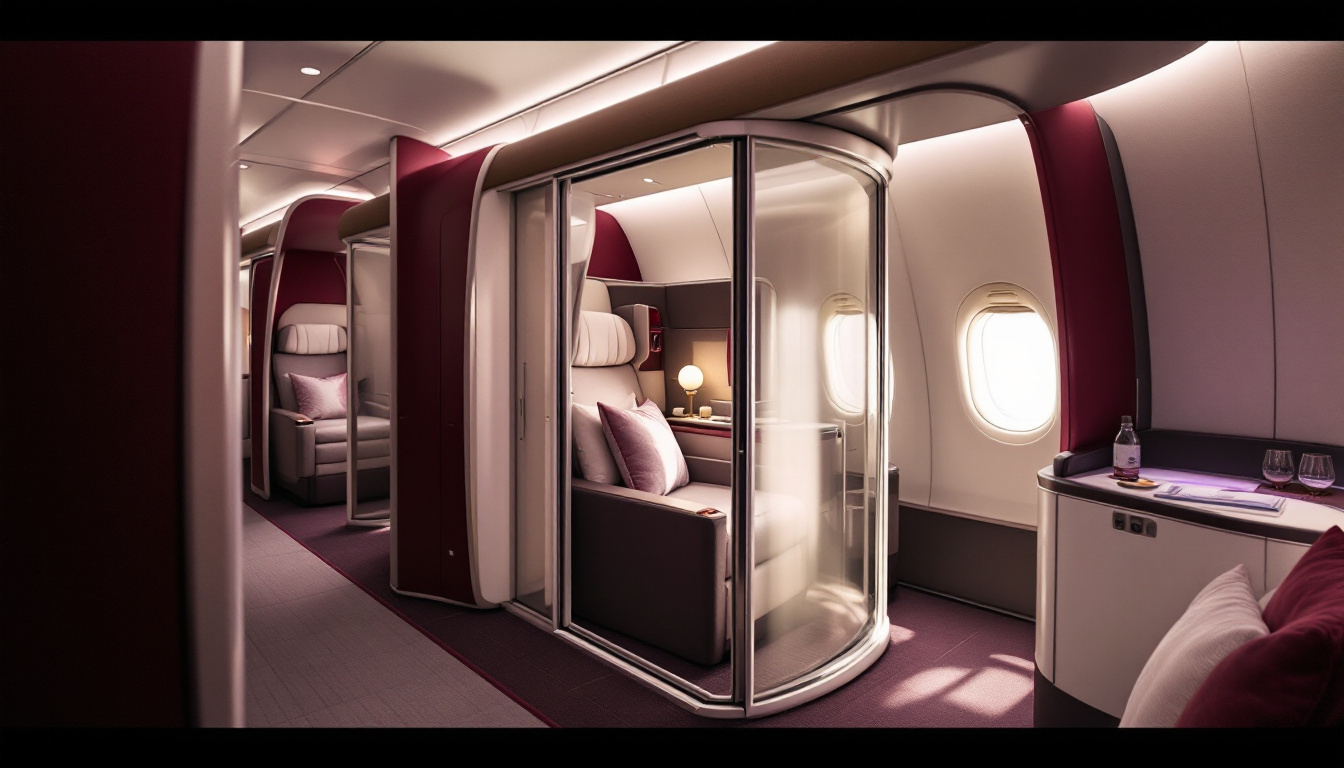
Qatar Airways’ next-generation Qsuite — the product that the carrier’s executives have spent eighteen months explaining is not, in marketing terms, called “Qsuite 2.0” but which everyone in the industry calls Qsuite 2.0 anyway — entered scheduled U.S. service on 1 March 2026 with a JFK-DOH rotation on aircraft A7-BAC. Six weeks later, the product is on at least one daily rotation from every U.S. gateway Qatar serves with the 777-300ER, and the carrier has committed to converting the remaining legacy-Qsuite rotations by 30 June 2026.
For corporate travel managers, frequent flyers banking American AAdvantage and Alaska Mileage Plan miles, and the executive-travel desks at the financial-services and energy clients who account for the bulk of premium Qatar bookings from the United States, the practical questions are the familiar ones at every fleet refresh: which routes, which aircraft, what changed, what did not change, and what does it mean for the redemption and contract-fare landscape over the rest of the year. This briefing addresses each in turn, and closes with notes on the ground product at Doha — which has changed materially in the same window — and the looming Privilege Club Qrewards revisions taking effect on 1 July.
What is flying where
As of 10 April 2026, Qatar Airways operates daily 777-300ER service to eight U.S. cities: New York JFK, Chicago O’Hare, Washington Dulles, Los Angeles, Dallas/Fort Worth, Houston Intercontinental, Seattle, and Boston. JFK, IAD, ORD, and LAX are each served by two daily rotations; DFW, IAH, SEA, and BOS by one. The Philadelphia route, which Qatar suspended in 2020 and has been the subject of intermittent reinstatement rumors, remains off the schedule and is not expected to return in 2026; Atlanta, San Francisco, and Miami remain unserved by Qatar metal, though the carrier sells codeshare inventory on American Airlines into all three from a number of European and Middle Eastern origins.
The Qsuite 2.0 deployment, route by route:
- JFK-DOH (QR702/QR701 and QR704/QR703): Both daily rotations have been operating with Qsuite 2.0 aircraft since 22 March 2026. JFK was the carrier’s chosen launch market in part because the rotation pattern allowed for an early-quarter aircraft swap-in without disturbing the West Coast trans-Pacific connections via Doha.
- ORD-DOH (QR726/QR725 and QR728/QR727): Both daily rotations on Qsuite 2.0 since 1 April. The QR725 inbound arrives at ORD in the early afternoon and turns as QR726, a pattern that has historically made Chicago the smoothest U.S. station for Qatar’s operations team.
- IAD-DOH (QR708/QR707 and QR710/QR709): Both daily rotations from 5 April. Dulles was prioritized because of the carrier’s significant U.S. government-contract corporate book and the volume of onward connecting traffic via Doha into the Indian subcontinent.
- LAX-DOH (QR740/QR739 and QR742/QR741): Both daily rotations from 8 April. LAX is Qatar’s longest U.S. sector at 8,300 nautical miles, and the carrier has positioned Qsuite 2.0 here aggressively because the competitive premium-cabin market between Southern California and the Gulf has tightened considerably with the arrival of Emirates’ A350 product on a second daily LAX-DXB rotation in late 2025.
- DFW-DOH (QR730/QR729): One daily Qsuite 2.0 rotation, evening departure ex-DFW. The second daily rotation (QR732/QR731, daytime departure) continues on the legacy Qsuite through 30 June.
- IAH-DOH (QR714/QR713): Single daily rotation, Qsuite 2.0 since 1 April. Houston has only one daily rotation; there is no legacy-Qsuite fallback here.
- SEA-DOH (QR734/QR733): Single daily rotation, Qsuite 2.0 since 5 April. Seattle had been a 787-9 route during the 2020-2022 period and only returned to 777-300ER service in 2024, which made it operationally simple to swap to Qsuite 2.0-equipped frames.
- BOS-DOH (QR744/QR743): Single daily rotation, Qsuite 2.0 since 8 April. Boston was a late addition to Qatar’s U.S. map (the route launched in mid-2024) and is also straightforwardly served by Qsuite 2.0 aircraft as the rotation cycles.
Qatar has not published an aircraft-level schedule and its position, like Delta’s and Emirates’, is that subfleet allocation is operationally determined and customers should not select flights on the basis of expected cabin variant. In practice, the carrier’s reservations system does display the new product at the time of booking on routes where it has committed Qsuite 2.0 to a specific rotation; the booking engine flags this as “Qsuite — refreshed cabin” without using the 2.0 label.
The remaining legacy-Qsuite operations — DFW QR732/QR731 daytime, the daytime DFW second daily, and the BOS and SEA daytime turnarounds where applicable — are the rotations Qatar has committed to converting by 30 June 2026. Beyond that date, every U.S.-Doha flight should be flying with Qsuite 2.0. The carrier’s published 777-300ER fleet count for the long-haul network is 39 frames; as of mid-April approximately 26 of those have been retrofitted, with the balance scheduled to complete by year-end.
The hard product, in detail
The defining design decision in Qsuite 2.0 is what was kept rather than what was added. When Qatar began the redesign in 2023, internal product-strategy memos circulated through the design-and-engineering organization argued strongly for dropping the quad “Q-Suite” configuration — the center pair of rows in which four passengers can fold down partitions and a shared center panel to create a working or dining area for four — in favor of pure 1-2-1 density with full doors on every seat. The argument was that the Q-Suite configuration is rarely used in actual revenue service, that it consumes cabin volume that could otherwise host more seats or wider seats, and that competing carriers (American, BA, JAL, Cathay) had largely moved past the conceit.
The argument lost. Akbar Al Baker’s successor as Chief Executive, Badr Mohammed Al-Meer, who took the role in late 2023, made the call personally in mid-2024 to retain the quad configuration on the grounds that it remained a marketable differentiator and that the political optics of “Qatar abandons its signature product feature” were unacceptable in a year when the carrier was simultaneously navigating the Boeing 777X delivery delays and the public dispute over the freighter conversion program. The decision was reinforced by an internal study from the carrier’s revenue-management team, which found that while only about 4% of all business-class passenger-flights actually use the partition-down configuration, those passengers skew heavily toward the carrier’s top corporate-contract customers — meaning the feature has a marketing and account-management value disproportionate to its in-flight usage rate.
Qsuite 2.0 therefore retains:
- The quad configuration in rows 4 and 5 (center pair), with the same fold-down partitions and shared center panel as the original Qsuite. The mechanism has been simplified and now operates via a single lever rather than the two-step procedure on the original; cabin crew can engage and disengage the quad configuration in roughly 30 seconds, down from the 90-plus seconds the original required.
- The double-bed configuration in the center pair, in which two adjacent center seats convert to a flat surface roughly the dimensions of a queen-size mattress. The bedding kit has been updated with a quilted topper and Qatar’s new private-label sleep pillows.
- The 1-2-1 layout with all-aisle access, the carrier’s signature differentiator at the time of the original Qsuite launch in 2017 and now table stakes in the long-haul business-class market.
- The 42-suite cabin count per 777-300ER — unchanged.
What is new:
- Full-height sliding doors that close flush to the ceiling rather than terminating at roughly 56 inches as the original Qsuite doors did. This brings Qsuite 2.0 into alignment with British Airways Club Suite, ANA’s “The Room,” and the JAL A350-1000 Suite on the question of whether a passenger seated in the cabin can see over the door into adjacent suites — they cannot.
- A 24-inch 4K OLED display, up from the original 21.5-inch panel. Qatar has confirmed that the supplier is the same Korean manufacturer that produces in-flight displays for Korean Air’s A350-1000 program and Delta’s refreshed A350 Suite.
- Wireless charging surfaces at the seat-side console supporting Qi 2.0. Wired USB-C, USB-A, and the legacy international AC power outlet remain at the existing positions.
- Bluetooth 5.3 audio pairing for the in-flight entertainment system, allowing passengers to use their own headphones without the wired adapter that had become a recurring complaint on the original Qsuite. The supplied Bang & Olufsen Beoplay headphones have been refreshed to the current consumer-retail model.
- A redesigned, deeper footwell that adds approximately three inches of usable length in flat-bed mode. The original Qsuite’s footwell had been a known compromise — particularly for passengers over six feet tall — and the redesign closes most of the gap with the Q-Suite’s first-class-equivalent competitors.
- A retractable privacy partition between the center pair that now fully recedes into the divider rather than partially stowing into the seat shell. This is mostly an aesthetic and cleanliness improvement; the original mechanism had been a recurring service-and-cleaning headache.
- Revised cabin lighting with a dawn-simulation program tuned by the carrier’s fatigue-science working group. The eastbound transatlantic dawn sequence runs approximately 90 minutes, up from 45 on the original Qsuite.
- New seat upholstery and finishes in a darker palette that Qatar’s design team described in its launch materials as “more residential, less corporate.”
What has not changed beyond the items listed above: the storage volume per suite, which remains adequate but unspectacular and is now visibly smaller than the Lufthansa Allegris Business Suite that entered service in late 2024; the absence of a dedicated coat closet at the seat (the cabin has shared closets at door positions, as the original did); and the buddy-dining geometry, which is identical to the original.
A point on which corporate buyers have asked for clarity: Qsuite 2.0 is being installed only on the 777-300ER fleet. Qatar’s A350-1000 fleet — which operates predominantly to European, African, and Asian destinations and is the fleet most affected by the protracted surface-degradation dispute with Airbus that has now been substantially resolved — continues to use a Qsuite variant that pre-dates the 2026 refresh. The A350-1000 cabin is similar in geometry but does not have the full-height doors, the new footwell, or the larger display. Qatar has said an A350-1000 refresh program is “under evaluation” but has not committed to a timeline; the carrier’s published guidance is that any A350-1000 cabin investment decision will be made after the Boeing 777X delivery schedule is clarified, which is now expected in Q3 2026.
The 787-9 fleet, which Qatar uses for some U.S. routes during off-peak windows and on a handful of secondary European and African routes, uses a 1-2-1 reverse-herringbone business cabin without the Qsuite quad geometry. It is not being refreshed in this round.
On-board service: what changed in March 2026
The hard-product refresh has been paired with a Q2 2026 refresh of the Qsuite on-board service program — modest in scope, but worth noting because the soft product is where Qatar has typically maintained its edge over the major U.S. and European carriers.
The most visible change is the introduction of a four-course chef-curated menu on flights over twelve hours, replacing the previous three-course-plus-light-meal structure. The new menu is built around rotating partnerships with chefs from the carrier’s home Middle East market and from the destination market. For the U.S. network in Q2 2026, the partnership chefs are Chef Tala Bashmi (of Bahrain’s Fusions restaurant), who is responsible for the Middle-Eastern-leaning rotation; and Chef Gabriela Cámara, who has built the U.S.-departure menus around her California-Mexican cuisine. The rotation changes in July.
Pre-departure beverages now include a non-alcoholic Seedlip option (matching the move that most U.S. and European carriers have made over the past two years), and a refreshed Champagne list that, as of 1 March 2026, includes Krug Grande Cuvée 172e Édition as the standard pour in Qsuite, up from Lanson Black Label on the original Qsuite service. The Krug pour is significant in the competitive context: only Singapore Airlines (in first), Emirates (in first), and Lufthansa (in first on Allegris) currently pour Krug, and Qatar is the only carrier pouring it in business class.
The dine-on-demand service that Qatar has operated on Qsuite since the cabin’s debut continues unchanged, as does the carrier’s signature à la carte structure that allows passengers to order from a single menu at any point in the flight rather than being constrained to scheduled service rounds. The bedding kit is now from The White Company, replacing the Bric’s package that ran from 2021; the amenity kit, for both men and women, is from the British design house Globe-Trotter and includes Diptyque skincare. The pyjamas remain from The White Company.
Wi-Fi service is now complimentary for all Qsuite passengers on all flights (not just Privilege Club Platinum and oneworld Emerald, as had been the case under the previous policy). The change took effect on 15 March 2026 and applies to all Qsuite-equipped aircraft regardless of cabin generation. Speeds on the SES-provided Ku-band network have been adequate but not exceptional; Qatar’s planned migration to Starlink-style LEO connectivity remains scheduled for a Q4 2026 rollout on a pilot fleet of six 777-300ERs.
Oneworld partner reciprocity: the redemption landscape in 2026
The most asked-about element of the Qsuite 2.0 rollout, in the inbox of this publication, has been whether the new product is bookable using oneworld partner miles at the same rates as the legacy Qsuite. The answer is yes, with caveats about award availability rather than pricing.
The relevant programs and rates, as of 10 April 2026:
- American AAdvantage prices a one-way U.S.-to-Doha business-class award at 70,000 miles in off-peak and 85,000 miles in peak — unchanged from 2025. AAdvantage’s web award search displays Qatar business inventory under the standard partner pricing, and bookings can be made online for cash co-pay scenarios; phone agents remain required for some constructed itineraries. AAdvantage has continued to bucket all Qsuite seats (original and 2.0) in the same inventory class.
- British Airways Executive Club Avios remains on the distance-based partner chart: 100,750 Avios from JFK/BOS/IAD one-way in peak, 80,750 in off-peak; 120,750 from LAX/SEA peak and 100,750 off-peak. The well-known Qatar fuel surcharges — which BA passes through to its members on partner awards in a way that AAdvantage does not — remain in effect and add approximately $560-$720 one-way in cash co-pay depending on the routing.
- Alaska Mileage Plan prices a one-way U.S.-to-Qatar-served business-class award at 85,000 miles, including the carrier’s continuing service beyond Doha to onward destinations in Africa, the Indian subcontinent, and the Maldives. This remains one of the strongest mileage values in the loyalty-program ecosystem for transatlantic-or-better premium-cabin redemption.
- Cathay Pacific Asia Miles, JAL Mileage Bank, Iberia Plus, Royal Jordanian Royal Plus, and Royal Air Maroc Safar Flyer all price Qatar business awards on their respective partner charts at rates unchanged from 2025. The most generous of these in absolute mileage terms remains JAL Mileage Bank at 80,000 miles one-way North America-to-Middle East in business; the most punitive is Iberia Plus, which has been steadily devaluing its Qatar partner pricing through the back half of 2025.
A note on award availability: in the first six weeks of the Qsuite 2.0 rollout, partner-bookable saver award space on the new product has been visibly tighter than on the legacy Qsuite. This is a familiar dynamic during cabin transitions — carriers tend to protect new-product inventory for revenue passengers in the first quarter of service — and Qatar has not commented publicly. The carrier’s revenue-management team has, however, told U.S. corporate-contract account managers that saver-bucket release will return to historical norms from 1 July 2026, the same date as the broader Qrewards reset described below.
For contracted corporate buyers: Qatar’s U.S. corporate-discount programs price Qsuite 2.0 at the same fare-class tier as the legacy Qsuite, with the carrier’s standard suite of upgrade, change-fee waiver, and lounge-access provisions intact. The published business-class fare floors on the JFK-DOH and IAD-DOH routes have risen approximately 6-8% versus April 2025 — broadly in line with the long-haul business-class market — but this is not specifically a Qsuite 2.0 effect.
For comparison-shopping corporate buyers weighing Qatar against the competing U.S. transatlantic-or-Gulf options, this publication has separately briefed the United Polaris 2.0 cabin, the Delta One Suite A350 refresh, and the American Flagship Suite on the 777-300ER. All three are commercially in the same window as the Qsuite 2.0 rollout, and corporate buyers negotiating 2027 contracts now have an unusually rich landscape of refreshed long-haul business products to play against one another in their commercial discussions.
Privilege Club Qrewards: the 1 July 2026 changes
Qatar Airways announced in November 2025 that its Privilege Club loyalty program would undergo a structural overhaul to the Qrewards earning and redemption mechanics, with most changes taking effect on 1 July 2026. The interim period — the seven months between announcement and effective date — was unusually long for a loyalty-program change, and reflected what the carrier described in its launch communication as a deliberate decision to give corporate-contract customers and frequent flyers time to adjust planning. The changes, as confirmed in a follow-up communication to Privilege Club members in February 2026, are:
Revenue-ticket Qpoints earnings move to dynamic pricing. From 1 July 2026, members earn Qpoints based on a U.S.-dollar-equivalent fare paid, rather than the current distance-and-fare-class table. The base rate for Qsuite revenue tickets will be 12 Qpoints per dollar; for premium-economy 8 per dollar; for economy 5 per dollar. Status-tier multipliers (1.25x for Burgundy, 1.5x for Silver, 2x for Gold, 2.5x for Platinum) apply on top of the base rate. This is the same structural model that American, Delta, United, and British Airways have already moved to, and reflects what is now industry-standard practice in the U.S. and European loyalty space.
For corporate-contract travelers on negotiated fares, the dynamic model is generally favorable: a Qsuite fare of $6,500 round-trip JFK-DOH-JFK will earn approximately 78,000 base Qpoints on the new model versus roughly 32,000 on the current distance-table system. For passengers who buy heavily discounted business-class tickets through consolidator channels, the new model will be less favorable.
Qcredits become earnable on partner-flown segments. Qcredits — Privilege Club’s soft-currency used for cabin upgrades — have historically been earnable only on Qatar-marketed and Qatar-operated flights. From 1 July, members will be able to earn Qcredits on flights operated by American Airlines, British Airways, Iberia, JAL, and Cathay Pacific (whether ticketed on QR codeshare or directly on the operating carrier), at a rate of one Qcredit per 1,000 status miles earned. This is a meaningful expansion for U.S.-based members who fly American or BA frequently on domestic or intra-European segments and want to bank upgrade currency for long-haul Qsuite redemptions.
Fixed-rate Qmiles award redemptions are not changing on 1 July. The published Qmiles redemption chart, which prices a one-way North America-to-Doha business award at 90,000 Qmiles in saver and 130,000 in standard, remains in effect through at least Q4 2026. Qatar has said separately that the chart will be “reviewed” in Q4 2026; corporate-buyer interpretations of this language vary, but the working assumption among the loyalty-program community is that some form of dynamic-or-hybrid award pricing is being considered for 2027.
Status qualification on Tier Qpoints continues unchanged. The four-tier Privilege Club structure — Burgundy, Silver, Gold, Platinum — and the Tier Qpoints qualification thresholds for each tier are not changing on 1 July. The 12-month and 4-year qualification windows that Qatar introduced in 2024 also remain in effect.
For Platinum members and oneworld Emerald-qualified Privilege Club members, the practical Q3 2026 picture is favorable: dynamic earning helps high-fare passengers (which Platinums disproportionately are), the new Qcredits earning on partners helps members with diversified flying patterns, and the unchanged award chart preserves the existing redemption value through at least the back half of the year. For lower-tier members buying heavily discounted fares, the picture is more mixed.
Ground product: Al Mourjan Business Lounge DOH after the 2026 refurbishment
Doha’s Hamad International Airport has been a defining piece of the Qatar Airways premium experience since the airport opened in 2014, and Al Mourjan Business Lounge has been the centerpiece of the connecting-passenger experience for nearly a decade. The lounge’s north wing closed in November 2025 for a four-month refurbishment and reopened on 15 March 2026 — the same window in which Qsuite 2.0 was rolling out onto the U.S. network, by design.
The refurbished north wing now includes:
- A dedicated transfer-passenger fast-track, which separates connecting traffic from terminating traffic in a way the original layout did not. Connecting passengers — the bulk of Qatar’s premium-cabin traffic at Doha — now enter through a dedicated security and immigration channel that bypasses the main lounge entrance entirely.
- The Garden, a new à la carte dining room, replacing the previous buffet-and-station hybrid in the north wing. The Garden seats approximately 110 and operates a menu designed by the Australian chef Tom Walton, refreshed quarterly. The previous buffet-and-station setup remains operational in the south wing, which works for passengers with shorter connection windows.
- Expanded shower-suite capacity, from 14 suites to 22. Shower waits, which had become a chronic complaint at peak windows (broadly, the 04:00-08:00 connection peak from Asia-to-Europe traffic), have not yet been benchmarked in the post-refurbishment period but Qatar’s operational data through the first three weeks of full operation indicates that wait times during the peak window have fallen from an average 25 minutes pre-refurbishment to approximately 8 minutes post.
- A quiet-zone library, with 38 reclining seats in a no-mobile-phone, no-conversation environment that is the lounge’s first dedicated quiet space. The library is a direct response to passenger feedback that the lounge, while large, had no genuinely quiet area for sleep or focused work; the new space addresses this gap.
- A refreshed business-services center with eight private meeting pods (bookable in 30-minute increments via the Qatar Airways app from 1 May 2026) and a redesigned print/scan/copy area.
- A spa, operated under the Six Senses brand, offering complimentary 15-minute treatments (neck-and-shoulder, scalp, foot reflexology) for all business-class passengers; longer paid treatments are available by appointment.
The south wing, which had operated at reduced capacity through the works, returned to full service on 15 March. Total simultaneous business-class lounge capacity at DOH is now approximately 1,800 guests, up from 1,500 before the refurbishment. The Al Mourjan Garden Lounge — the smaller secondary lounge that opened in 2022 and that had served as overflow during the north-wing closure — remains operational and is now used primarily for first-class connecting passengers during peak windows. Al Safwa First Lounge, Qatar’s first-class lounge, was not part of the 2025-2026 refurbishment program and continues to operate as before.
For corporate travel managers building Doha-connection itineraries for their executives, the most consequential change is the transfer-passenger fast-track: a connecting passenger arriving from JFK on QR701 at 17:35 and departing on QR906 to Singapore at 19:55 — a tight but routine connection — can now reach the lounge in under twelve minutes from arrival gate, versus the 25-30 minutes that the previous routing required. For shorter connections this is the difference between making the lounge at all and going straight to the departure gate.
What it means for corporate buyers and 2027 contracts
Putting the four pieces of the Q2 2026 picture together — Qsuite 2.0 on the U.S. network, oneworld redemption rates unchanged, the 1 July Qrewards mechanics shift, and the Al Mourjan refurbishment — Qatar’s posture for the rest of 2026 looks straightforwardly aggressive in the U.S. corporate-contract market. The carrier is investing in the hard product, holding redemption pricing where partner-program loyalists already value it, expanding Qcredits earning in a way that broadens the gravitational pull of the Privilege Club program, and materially improving the ground experience at the connecting hub that defines the Qatar long-haul proposition.
For travel managers in the active negotiation window for 2027 contracts — broadly, the May-through-August window for Q1 2027 renewals — the practical implications are three:
First, Qatar has substantially closed the hard-product gap with the best of its direct competitors. The argument that “Qsuite is the best business-class seat in the air” had become harder to defend in 2024 and 2025 as ANA, JAL, Lufthansa, and the refreshed BA Club Suite all caught up or pulled ahead on specific dimensions. Qsuite 2.0 reasserts the case at least on the U.S. transatlantic-via-Gulf and U.S.-via-Gulf-to-South Asia rotations where Qatar’s network structurally advantages it.
Second, the dynamic-earning Qrewards model converges Qatar’s loyalty mechanics with the U.S. industry norm, which makes apples-to-apples comparison with competing programs (American, Delta, United, British Airways) easier in side-by-side procurement evaluations. This is a small but real procurement-process simplification.
Third, the Al Mourjan refurbishment and the fast-track in particular meaningfully improves the connecting experience that has historically been the friction point in routing corporate traffic via Doha. For corporate clients with significant intra-Asia or sub-Saharan Africa volume connecting via the Gulf, the marginal case for Qatar over Emirates or Etihad has tightened.
None of these is decisive in isolation; in combination they form a coherent commercial posture for a carrier that, twelve months ago, was navigating the simultaneous distractions of the Boeing 777X delay, the Airbus A350-1000 surface dispute, and the change-of-CEO transition. With those distractions substantially behind it, Qatar in mid-2026 is back to competing on the things that travel managers and frequent flyers actually buy: a refreshed cabin, a stable redemption framework, a clearer loyalty program, and a better hub experience.
The next inflection point on the carrier’s calendar is the Q4 2026 Qmiles award-chart review and the expected mid-2027 entry-into-service of the first Boeing 777-9, both of which will be the subject of subsequent briefings. For now, on the U.S. network in Q2 2026, the picture is unusually clear: every Qatar Airways business-class passenger boarding a 777-300ER at JFK, ORD, IAD, or LAX is flying in the new product, and by the end of the quarter the same will be true at DFW, IAH, SEA, and BOS.