
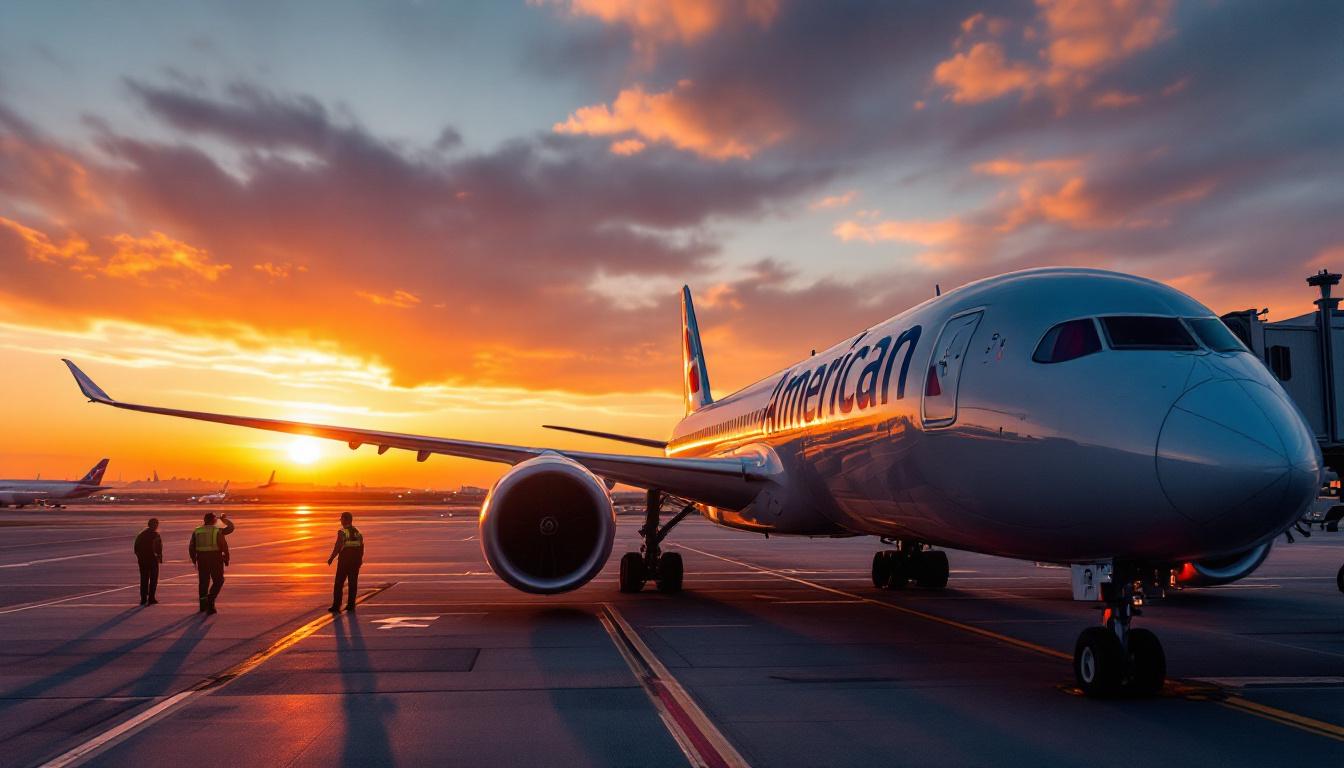
American Airlines confirmed on 24 March 2026 what had been heavily reported through February: the carrier will inaugurate daily nonstop service between New York JFK and Bengaluru’s Kempegowda International Airport (BLR) on 28 October 2026, using a 787-9 in a 234-seat Flagship Business configuration. It is the first U.S. carrier nonstop to South India, the longest 787-9 sector American operates, and — for the corporate-travel desks that handle the bulk of trans-Pacific and trans-Atlantic India traffic — the most consequential schedule announcement of the spring.
The route fills the most obvious gap in American’s South Asia map. Since the carrier suspended JFK-Delhi in March 2020 and never reinstated it, American has had no nonstop service to India of any kind, ceding the U.S.-India premium market to United (which flies EWR-DEL and EWR-BOM), Air India (which has rebuilt to nine U.S. nonstops since the Tata takeover), and the Gulf big three. Bangalore — not Delhi or Mumbai — is the surprise pick, and it reflects a deliberate corporate-travel bet that the city’s IT and biotech engineering economy will sustain a daily widebody where Delhi-government and Mumbai-finance demand has been adequately served by competitors.
This briefing covers the schedule, hard product, competitive positioning against United’s EWR-DEL and Air India’s BOM-JFK, the corporate-program implications, and the open operational questions that will determine whether the route survives its first winter.
The Schedule
AA292 departs JFK at 7:45 p.m. and arrives BLR at 11:15 p.m. local time the following day. AA293 departs BLR at 1:35 a.m. and arrives JFK at 6:05 a.m. local time the same day. Eastbound block time is 16 hours 30 minutes; westbound is 17 hours 30 minutes, with the difference largely a function of the jet-stream calculus over the North Atlantic and Black Sea. Both directions are scheduled daily year-round, with the option — quietly noted in American’s slot filing — to drop to five-weekly during the monsoon trough in July and August if loads warrant.
The eastbound timing is unusual for a JFK long-haul. Most JFK-India and JFK-Gulf operations depart between 9:00 p.m. and 11:30 p.m. to land at destination in the morning. American’s 7:45 p.m. departure is engineered around two constraints: the BLR runway curfew (the airport has no formal ban but operations between 11:00 p.m. and 6:00 a.m. carry a noise surcharge that biases carriers toward the late-evening window), and the desire to feed the 11:15 p.m. arrival into next-day morning IndiGo and Vistara departures to Hyderabad, Chennai, Kochi, and Trivandrum.
The westbound 1:35 a.m. departure is conventional for India-U.S. flying and produces a 6:05 a.m. JFK arrival that connects cleanly to American’s domestic morning bank out of Terminal 8 — Boston, Chicago, Dallas-Fort Worth, Miami, Los Angeles, and San Francisco are all reachable on a same-day onward ticket. That morning-bank feed is, in fact, the principal commercial argument for the route. Bangalore-Boston, Bangalore-Raleigh, and Bangalore-San Jose are the three highest-volume city pairs in the U.S.-South India market by corporate-booking volume, and none of them previously had a JFK option with sub-three-hour connection times.
The Aircraft and the Cabin
American is operating the route with a 787-9 in its newest 234-seat configuration. The aircraft is drawn from the sub-fleet that previously flew JFK-Delhi and currently flies JFK-Athens, JFK-Madrid, and DFW-Tokyo Haneda. The configuration is:
- 30 Flagship Business suites in 1-2-1
- 21 Premium Economy seats in 2-3-2
- 36 Main Cabin Extra seats in 3-3-3
- 147 Main Cabin seats in 3-3-3
The Flagship Business product is the Adient Ascent suite, which American began retrofitting onto its 787-9 fleet in late 2024 and which is now standard on all newly delivered or refurbished long-haul widebodies. The suite has full-height sliding doors, an 80-inch flat bed, a 17.3-inch 4K screen, wireless charging, and Bluetooth audio pairing. Throw pillows and bedding are by Saks Fifth Avenue. Dining is à la carte on demand. The product is competitive with — though, in seasoned hands, slightly behind — Qatar Airways’ Qsuite and Air India’s new A350 J product, both of which are direct competitors on the U.S.-India routing.
There is no First Class. American has not operated an international First Class cabin since 2018, when it removed the eight-seat First product from its 777-300ERs. Buyers who require a true First Class for executive travel into Bangalore will continue to route on Singapore Airlines, Emirates, or Lufthansa via their respective hubs.
Premium Economy on the route uses the 2-3-2 Recaro PL3530 seat. It is — straightforwardly — the best premium economy product currently flying to India from the U.S. East Coast. United’s EWR-DEL operates a 2-4-2 premium economy on the 777-300ER, which is a meaningfully worse product. Air India’s BOM-JFK premium economy on the 777 is closer in quality but operates with a less consistent crew product.
The 787-9 cabin features include the higher humidity and lower cabin altitude that have become standard arguments for the type on long-haul flying. For a 16-to-17-hour sector, this matters more than the seat itself.
The Bangalore End: Why It Is Not Delhi or Mumbai
The choice of Bangalore over Delhi or a second Mumbai is the most analytically interesting decision in the announcement. American has the slots for either DEL or BOM at JFK and could have reinstated DEL with relatively little operational disruption. It did not. The reasoning, as articulated by American’s network planning team during the 24 March briefing and as supported by the data, comes down to four factors.
First, the corporate demand mix. Bangalore is the engineering and software hub for roughly 70% of the Fortune 500’s Indian operations, and the U.S.-Bangalore corporate-travel market has been the fastest-growing India sub-market for six consecutive years. Corporate travel into Bangalore is heavily weighted toward business class and premium economy — yield-rich traffic that justifies a widebody operation.
Second, competitive whitespace. Air India does not fly BLR-U.S. nonstop. United does not fly BLR-U.S. nonstop. No carrier flies BLR-U.S. nonstop. The closest competitor is Air India’s BLR-SFO, which operates daily on the 777-200LR but serves a different demand pool (the West Coast tech corridor) and is consistently overbooked in both directions. American’s JFK service captures the East Coast and the Midwest connecting traffic with no overlap.
Third, oneworld weakness in India. The alliance has been thinly served in India since Jet Airways collapsed in 2019, and there has been ongoing strategic concern that the Tata-led consolidation of Air India, Vistara, and AIX would lock the alliance out of meaningful India presence entirely. (Vistara was Star Alliance-aligned through its codeshare with United and Singapore Airlines; Air India has been SkyTeam-bound since November 2025.) Bangalore is the largest Indian metro where oneworld can plausibly establish a flagship operation without going head-to-head with a Star or SkyTeam fortress hub.
Fourth — and this is the operational point that buyers should weigh carefully — Bangalore is the easier widebody operation. BLR’s new Terminal 2 has wide-body-capable gates, modern customs and immigration, a dedicated business-class lane, and no significant slot constraint. Delhi’s IGI is slot-constrained at the peak hours that work for U.S. East Coast scheduling. Mumbai’s BOM is operationally chaotic and runway-constrained. Bangalore is, frankly, the airport American would design if it could.
The Feed: IndiGo, Vistara, and Qatar Airways
Bangalore’s domestic and short-haul market is dominated by IndiGo, which holds approximately 58% of domestic capacity at BLR, followed by Air India (now including the merged Vistara network) at roughly 24%, and a long tail of low-cost carriers. None of these are oneworld members. This is the central commercial challenge of the route.
American’s solution is a layered one. The carrier will operate an interline agreement with IndiGo — not a codeshare — that allows through-checked baggage and single-ticket itineraries from JFK to roughly 30 Indian secondary cities via BLR. The interline does not provide elite-status reciprocity, lounge access, or guaranteed re-accommodation in irregular operations, which limits its corporate-program value. For full-service feed, American will rely on its existing codeshare with Qatar Airways, which operates four daily BLR-DOH frequencies and connects to QR’s full Indian sub-continental network at Doha. The Qatar codeshare gives oneworld a backstop feed without requiring AA metal beyond JFK.
For corporate programs that need a single-PNR, single-loyalty experience into Indian secondary cities, the practical reality is that BLR-Hyderabad, BLR-Chennai, BLR-Kochi, and BLR-Trivandrum will need to be ticketed on IndiGo or Air India locally. This is not a deal-breaker — most corporate India programs already accept this — but it is a material difference from the United-EWR-DEL experience, where Air India’s SkyTeam alignment now provides single-ticket reach to roughly 50 Indian cities under one airline code.
Versus United EWR-DEL
United’s Newark-Delhi service has been the default U.S.-India corporate option for the East Coast since 2005. It is now in its 21st year, operates on a 777-300ER with 60 Polaris suites, departs EWR at 8:35 p.m., and arrives DEL at 8:45 p.m. local time the following day. The route is a well-understood, predictable, operationally mature service.
American’s JFK-BLR competes against it on three dimensions and concedes on one.
It competes on geography. For Bangalore-bound traffic, BLR direct is uncompetitively superior. United’s EWR-DEL plus DEL-BLR domestic on Air India or IndiGo adds roughly 5 hours to the journey, requires a re-clear at DEL, and produces consistent next-day arrivals into BLR rather than same-day evening arrivals.
It competes on hard product. The Adient Ascent suite is, in 2026, a fresher and slightly more contemporary Business Class product than United’s Polaris on the 777-300ER. (United’s newer Polaris Studio suite on the 787-9 is the more direct hard-product comparison, but Polaris Studio is currently deployed on Pacific routes, not on EWR-DEL.) Premium Economy on the AA 787-9 in 2-3-2 is materially better than UA’s 2-4-2 on the 777-300ER.
It competes on the JFK domestic-connection bank. JFK Terminal 8 is now a fully integrated AA-BA-IB-Qantas oneworld facility with a strong domestic morning bank. EWR’s domestic connectivity for non-United-hub destinations is uneven.
Where American concedes is the network depth at the Indian end. United’s EWR-DEL plus the SkyTeam Air India feed offers reach into 50+ Indian cities under one ticket and one loyalty program. American’s BLR offering, at launch, will be a strong gateway for the southern half of India but will require interline ticketing for connecting traffic, which corporate-programs auditors will flag.
The likely market split: Bangalore demand will migrate sharply to AA. Delhi demand will stay on UA. Mumbai demand will stay split between UA’s EWR-BOM and Air India’s BOM-JFK. Hyderabad, Chennai, and Kerala-region demand will be the contested market — AA’s BLR feed plus IndiGo will compete against UA-DEL plus Air India for connecting traffic, and that competition will be decided on price, on schedule alignment with the morning IndiGo bank ex-BLR, and on the reliability of the AA-IndiGo interline through its first year.
Versus Air India BOM-JFK
Air India operates BOM-JFK daily on the 777-200LR, departing BOM at 1:30 a.m. and arriving JFK at 6:25 a.m. The carrier flies a refreshed J product on the A350-900 — though the BOM-JFK rotation has not yet received the A350 retrofit as of March 2026 — and prices aggressively against the U.S. legacy carriers.
Air India’s premium-cabin product is, in early 2026, in the middle of its most aggressive upgrade cycle since the Tata takeover. The new A350 J suite — by Stelia — is a strong product, with doors, direct-aisle access, and a 78-inch bed. Where Air India still concedes is in soft-product consistency: crew training, catering, and irregular-operations handling remain works in progress. For corporate buyers, the AI question is not whether the hard product is competitive — it now is — but whether the carrier can deliver the consistent on-time, well-catered, predictably-staffed operation that mature corporate programs require. Through 2025, AI’s on-time performance on its U.S. routes was 73%; American’s JFK long-haul OTP in the same window was 81%; United’s was 79%.
For Bangalore-bound traffic, Air India’s BOM-JFK is not a direct competitor. The connection through Mumbai adds 3-5 hours and requires a domestic transfer that — at BOM — is operationally unpredictable. The competitive set for AA’s JFK-BLR is the Gulf-carrier one-stops via DOH and DXB, not Air India.
Versus the Gulf Big Three
The dominant U.S.-Bangalore connections today are Emirates’ DXB hub, Qatar Airways’ DOH hub, and Etihad’s AUH hub. All three offer multiple daily JFK-Gulf and Gulf-BLR rotations, with Qatar Airways operating the most BLR frequencies (four daily) and Emirates operating the most premium-cabin capacity into BLR.
The Gulf carriers’ premium-cabin products — Qsuite on the QR 777, Emirates’ refreshed 777 J and A380 J, and Etihad’s Business Studio — are competitive with or, in the case of Qsuite, superior to American’s Adient Ascent. The one-stop nature of the Gulf routing adds 3-5 hours of total trip time but removes the operational stress of a 17-hour sector, which some travelers prefer.
American’s commercial argument against the Gulf alternatives is straightforward: time. A direct flight saves 4-6 hours in each direction, which compounds for short-stay business travel. For a three-day Bangalore engagement, AA’s JFK-BLR plus return is roughly 36 hours faster door-to-door than QR via DOH. That savings has measurable value at executive-time billing rates, and it is the basis on which corporate programs will be asked to mandate AA over the Gulf one-stops.
The argument has limits. For travelers on extended Bangalore stays, the time savings matter less. For travelers based outside the AA hub-and-spoke (Texas, the Midwest, the West Coast outside SFO and LAX), the Gulf carriers’ multi-gateway U.S. operations remain more convenient. The Gulf carriers will retain — and probably continue to grow — their share of the U.S.-Bangalore market. American’s realistic target is not displacement but capture of the East Coast corporate yield-rich traffic that has historically routed via Doha or Dubai only because no direct option existed.
Corporate-Program Implications
For corporate travel managers, the JFK-BLR launch is one of the most significant route additions of 2026 and should trigger a structured program review for any organization with material India travel demand.
The case for adding the route to mandated-carrier lists from launch:
- It is the only nonstop U.S.-Bangalore option from the East Coast and will remain so for the foreseeable future.
- It removes a 4-6 hour one-stop penalty from a high-value executive market.
- It is operated on a fresh hard product with a competitive Business and Premium Economy cabin.
- It opens up corporate-negotiated J fares in a market that has historically been dominated by Gulf-carrier published fares with limited corporate-discount transparency.
- For programs with existing American Airlines contracts, it is an easy add to existing route mandates rather than a new-carrier negotiation.
The case for piloting rather than mandating:
- This is American’s longest 787-9 sector. The aircraft can do it, but the operational margins are thinner than on shorter long-hauls, and irregular-operations recovery (mechanical, weather, crew) will be slower.
- BLR has weather risk in monsoon season (June-September) and winter-fog risk in December and January. The route’s first full operational year will not be tested against a complete weather cycle until October 2027.
- The oneworld feed at BLR is interline-only, which limits the irregular-operations protection for connecting passengers.
- AA’s published J fares at launch are pricing above UA-DEL by roughly $1,000, and it is unclear whether that premium will hold or compress over the first six months.
The recommendation for most corporate programs: add JFK-BLR to the approved-carrier list from launch, mandate it for Bangalore-direct travel beginning in November 2026, and defer mandating it for connecting travel into other South Indian cities until April 2027, when the AA-IndiGo interline has had six months of operational data.
Loyalty and Award-Availability Implications
For frequent-flyer-program members, JFK-BLR opens a new redemption option in a market where award space has historically been thin. American’s AAdvantage Business saver level on the route opens at 80,000 miles each way; the anytime level is 250,000 miles each way. Initial award-calendar surveys show stronger Business saver availability than is typical for new long-haul launches, which suggests American is using award space to seed demand and build loyalty in the East Coast Bangalore market.
For oneworld partners, the route is bookable through British Airways Executive Club at 100,000 Avios each way in Business (peak), Cathay’s Asia Miles at 110,000 miles each way, and Qatar Airways’ Privilege Club at 95,000 Avios each way. Qantas Frequent Flyer has not yet loaded the route as of 24 March but is expected to do so by July 2026.
For elite-status holders, the route will be eligible for AAdvantage Executive Platinum and Platinum Pro upgrades from Main Cabin Extra to Premium Economy, and from Premium Economy to Business, subject to standard upgrade-priority rules. Systemwide Upgrades will be valid on the route from launch.
Open Operational Questions
Several questions will not be answered until the route enters service.
The fuel-tankering economics on the westbound BLR-JFK leg are tight. The 787-9 has the range, but the typical winter westbound load — heavier with cargo, lighter on premium-cabin payload — will pressure margins. American’s network team has confirmed that the route is being underwritten with a cargo-revenue assumption in the 14-16% of total-route-revenue range, which is high for a passenger-led operation and will be sensitive to the global air-cargo market.
The crew-cycle implications of a 17-hour westbound sector require a four-pilot, four-flight-attendant relief crew on every rotation. American’s JFK-based long-haul crew pool is currently sized for the existing network; the BLR addition will require either net new hiring or reduced rotations on other long-hauls. The carrier has confirmed it expects to net-add 40 pilots and 110 flight attendants to JFK long-haul flying by Q4 2026 to support the route.
The slot situation at BLR is comfortable today but tightening. Bangalore’s annual passenger growth has averaged 12% for three consecutive years, and the airport’s third runway is not scheduled for completion until 2029. AA’s late-evening arrival slot is well-positioned to remain stable, but the westbound 1:35 a.m. departure slot will be re-evaluated in BLR’s 2027 slot allocation, and competing carrier requests could push it.
Monsoon-season reliability is the largest unknown. BLR’s monsoon — June through September — produces weather-related diversions on roughly 3-5% of widebody operations. Most carriers absorb that through schedule padding and alternate routing. American’s first monsoon on the route, June through September 2027, will be the meaningful test of operational reliability.
What Comes Next
The 28 October 2026 launch is the first phase of what American has signaled is a broader South Asia reentry. The carrier has not announced a second India route but has confirmed that it is “actively evaluating” options for a second daily, with Mumbai, Delhi, and Hyderabad named as the principal candidates. A second route would not be expected before mid-2027 at the earliest and is contingent on the JFK-BLR operational performance through its first six months.
The competitive response from United and Air India will be the proximate signal of how the market reads the launch. United has the EWR-BLR option in its slot portfolio but has not announced it; the carrier’s recent strategic statements have emphasized Pacific expansion over India additions. Air India’s BLR-U.S. options are limited by 777-200LR availability — the carrier operates the BLR-SFO daily and would require additional aircraft to add a BLR-East Coast service. Neither carrier is expected to respond before late 2026, which gives American a window of unopposed operation through at least the first quarter of 2027.
For now, the calendar is set: 28 October 2026, 7:45 p.m. JFK, 234 seats, daily. The corporate-travel desks have seven months to update their preferred-carrier lists, renegotiate their AA corporate contracts, and brief their travelers. The route is the most significant addition to the U.S.-India premium market since United launched EWR-BOM in 2019, and it will reshape East Coast Bangalore travel for the rest of the decade.