
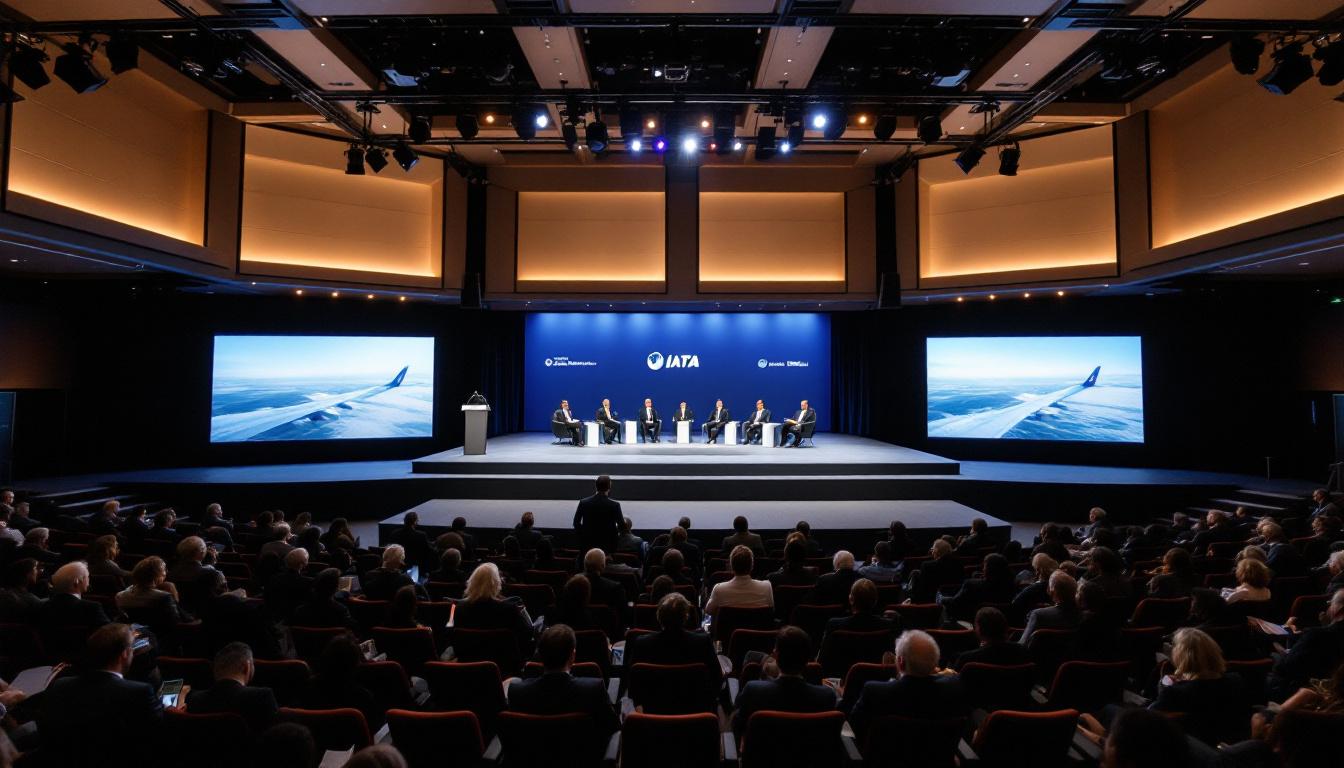
The aviation industry’s annual reckoning lands in New Delhi this June, and for the first time in more than four decades, the host city sits east of Dubai. The 82nd IATA Annual General Meeting and World Air Transport Summit convenes June 7-9, 2026 at the Bharat Mandapam convention complex, with Air India as host carrier and Campbell Wilson assuming the chair of IATA’s board of governors. The symbolism is heavy. The substance, for corporate travel buyers, is heavier.
This is the meeting where roughly 300 airline chief executives, regulators, and industry suppliers will spend three days arguing in public and bargaining in private about the questions that will define managed travel programs through 2027: how Sustainable Aviation Fuel gets accounted for on a corporate Scope 3 ledger, what New Distribution Capability looks like in its tenth year of deployment, how the post-commission distribution model evolves now that the largest TMCs have pivoted to fee-for-service, and whether the regulatory pile-up in Brussels, Westminster, and Washington will get the unified industry response that IATA’s secretariat has been promising since the Istanbul AGM.
For travel managers, the AGM is rarely the venue where the most consequential decisions get made. Those happen in the IATA Passenger Standards Conference, the World Financial Symposium, and the bilateral conversations between airline commercial chiefs and the largest TMC sourcing teams. But the AGM is where the industry tells the market what it has agreed to, and the resolutions passed on the floor at Bharat Mandapam will set the negotiating posture for every airline RFP cycle that opens between July 2026 and the Doha AGM in June 2027.
Here is what to watch.
The host city and the headline
India is not an accidental venue. The country crossed 175 million domestic passengers in 2025, overtook Japan as the world’s third-largest domestic aviation market by seat capacity, and now hosts two of the ten largest aircraft order books in commercial aviation history through Air India and IndiGo. Wilson’s chairmanship is a deliberate signal from the IATA board that the center of gravity in commercial aviation has shifted, and the secretariat wants to be seen acknowledging it before the European and North American carriers do.
That framing matters for what travel managers will hear from the stage. The keynote address from director general Willie Walsh is expected to lean heavily on three themes: capacity discipline as a profitability strategy, regulatory overreach in mature markets, and what Walsh has called “the unfinished business” of distribution modernization. Walsh has a long-standing habit of using the AGM keynote to set up confrontations that the secretariat then prosecutes over the following twelve months, and the 2026 edition is unlikely to break the pattern.
Expect specific call-outs on the EU’s revised passenger rights regulation, the UK’s Airport Slots Reform Bill, and the US Department of Transportation’s expanded ancillary fee disclosure rules. None of those file directly into a corporate travel manager’s daily workflow, but the airline response to each will reshape what content TMCs can access, how dynamic fares are presented to corporate bookers, and what compliance reporting becomes mandatory for managed programs operating across multiple jurisdictions.
Sustainable Aviation Fuel: from pledge to ledger
The single most consequential AGM agenda item for sustainability-focused travel programs is the formalization of IATA’s SAF Registry framework. The registry has been in technical development since the 2024 Dubai AGM and entered limited pilot in the second half of 2025 with roughly twenty airlines, six fuel producers, and a small group of corporate buyers including a handful of Fortune 100 names that have publicly disclosed SAF book-and-claim purchases.
What the AGM is expected to ratify is the production-side and claims-side ruleset that governs how a corporate buyer can attribute SAF environmental attributes to its own emissions reporting. The technical specifics are dense, but the practical question for travel managers reduces to three points.
What counts as a credible claim
The registry framework distinguishes between physical SAF uplift at the airline level, book-and-claim purchases where the corporate buyer pays for SAF that is consumed by an airline at a different airport, and bundled SAF certificates sold through aggregators. The AGM resolution is expected to endorse all three pathways but require chain-of-custody documentation that can survive scrutiny from the Greenhouse Gas Protocol Scope 3 guidance and, by extension, the assurance reviews that increasingly accompany corporate sustainability reports.
For travel managers who have purchased SAF through airline partnership programs over the past two years, the registry creates both an opportunity and a risk. The opportunity is that purchases made after the registry goes live will carry independently verified attribute claims that auditors and CDP reviewers are increasingly demanding. The risk is that pre-registry purchases may need to be re-documented or, in some cases, may not transfer cleanly into the new accounting standard.
The double-counting problem
The most contested technical question heading into the AGM is whether SAF purchased under government-mandated blending obligations, particularly the EU ReFuelEU Aviation regulation that took effect in January 2025, can also be claimed by voluntary corporate buyers. IATA’s working group position is that mandated SAF should be treated as the regulatory baseline and not available for voluntary claims, which aligns with how renewable electricity attribute markets handle compliance versus voluntary purchases.
European airlines have largely supported that position. A handful of Middle Eastern and Asian carriers have pushed back, arguing that the rule effectively penalizes corporate buyers whose travel patterns concentrate in regulated markets. The AGM resolution will need to land somewhere between those positions, and the language adopted on the floor will determine whether a US-based multinational with heavy European travel can continue to claim SAF reductions on flights touching EU airports.
What corporate buyers should ask in 2026 RFPs
Once the registry framework is ratified, every airline RFP issued in the second half of 2026 should include questions about registry participation, the airline’s expected SAF supply pipeline for 2027 and 2028, and the price points at which book-and-claim allocations will be made available to corporate customers. Programs that fail to ask those questions in upcoming sourcing cycles will be locked into terms that may not align with the disclosure standards their own sustainability teams are committing to.
NDC at year ten
New Distribution Capability is now more than a decade old as an IATA initiative, and the AGM is expected to mark a transition in how the program is described. The 2026 agenda includes a session titled “Retailing Maturity” that, on the surface, reads like a victory lap. The reality is more complicated.
NDC content now accounts for somewhere between forty and fifty-five percent of indirect channel bookings at the largest network carriers, depending on which metric is used and which markets are included. The major TMCs have functional NDC capability in their primary booking platforms, and the corporate booking tools that dominate the managed travel segment now display NDC offers alongside legacy GDS content with varying degrees of fidelity.
But the structural problems that travel managers have been complaining about since the program’s early years have not disappeared. Servicing parity remains the most persistent complaint. Exchanges, refunds, name corrections, and disruption management still work less reliably in NDC channels than in legacy fare environments, and the gap is widest in the precise scenarios where corporate travelers need fast resolution: schedule changes on multi-segment international itineraries and irregular operations on premium cabin bookings.
The AGM is expected to do three things on this file.
Endorse a servicing maturity benchmark
IATA’s Passenger Standards Conference has been developing a servicing maturity assessment that rates participating airlines on the completeness and reliability of NDC servicing capabilities. The AGM is expected to formally endorse the benchmark and commit the largest member carriers to publishing their scores annually. For corporate travel managers, this would provide the first standardized way to compare NDC servicing readiness across airlines during RFP evaluation, which has been an opaque exercise to date.
Address the aggregator question
The proliferation of NDC aggregators between the airlines and the TMCs has created a layered ecosystem where content quality, surcharge handling, and ancillary availability can vary depending on which aggregator a given TMC is using for a given airline. The AGM is expected to address aggregator certification standards, though the specific resolution language is still being negotiated, and several airlines have signaled they want to retain flexibility in how they partner with aggregators.
For managed programs, the aggregator question is functionally invisible until something goes wrong with a booking. A travel manager whose program relies on a TMC that uses Aggregator A for a given airline may be receiving materially different content than a peer program using Aggregator B for the same airline, even though both programs believe they have “full NDC content” from that carrier.
Confirm offer and order management timelines
The longer-term roadmap for IATA’s distribution program is the transition from Passenger Service System architecture to a true offer and order management environment, where airlines maintain a single source of truth for each customer interaction and external distribution partners consume rather than recreate that record. Most major carriers have been working on this transition for several years, with vastly different progress.
The AGM is expected to confirm a sector-wide target date for offer and order management capability, likely 2028 or 2029, and the resolution will probably commit the major carriers to interim milestones that travel managers can use to track which airlines are on schedule and which are slipping.
The post-commission distribution model
The most politically charged item on the agenda concerns the economics of distribution itself. The headline-grabbing version is “Are commissions coming back?” The honest answer is no, and the AGM will not pass a resolution that reinstates base commissions. But the underlying question of how the airlines compensate the intermediaries that move their content remains very much open.
The Passenger Agency Program, which governs the relationship between IATA member airlines and accredited travel agencies, is undergoing its most significant rewrite in roughly a decade. The proposed changes affect remittance cycles, financial security requirements, the role of NDC certification in agency accreditation, and the conditions under which an airline can withdraw participation from a specific market or channel.
For the TMCs that handle managed corporate travel, the agency program rewrite directly affects working capital requirements, the cost of capital required to maintain BSP participation across multiple markets, and the conditions under which a TMC can credibly offer “all content” servicing to its corporate clients. None of those mechanics are visible to a corporate travel manager in the normal course of program management, but they show up in TMC pricing, in the fee structures that get negotiated during TMC RFPs, and in the willingness of a given TMC to extend particular service levels in particular markets.
Watch the remittance debate
The most contentious sub-issue is whether IATA will move to a weekly or biweekly remittance cycle in markets that currently operate on a monthly or bi-monthly cadence. Airlines, particularly those with thinner margins or recent payment events involving agency failures, want faster remittance to reduce their working capital exposure to the indirect channel. TMCs and consolidators want to preserve the existing cadence because faster remittance compresses their own working capital and forces operating model changes.
The AGM resolution will probably split the difference, accelerating remittance in selected high-risk markets while preserving existing cadence elsewhere, but the precise language matters for any corporate program that relies on a TMC operating across multiple BSP regions.
Watch the certification language
The other key sub-issue is how NDC-related capabilities feature in agency accreditation. The strict version, which a minority of airlines support, would require accredited agencies to demonstrate NDC servicing capability for participating carriers. The softer version, which most airlines and all major TMC representatives support, treats NDC capability as a competitive differentiator rather than a baseline accreditation requirement. The resolution language will signal how aggressively IATA intends to use accreditation to drive distribution modernization.
Regulatory affairs: the unified industry response
If sustainability is the existential theme of the AGM and distribution is the operational theme, regulatory affairs is the political theme. IATA’s secretariat enters the 2026 AGM facing the largest pile-up of regulatory action across multiple jurisdictions in roughly fifteen years.
European Union
The revised Passenger Rights Regulation, which entered force in late 2025 after a multi-year legislative process, has expanded compensation obligations on intra-European flights and tightened the disruption notification timelines. Airlines argue the regulation imposes costs that cannot be recovered through fares in a competitive market. Consumer groups argue the regulation is overdue and does not go far enough on transparency.
The AGM will produce a coordinated airline position on what the secretariat will pursue in its judicial challenges to specific provisions of the regulation, particularly the provisions on extraordinary circumstances and the compensation thresholds for short-haul disruptions.
United Kingdom
The UK Airport Slots Reform Bill, which is making its way through Parliament with cross-party support, would replace the legacy use-it-or-lose-it framework with a market-based slot allocation system at Heathrow and Gatwick. The airlines holding incumbent slot portfolios are largely opposed. The airlines that have struggled to access those slots are largely supportive. IATA’s secretariat has tried to steer a middle path, advocating for transitional protections that preserve some incumbent slot value while opening capacity for new entrants over time.
The AGM resolution on slots reform will not change the bill’s trajectory in Parliament, but it will signal how IATA intends to position globally as similar slot reform debates emerge in other constrained markets, including potentially New York JFK, Tokyo Haneda, and Frankfurt.
United States
The Department of Transportation’s expanded ancillary fee disclosure rules, which finalized in late 2025 and phased into effect through the first half of 2026, require airlines to display total trip cost including specified ancillaries at the point where a fare is initially presented. The rules apply to direct channels and, importantly for travel managers, also impose obligations on agency channels that affect how corporate booking tools present airline content.
The AGM will not produce a frontal rejection of the DOT rules. The secretariat’s posture is that the rules can be lived with, but the implementation guidance has created technical ambiguity about exactly which ancillaries fall within scope and how the disclosed totals must be presented when the trip includes optional services that a given traveler may or may not select. The AGM is likely to produce a coordinated industry position on the implementation questions, which the major US carriers will then pursue through DOT engagement over the back half of 2026.
What travel managers should take from the regulatory thread
The regulatory pile-up matters for corporate travel programs in three concrete ways. First, the EU passenger rights regime is increasing the cost of intra-European disruption, which will show up in fare structures and in airline behavior around delay management. Second, the UK slots reform will eventually affect what carriers operate which slots at London airports, which over a multi-year horizon will reshape the competitive set on key transatlantic and European business routes. Third, the DOT ancillary disclosure rules are forcing changes to how content displays in corporate booking tools that managed programs use, and the implementation details affect what travel policy enforcement looks like in practice.
Participating CEOs and the political signal-reading
The AGM is also the year’s most concentrated gathering of airline chief executives, and the schedule of who attends, who speaks, and who skips sends political signals that get parsed across the industry.
The chair, Campbell Wilson, brings Air India’s transformation narrative to center stage. Wilson took over a state-owned carrier that was widely considered the weakest of the major Asian network airlines and has executed a fleet renewal, a brand consolidation that absorbed Vistara, and a service quality reset that has, by most measures, moved Air India from “avoid if possible” to “competitive option” on transcontinental business routes. The Air India narrative will feature heavily in the host carrier remarks and in the World Air Transport Summit panels.
Willie Walsh, in his director general role, will deliver the headline keynote and host the year-end financial outlook briefing that traditionally closes the second day. Walsh’s combative style with regulators and with the secretariat’s perceived adversaries has been consistent since he took the DG role, and the 2026 edition is unlikely to soften.
The chief executives expected on the main stage panels include Tim Clark or his successor at Emirates, Badr Mohammed Al-Meer at Qatar Airways, Goh Choon Phong at Singapore Airlines, Carsten Spohr at Lufthansa Group, Luis Gallego at IAG, Ben Smith at Air France-KLM, Ed Bastian at Delta, Scott Kirby at United, Robert Isom at American, Bilal Eksi at Turkish Airlines, Shinichi Inoue at ANA, Mitsuko Tottori at Japan Airlines, and Vanessa Hudson at Qantas. The full panel roster firms up in the two weeks before the meeting, and notable absences typically draw industry commentary about boardroom or strategic distractions at the absent carrier.
Reading the panel themes
The panel themes for the World Air Transport Summit portion of the agenda offer the clearest signal of what the secretariat wants the industry conversation to be about. The 2026 agenda includes panels on “The Profitable Decade,” which reads as an effort to lock in capacity discipline messaging now that the post-pandemic capacity recovery is largely complete; “Retailing at Scale,” which is the distribution conversation under a softer brand; “Talent in a Constrained Market,” which addresses the pilot, mechanic, and cabin crew shortages that have shaped operating costs over the past three years; and “The Geography of Growth,” which is the conversation about how the center of aviation gravity continues to shift toward India, Southeast Asia, and the Gulf.
Each of those panel themes has direct implications for corporate travel programs. Capacity discipline means continued upward pressure on premium cabin pricing on the highest-demand business routes. Retailing at scale means the NDC and offer and order management programs continue to advance, with all the servicing complications discussed earlier. Talent constraints mean continued operational fragility in peak-demand periods, particularly for irregular operations. The geography of growth means the routes that matter most to corporate programs five years from now may not be the routes that matter most today.
What corporate travel managers should watch
If a travel manager has time to watch only the outputs of three sessions at the AGM, the three to prioritize are the SAF Registry resolution, the NDC servicing maturity resolution, and the closing day press conference from the director general where the annual financial outlook gets delivered and where the major regulatory positions get articulated for the general aviation press.
The SAF Registry resolution
The exact ruleset that gets endorsed determines what corporate buyers can claim, how they need to document those claims, and what their RFP processes need to look like for the back half of 2026 and through 2027. Sustainability teams in larger organizations should be briefed on the resolution outcome within forty-eight hours of the resolution passing.
The NDC servicing maturity resolution
If the resolution endorses a benchmark with mandatory annual disclosure, corporate travel managers will gain a tool that has been missing from RFP evaluation since the NDC program began. If the resolution falls short of mandatory disclosure, the status quo continues and the burden of evaluating NDC readiness during airline RFPs remains on the travel manager and the TMC.
The director general’s closing remarks
Walsh’s closing press conference is where the political positioning gets stated most clearly. The forward-year financial outlook signals what travel managers can expect on fare trajectory, capacity, and load factors in the next twelve months. The regulatory positions signal where the industry is going to fight, where it is going to negotiate, and where it is going to accept the new operating environment.
The numbers behind the meeting
A few data points to keep in mind as the proceedings unfold.
The IATA airline financial outlook delivered at the 2025 Dubai AGM forecast industry net profits of approximately 36.6 billion dollars for 2025, with revenue passenger kilometer growth of 8 percent and a global industry load factor of 83.4 percent. The 2026 outlook will be presented at the New Delhi meeting and will be the primary source for the year-end forecast that gets cited across the trade and general business press for the remainder of 2026.
Global airline capacity has now exceeded 2019 levels by approximately 5 percent on a seat-kilometer basis, with the post-pandemic recovery technically complete and the conversation having shifted to whether capacity discipline can be maintained in markets, particularly North America and intra-Europe, where multiple carriers are still adding capacity faster than the secretariat would prefer.
SAF production reached approximately 2.4 million tonnes in 2025, roughly triple the 2023 volume but still less than 1 percent of total jet fuel consumption. The 2030 production target embedded in industry messaging is significantly higher, and the AGM will likely include direct messaging on what policy support the industry believes is required to reach that target.
Indian aviation now accounts for approximately 5 percent of global revenue passenger kilometers, up from roughly 3 percent a decade ago, and the country’s aircraft order book represents approximately 14 percent of the global commercial backlog. Those numbers underpin the host-city narrative and will be referenced repeatedly in opening remarks.
What is unlikely to happen
A few things that will not happen at the AGM but are sometimes speculated about in the days before the meeting.
The AGM will not announce a new global cap on airline carbon emissions beyond what has already been committed under CORSIA. The 2050 net-zero pledge remains the headline industry commitment, and the AGM will reaffirm but not extend it.
The AGM will not produce a single global standard for airline ancillary fee taxation. The regulatory environment for ancillary fees is fragmenting, not converging, and the AGM will reflect that fragmentation rather than resolve it.
The AGM will not reinstate base commissions for travel agencies. The conversation about TMC and agency economics is real and ongoing, but it is not a commission conversation.
The AGM will not produce a sector position on the use of artificial intelligence in dynamic pricing or in fare construction. That conversation is happening across the industry but is not yet at the stage where the AGM is ready to take a coordinated position. Expect the AI question to feature heavily at the 2027 Doha AGM.
What comes next
Following the New Delhi meeting, the next major IATA event for travel managers to track is the World Financial Symposium in Geneva in September 2026, which is where the technical implementation details for whatever the AGM ratifies will be worked through. The Passenger Standards Conference in October 2026 will follow with the operational rule-making for distribution standards.
For corporate travel programs that handle their own airline sourcing, the airline RFP cycles that open between July and October 2026 are the first opportunity to incorporate AGM outcomes into program negotiations. The travel manager who has read the AGM resolutions, watched the press conferences, and tracked the panel commentary will enter those RFPs with a materially stronger negotiating position than the manager who waits for the airline sales team to characterize the AGM outcomes through whatever framing serves the airline’s interest.
The 2027 AGM is scheduled for Doha, hosted by Qatar Airways, with Badr Mohammed Al-Meer expected to assume the board chair role. The Doha meeting will measure what New Delhi promised against what the industry actually delivered in the intervening twelve months, and the gap between promise and delivery is, as always, where corporate travel programs find both their opportunities and their frustrations.
The aviation industry talks publicly at the AGM. It then operates privately for the eleven months that follow. The travel managers who listen carefully in June get to spend the rest of the year acting on what they heard.