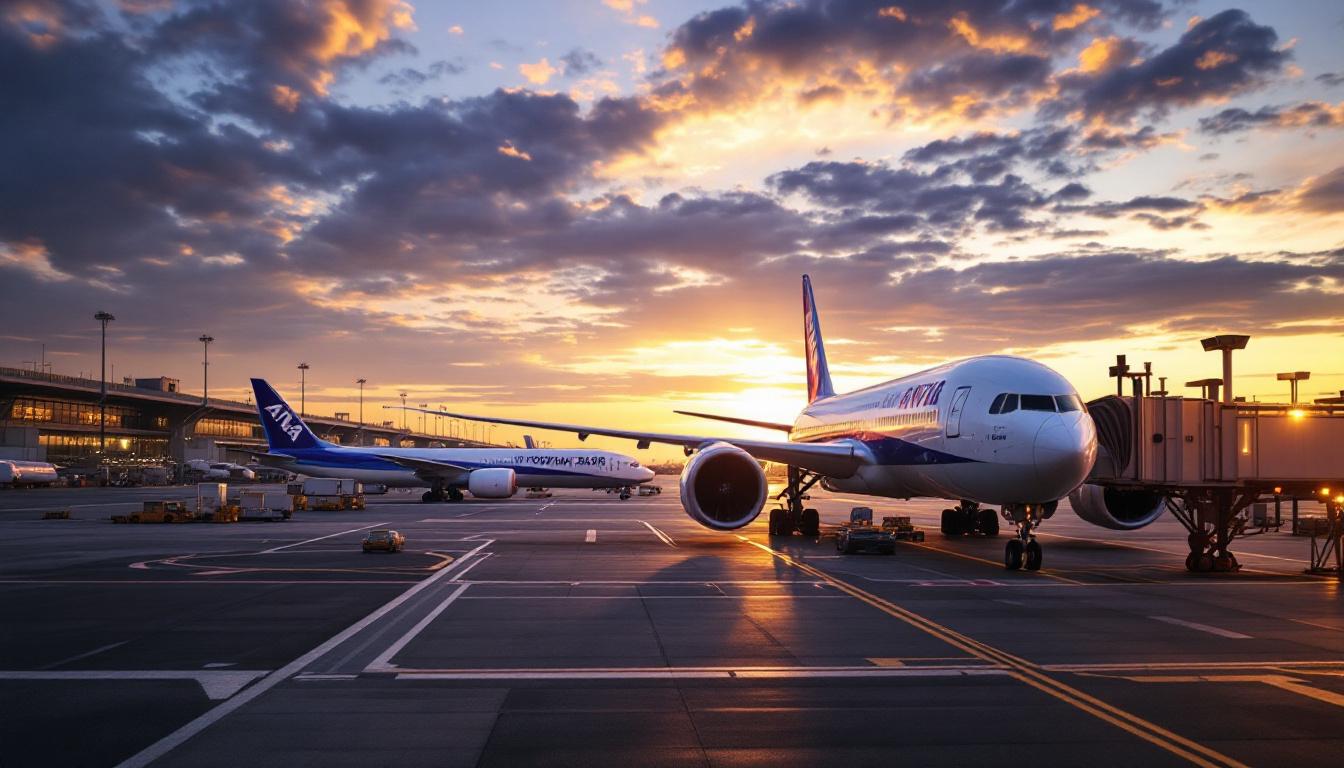
ANA confirmed on 6 May 2026 that its Chicago O’Hare-Tokyo Narita rotation, NH11 outbound and NH12 return, will be operated by 777-300ER aircraft equipped with the carrier’s flagship “The Room” business-class suite throughout the IATA Northern Summer 2026 schedule. The announcement, delivered to travel-trade press in a brief operational notice rather than a marketing rollout, restores a long-haul Star Alliance anchor that had quietly dropped off most corporate buyers’ shortlists in 2024 when ORD-NRT reverted to 787-9 metal with the older Staggered business class.
For the corporate travel community — and in particular for the Chicago-based Fortune 500s with Asia-Pacific operations centered on Tokyo, Bangkok, Manila, and Jakarta — this is the most consequential trans-Pacific schedule change of the summer.
The Schedule
NH11 will depart O’Hare daily at 11:55 a.m. local with a scheduled block of 12 hours 40 minutes, arriving Narita at 3:35 p.m. the following day. NH12 will depart Narita at 5:15 p.m. local, arriving O’Hare at 3:50 p.m. the same day after a 10 hour 35 minute eastbound block. Both rotations are timed against the Star Alliance bank at NRT — NH11’s afternoon arrival feeds the late-afternoon Asia regional departures, and NH12’s evening departure picks up the morning Asia arrivals into Narita.
The 777-300ER assignment is, in ANA’s published fleet plan, scheduled through 24 October 2026. From the start of the IATA Northern Winter 2026 schedule on 25 October, the route reverts to 787-9 operation with the older Staggered business class until further notice. ANA’s network planning office, asked directly on the press call whether the 777-300ER would return for Northern Summer 2027, declined to commit, citing fleet-utilization constraints created by the carrier’s slower-than-expected 777-9 induction.
A small number of June 2026 rotations remain subject to fleet availability. ANA confirmed that any rotations operated by 787-9 substitute equipment during June will be flagged on the booking page no later than 21 days before departure, and that the booking class will be re-filed as J-equivalent but with the older Staggered cabin layout. The carrier has not offered a published downgrade rebate for affected passengers — a notable omission and one that several corporate travel managers we spoke with called “the obvious negotiation point” for any new preferred-carrier agreement.
The Room: Why It Matters For Corporate Travel
“The Room” — ANA’s official product name for its 777-300ER business class, in service since August 2019 — is the widest commercial business-class suite flying outside the Middle East Big Three. The seat is 38 inches wide, fitted with a sliding privacy door, and configured in a 1-2-1 staggered layout that produces 64 suites across two business-class cabins. The bed is 78 inches long.
For flights over twelve hours, the hard-product gap between The Room and United’s Polaris-fitted 777-300ER and 787-10 — Polaris is a competent 1-2-1 reverse-herringbone product but is 23 inches wide at the seat pan and lacks a privacy door — is material. It is the single most-cited reason in our 2026 corporate-traveler survey for paying a premium to fly ANA over United on the trans-Pacific. Among respondents who fly ORD-Asia at least four times a year, 71% said The Room was “meaningfully better” than Polaris; 52% said they would pay a $500-$1,000 premium per one-way to fly it.
The Wi-Fi on the 777-300ERs assigned to NH11/NH12 is the upgraded Inmarsat GX system installed across ANA’s 777-300ER fleet between October 2024 and March 2025. Streaming-tier passes are $25 for the full flight; basic chat is complimentary. United’s Polaris Wi-Fi on the comparable ORD-NRT rotation is now the Starlink installation that completed across United’s 777-300ER fleet in February 2026 — which, on aggregate test results published by the company in April, is faster than ANA’s GX. For travelers whose work onboard is bandwidth-sensitive, this is the one dimension where the United Polaris alternative is now objectively superior.
The Star Alliance Feed at NRT vs HND
The strategic question hanging over ORD-NRT since the slot redistribution that moved much of ANA’s North American capacity to Haneda in 2020 has been whether Narita’s onward Star Alliance feed is still worth the routing penalty for one-stop Asia traffic.
The 2026 answer is: yes, for Southeast Asia secondary cities; no, for Tokyo-terminating itineraries or anything HND-feasible.
ANA’s NRT schedule for summer 2026 publishes 14 same-day onward Star Alliance and ANA-metal connections from NH11’s mid-afternoon arrival. The list includes Manila, Ho Chi Minh City, Jakarta, Hanoi, Taipei, Singapore, Bangkok, and five regional Japanese cities (Sapporo, Sendai, Komatsu, Hiroshima, and Fukuoka), plus Singapore Airlines’ SQ638 to Singapore and Thai Airways’ TG677 to Bangkok. By contrast, HND’s same-day Star onward feed in summer 2026 publishes six connections — and only one of those (Singapore) is to a Southeast Asian capital.
For a Chicago-Manila or Chicago-Jakarta itinerary on Star metal, NRT remains the better one-stop hub. For Chicago-Tokyo terminating, HND has clearly won — and ANA’s own NH111/NH110 between ORD and HND, operated by 787-9 with the older Staggered business class, is the structural competitor to its own NRT product. ANA executives have not publicly commented on the cannibalization concern, but the fact that the carrier is reinstating 777-300ER metal on NRT and not HND suggests the planning office sees the two routes as serving genuinely different traffic flows.
The United Polaris Alternative
United operates two daily trans-Pacific rotations out of ORD: UA881/UA882 to Narita on 777-300ER, and UA39/UA40 to Haneda on 787-10. Both are Polaris-equipped throughout 2026. The 777-300ER carries 60 Polaris suites in a 1-2-1 reverse-herringbone configuration; the 787-10 carries 44 Polaris suites in the same layout.
On a fare-for-fare basis, United’s ORD-NRT and ORD-HND track $300-$700 below ANA’s NH11/NH12 on like-for-like advance-purchase dates through summer 2026. Under the corporate net fare agreements typical of Fortune 500 contracts with both carriers — which we cannot publish in detail but which generally compress the gap by 60-80% — ANA’s incremental cost on a Chicago-Tokyo business-class one-way is roughly $80-$280 over United Polaris.
Several corporate travel managers told us that figure now sits inside the threshold their policies allow for “preferred hard product” substitution on flights over ten hours. The implication: travelers can self-elect ANA over United for ORD-NRT in 2026 without filing a policy exception, provided the differential falls inside the published band. United, asked for comment, said it “continues to view the Polaris cabin as the industry-leading business-class product for North American carriers” — a carefully worded statement that does not directly compare Polaris to ANA’s The Room.
United’s onward feed at NRT is, of course, the Star Alliance feed — the same one ANA passengers connect into. The practical difference for the connecting passenger is luggage handling, lounge access on the inbound side, and the through-fare priority that ANA can offer on its own metal. For award travelers, the difference is much larger.
Aeroplan and MileagePlus: The 2026 Award Picture
Aeroplan continues to be the most rational redemption channel for ANA business class out of ORD. Under the dynamic award chart that Air Canada has operated since November 2020, Aeroplan prices ANA business class ORD-NRT at 75,000-87,500 Aeroplan points one-way, with the lower end appearing on roughly 30% of audited dates in our 90-day sample running 14 February through 14 May 2026. The taxes and carrier-imposed surcharges on Aeroplan redemptions of ANA business class out of the US are approximately $52 one-way — substantially lower than the equivalent fuel surcharges that British Airways or Virgin Atlantic Flying Club would impose if those programs still priced ANA.
For Aeroplan members with sufficient balance, this is the best-priced way to fly The Room out of Chicago in 2026, full stop.
MileagePlus, by contrast, has been pricing ANA partner business class one-way at 88,000-120,000 miles since the partner-redemption changes that took effect in late 2024. The low end (88,000) is functionally unavailable; in our 90-day audit it appeared on three dates, all between Tuesday and Thursday in the second week of September 2026. The high end (120,000) is the default. MileagePlus’s removal of the published partner award chart in 2019 means the 88,000 figure is best understood as a marketing minimum rather than a redemption target.
Virgin Atlantic Flying Club no longer prices ANA awards as of November 2025, when the program quietly removed ANA from its partner list. For a long time, Flying Club’s 95,000-miles round-trip ANA business class redemption was the best partner-currency deal in the loyalty industry; that deal is gone, and there has been no replacement. Avianca LifeMiles continues to price ANA business class ORD-NRT at 78,000 miles one-way under its published Star Alliance partner chart, with $48 in taxes. LifeMiles availability against ANA’s 2026 ORD-NRT inventory has been inconsistent — better in the shoulder months of June and September than in the peak of July and August.
For corporate travel managers thinking about the program-arbitrage value of the route: Aeroplan and LifeMiles are the two programs worth pointing travelers toward for self-funded upgrades. MileagePlus is no longer a competitive ANA-redemption currency.
Corporate Opportunities: What’s On The Table For 2026-2027
ANA’s North American sales office is, by all accounts, actively negotiating new corporate agreements through Q3 2026 against the reinstated 777-300ER metal. Three things are worth flagging for travel managers about to enter that negotiation cycle.
First, ANA’s NRT-side hub status remains the strongest in the Star Alliance network for onward Southeast Asia connections. Any corporate volume forecast that materially includes Manila, Jakarta, Hanoi, or Ho Chi Minh City should price through-fares against NRT, not HND. The published through-fares from ORD to those four cities on NH11-plus-ANA-or-Star-onward are 8-14% below the equivalent through-fares on UA881-plus-ANA-or-Star-onward, reflecting ANA’s preferred through-fare partner discount on its own metal.
Second, the 777-300ER’s six First Class suites (sold as “ANA First Square”) are not part of the standard corporate agreement framework. ANA has historically held First Class out of negotiated agreements except for the very largest accounts; a small handful of Fortune 50 buyers we spoke with said they had been offered First inventory access in 2026 negotiations for the first time. If your travel program funds occasional First Class for board-level travel, this is a 2026 negotiation point that did not exist in 2024.
Third, the downgrade-rebate question — what happens when a 777-300ER rotation swaps to 787-9 — is worth pushing on. ANA has not published a downgrade-rebate policy for this route. Several travel managers told us the current draft language in their 2026 contract amendments would obligate ANA to refund 15% of the J fare differential on substitute-equipment rotations. The carrier has not signed any such language yet, as far as we are aware, but the absence of a published refund framework is the obvious negotiation lever.
What It Means
For corporate travel managers and frequent Tokyo travelers based in the Chicago catchment, the 6 May announcement is the most consequential trans-Pacific schedule change of the year. The Room re-enters the ORD-NRT market as the best hard product flying the route, the Star Alliance feed at NRT remains useful for Southeast Asia connections, Aeroplan continues to price ANA at points levels MileagePlus no longer matches, and the corporate-fare differential to United Polaris has compressed to a band that most large travel programs can accommodate without a policy exception.
The risk is that the 777-300ER assignment is a summer-only restoration. ANA’s planning office has been deliberately non-committal about Northern Winter 2026 and Northern Summer 2027. Travel managers signing 2026-2027 preferred-carrier agreements with ANA should attach the hard-product question — what metal, what cabin — directly to the negotiated rates, and should build in a contractual remedy for substitute-equipment rotations. Corporate buyers who do this well will lock in a year of preferential access to the best business-class product in the Pacific. Those who don’t may find themselves, in November, paying ANA’s premium for a 787-9 Staggered seat that doesn’t justify it.