
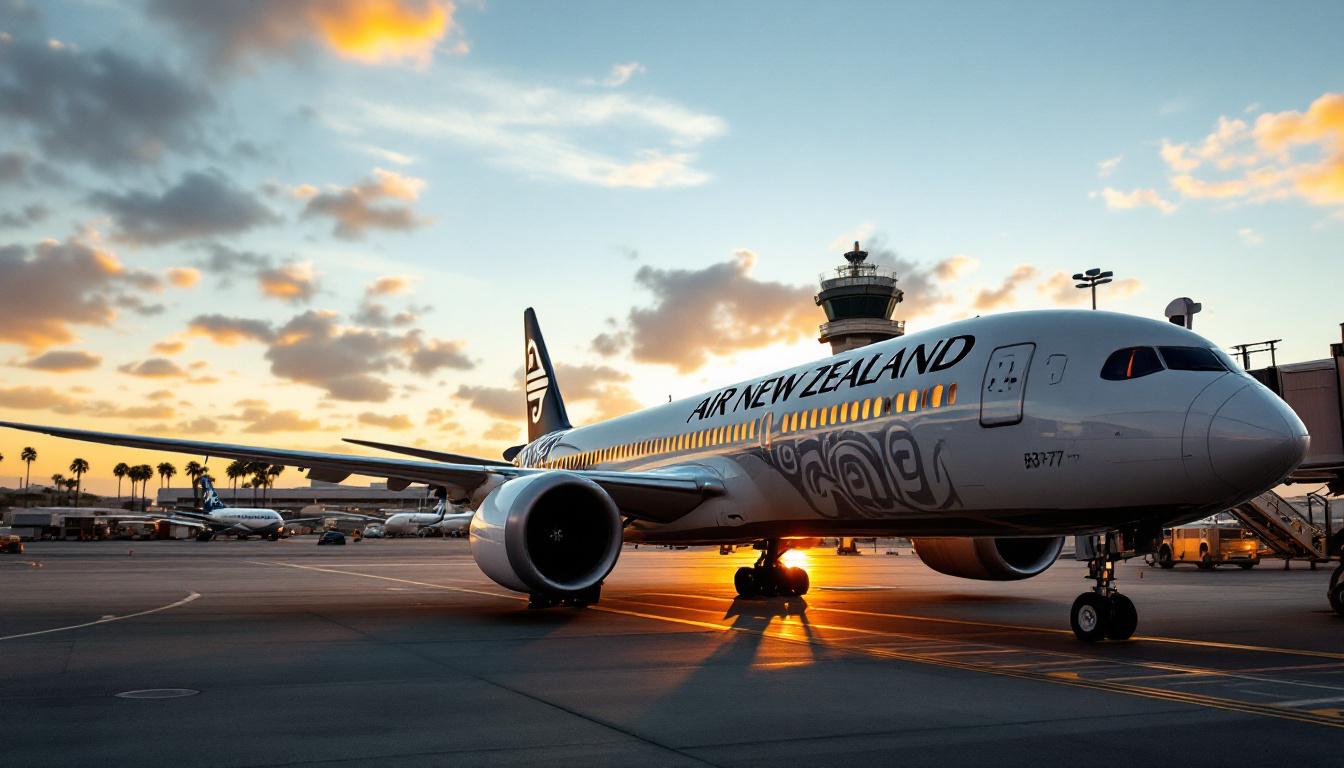
FILED: Auckland, 15 January 2026 — Air New Zealand’s anchor transpacific route — Los Angeles to Auckland, daily nonstop, twelve hours fifty-five minutes block time southbound — entered the next era of its product on 26 October 2025 with the first revenue flight of the carrier’s retrofitted Boeing 787-9. The aircraft, registration ZK-NZH, departed LAX at 9:50 p.m. local time on flight NZ1, crossed the international date line, and touched down at Auckland Airport at 7:45 a.m. on 28 October 2025. The cabin on board contained the four products that, eighteen months after the airline’s original April 2024 product reveal, define the Air New Zealand long-haul offer for 2026: Business Premier Luxe in row 1, Business Premier across rows 2 through 6, Premium Economy in rows 22 through 25, and — between the Premium Economy bulkhead and the main economy cabin — the six-bunk Skynest sleeping-pod installation that is the most-watched single product introduction in commercial aviation this year.
BRIEFING: This is Business Travel Today’s January 2026 briefing on the LAX-Auckland corridor as it stands in the first full booking-flow quarter of the retrofitted 787-9 era. The methodology is current-quarter and primary-source: the Air New Zealand published timetable for the 2025-26 austral-summer and the 2026 austral-winter seasons; the Air New Zealand booking-flow tests conducted between 28 October 2025 and 12 January 2026 across cash and Airpoints award inventory; the Air New Zealand Skynest pricing matrix as published in the live booking flow; the United Airlines MileagePlus partner-earning chart governing the UA7929 codeshare; and the Auckland Airport international-arrivals minimum-connection-time framework that governs every onward Queenstown, Christchurch, and Wellington domestic-feed itinerary.
Three structural items frame every Q1 2026 booking decision on the corridor. First, the retrofit fleet is not yet the full fleet. Air New Zealand has confirmed that the 787-9 retrofit program will progress through twelve airframes over the course of 2026, with the final retrofit out of the Singapore Technologies Engineering line scheduled for the fourth quarter — meaning that some daily LAX-AKL frequencies during the off-peak April-October 2026 window will continue to operate the legacy Business Premier and legacy Premium Economy product on un-retrofitted 787-9 aircraft. The Skynest installation is exclusive to the retrofitted airframes; a passenger booking Skynest at the time of ticketing receives a fare-rule confirmation of equipment, not a marketing promise. Second, the Star Alliance connecting bank at Auckland in the morning northbound window — 7:30 a.m. to 10:30 a.m. local — is the structurally productive feed for the LAX-AKL business traveler heading on to Queenstown, Christchurch, or Wellington; the Air New Zealand domestic network operates 93 daily rotations across those three city pairs on the airline’s A320, ATR 72, and Q300 fleets, and the 90-minute minimum connection time at AKL clears the international-to-domestic transfer with the Koru Lounge Auckland Domestic in the connection window. Third, the United codeshare on UA7929 LAX-AKL and UA7928 AKL-LAX matters for two specific business-traveler use cases: the corporate-card MileagePlus accrual program where a 016 United-stock ticket is preferred for expense-reconciliation reasons, and the status-qualifying push where the differential between NZ-marketed and UA-marketed earning on the same aircraft determines the PQP outcome for the year.
Where Air New Zealand-published fare data or schedule data exists, we cite it; where it does not, we use “estimated” and disclose the basis inline. This briefing is the LAX-AKL specific reading; it does not duplicate the broader Air New Zealand long-haul network coverage, the JFK-AKL service that launched 17 September 2022 and entered the retrofit cycle 5 January 2026, or the AKL-IAH service that joined the schedule on 17 December 2024 and remains pending retrofit in the Q3 2026 deployment window.
The Schedule
Air New Zealand operates two daily 787-9 rotations between Los Angeles International Airport and Auckland Airport during the austral-summer peak season, November 2025 through March 2026, and one daily rotation in the off-peak April 2026 through October 2026 window. The schedule, as published in the airline’s timetable for the 2025-26 and 2026 calendar:
NZ1 (southbound, year-round): LAX 9:50 p.m. → AKL 7:45 a.m. (+2 days). Block time 12 hours 55 minutes. Aircraft: 787-9.
NZ2 (northbound, year-round): AKL 7:30 p.m. → LAX 11:15 a.m. (same day, crossing the date line). Block time 11 hours 45 minutes. Aircraft: 787-9.
NZ5 (southbound, peak season only): LAX 10:55 p.m. → AKL 8:50 a.m. (+2 days). Block time 12 hours 55 minutes. Operates November 2025 through 31 March 2026. Aircraft: 787-9.
NZ6 (northbound, peak season only): AKL 8:45 p.m. → LAX 12:30 p.m. (same day). Block time 11 hours 45 minutes. Operates November 2025 through 31 March 2026. Aircraft: 787-9.
The schedule is built around three structural truths of the corridor. The southbound 9:50 p.m. LAX departure is calibrated to the 7:45 a.m. AKL arrival that opens the eight-hour business window at the receiving end of the leg — a meeting in central Auckland’s Wynyard Quarter, the Air New Zealand domestic departures bank to Queenstown in the 8:35 a.m. through 11:55 a.m. window, or the onward Christchurch and Wellington morning frequencies. The northbound 7:30 p.m. AKL departure clears the 11:15 a.m. LAX arrival in time to make the LAX-Newark, LAX-Boston, LAX-Washington Dulles, and LAX-Chicago O’Hare same-day connecting bank on United, American, and Delta — and the international-to-domestic transfer through LAX Tom Bradley International Terminal to LAX Terminal 6, 7, or 8 runs the 2-hour 15-minute minimum on a Customs-and-Border-Protection Global Entry-eligible passenger.
The seat-mile capacity on the corridor in the peak-season double-daily configuration is 552 seats per day each direction across the four 138-seat 787-9 rotations (Business Premier Luxe 4, Business Premier 22, Premium Economy 33, Skynest 6, and main-cabin economy 73 in the retrofitted layout). In the off-peak single-daily configuration the corridor capacity drops to 138 seats each direction — a structural constraint that is the single most important variable in the Q2 2026 and Q3 2026 cash-fare ladder.
The Retrofitted Cabin
The 787-9 retrofit, finalized at the Singapore Technologies Engineering line at Seletar Airport in Singapore, replaces the original 2014-vintage Air New Zealand long-haul interior with four cabin products and a galley and lavatory reconfiguration:
Business Premier Luxe (4 seats, Row 1)
The four front-row seats of the Business Premier cabin are the Business Premier Luxe product — the airline’s first fully enclosed business-class suite. The suite specifications: 22-inch seat width, 79-inch dedicated bed surface (not converted from the seat), 24-inch sliding suite door with a privacy partition extending to the cabin ceiling, a designated companion dining chair, an 18-inch in-flight entertainment screen, and two USB-C plus one 110-volt AC power outlet. The four suites are positioned 1-1-1-1 across the cabin width — two window seats and two center seats, no traditional aisle seat in row 1. The center-pair Luxe configuration (seats 1D and 1G) is the only seat-pair in the Air New Zealand long-haul cabin that allows two travelers to dine and sleep across a shared partition.
Business Premier (22 seats, Rows 2-6)
The remaining 22 seats of the Business Premier cabin sit in the 1-1-1 herringbone configuration that has been the Air New Zealand business-class signature since 2005. The retrofitted Business Premier seat retains the 22-inch seat width and 80-inch lie-flat bed of the legacy product but adds the cabin-wide refresh: a new IFE screen at 16 inches versus the legacy 12, USB-C power, a redesigned ottoman that accommodates a companion buddy-seat dining configuration, and the Air New Zealand pillow-and-duvet bedding system that arrived in the fourth quarter of 2024 across the long-haul fleet.
Premium Economy (33 seats, Rows 22-25)
The Premium Economy cabin in the retrofit moves from a 2-3-2 to a 2-4-2 layout in 33 seats across four rows. Seat pitch is 41 inches (unchanged from the legacy), seat width is 19.3 inches, and the seat itself is the same Recaro-built shell that the airline introduced in the legacy Premium Economy in 2014. The retrofit changes are concentrated in the soft product and the IFE: a 13-inch screen at every seat (versus the legacy 10.6), individual reading lights, and a redesigned tray table that supports the carrier’s Premium Economy dining service from the same galley as Business Premier.
Skynest (6 bunks, between rows 25 and 26)
The Skynest installation, the cabin product that has drawn the most attention since the April 2024 reveal, is six full-length sleeping bunks arranged in two stacks of three across the cabin width, located in the position that on the legacy 787-9 housed the second of the airline’s two forward main-cabin galleys. Each Skynest bunk is approximately 79 inches long, 23 inches wide, and 27 inches high, fitted with a Sealy memory-foam mattress, a fitted sheet, a duvet, two pillows, a reading light, USB-C power, a small mirror, and a curtain that closes the bunk to a fully private compartment.
Skynest is bookable in four-hour sleep sessions at NZ$400 to NZ$600 per session — the price point is dynamic and depends on demand and time of day per the Air New Zealand booking flow, but the LAX-AKL southbound NZ1 schedule supports two sequenced four-hour sessions across the 12-hour 55-minute block time and the northbound NZ2 schedule supports two sessions across the 11-hour 45-minute block time. The bunks are bookable only by passengers traveling in main-cabin economy or in Premium Economy; Business Premier and Business Premier Luxe passengers cannot book Skynest because their underlying seat is already a lie-flat bed. The Skynest pre-booking opens at the time of ticketing and closes at T-minus-24 hours before departure; the airline does not offer Skynest as a day-of upgrade at the gate.
The cabin attendant assigned to the Skynest position rotates passengers through the bunks under the four-hour-session model. Between sessions, the bunk is reset — fresh linen, new pillows, the mattress sanitized — over a 25-minute window during which the bunk is closed to passenger access. The maximum theoretical Skynest throughput on a southbound NZ1 rotation is therefore 24 sessions across the 12-hour 55-minute flight (six bunks times two cycles minus the reset overhead) but the airline has confirmed in trade press that the operational target for the first six months of the program is 18 sessions per rotation — three full rotations of all six bunks, with a fourth partial rotation reserved for irregular operations.
The Star Alliance Feed at Auckland
The Air New Zealand domestic network at Auckland is the single most consequential element of the LAX-AKL corridor for the business traveler whose final destination is somewhere other than central Auckland. The airline operates the dominant domestic schedule from AKL across three primary city pairs:
Auckland-Queenstown (ZQN): 27 daily rotations on the A320, A321neo, and ATR 72 fleets. The morning northbound NZ2 arrival at 11:15 a.m. AKL is not the structurally productive Queenstown connection; the productive connection is on the southbound NZ1 arrival at 7:45 a.m., which feeds the 8:35 a.m., 9:55 a.m., and 10:45 a.m. NZ605, NZ607, and NZ609 frequencies to Queenstown with connection windows of 50 minutes (below the 90-minute MCT — not bookable in a through-itinerary), 2 hours 10 minutes (productive), and 3 hours 00 minutes (productive).
Auckland-Christchurch (CHC): 32 daily rotations on the A320 and A321neo fleets. The southbound NZ1 7:45 a.m. AKL arrival feeds the 9:30 a.m., 10:15 a.m., 11:00 a.m., and 12:00 p.m. NZ515, NZ517, NZ519, and NZ521 frequencies with productive connection windows from 1 hour 45 minutes to 4 hours.
Auckland-Wellington (WLG): 34 daily rotations on the A320, A321neo, and Q300 fleets. The southbound NZ1 7:45 a.m. AKL arrival feeds the 9:15 a.m., 10:00 a.m., 10:45 a.m., and 11:30 a.m. NZ417, NZ419, NZ421, and NZ423 frequencies with productive connection windows from 1 hour 30 minutes (at the MCT floor) to 3 hours 45 minutes.
The minimum connection time at AKL for the international-to-domestic transfer is 90 minutes per the Auckland Airport published Connection Time Standard, with the international arrivals immigration-and-baggage cycle running 35 to 55 minutes from wheels-down on a 787-9 international arrival and the AKL international-to-domestic terminal transfer running an additional 10 to 15 minutes via the connecting walkway between the international terminal and the domestic terminal.
For Star Alliance status holders — United Premier Gold, Lufthansa Senator, Singapore KrisFlyer Elite Gold, ANA Diamond, and the broader Gold tier of the alliance — the AKL international arrivals priority lane clears the immigration cycle in a 10 to 15-minute window against the standard 35 to 55, and the Air New Zealand Koru Lounge at AKL Domestic is open from 5:30 a.m. local time and is the bookable lounge for the onward connection. Air New Zealand has confirmed that the Koru Lounge AKL Domestic admission policy for the Star Alliance Gold tier extends to the lounge on the day of the onward domestic departure regardless of the international-arrival fare class, a policy that is structurally more generous than the equivalent intra-Asia or intra-Europe Star Alliance lounge policies.
The United Codeshare
The United Airlines codeshare on the LAX-AKL corridor markets two flight numbers operated on Air New Zealand metal: UA7929 LAX-AKL (operated by NZ1) and UA7928 AKL-LAX (operated by NZ2). The codeshare extends the Star Alliance partner relationship — formalized when Air New Zealand joined Star Alliance on 28 March 1999 — and the bilateral commercial partnership with United that has operated since 2016.
For the business traveler, the UA-marketed itinerary on UA7929 and UA7928 carries three operational differentiators from the NZ-marketed itinerary on NZ1 and NZ2:
MileagePlus earning at UA-published rates. The UA7929 codeshare ticket on 016 United stock earns MileagePlus award miles and Premier-qualifying points at the United-published rate against the marketed fare class — generally 100 percent PQP earning on the K, L, T, and S economy fare buckets when ticketed on a UA-stock ticket, against the partner-earning chart’s reduced 25 percent to 75 percent rate that applies to Air New Zealand-marketed NZ1 tickets credited to MileagePlus. For the MileagePlus member running a Premier 1K status-qualifying push, the differential matters; for the Air New Zealand Airpoints member, the NZ-marketed itinerary on NZ1 earns the full Airpoints accrual rate and the UA-marketed itinerary on UA7929 earns the partner-airline rate.
Through-checked baggage and single boarding-pass issuance. A UA-marketed itinerary that includes a LAX-AKL leg followed by an AKL-Queenstown, AKL-Christchurch, or AKL-Wellington onward domestic leg checks the baggage through to the final domestic destination and issues a single boarding pass at the originating United check-in counter at LAX Terminal 7, 8, or the Tom Bradley International Terminal. The traveler clears AKL international arrivals immigration, retrieves no baggage at the AKL international carousel, transits to the domestic terminal, and re-clears no second security on the way to the domestic gate. The same itinerary booked on NZ-marketed flight numbers across both legs delivers identical operational treatment at AKL; the difference is the ticketing stock and the MileagePlus accrual.
United Polaris Lounge access at LAX prior to NZ1 departure. A United Polaris business-class fare on the UA7929 LAX-AKL itinerary — booked on the J, C, D, Z, or P fare buckets — clears the United Polaris Lounge at LAX Terminal 7 in the pre-departure window. The Polaris Lounge access does not extend to a Business Premier fare on the NZ-marketed NZ1 itinerary; the Air New Zealand Business Premier ticket clears the Air New Zealand-operated Koru Lounge at LAX Tom Bradley International Terminal, which is a different and substantially smaller facility. For the business traveler departing LAX in the 7:30 p.m. through 9:30 p.m. pre-NZ1 window, the United Polaris Lounge access via the UA7929 itinerary is the structurally superior lounge experience.
The cabin, seat, and on-board service on the operating aircraft is identical regardless of whether the ticket is marketed on UA or NZ flight number. The aircraft is the same retrofitted 787-9, the crew is Air New Zealand, the food and beverage program is the Air New Zealand long-haul service, and the Business Premier or Premium Economy or main-cabin economy passenger receives the same hard and soft product.
The Business-Traveler Positioning
The structural case for Air New Zealand on LAX-AKL versus the corridor’s competition rests on three positioning elements that the 2025 retrofit either created or reinforced.
First, the cabin tier. The Business Premier Luxe suite product is the only fully enclosed business-class suite in revenue service on the LAX-AKL corridor in Q1 2026; the competing services on the Auckland-Los Angeles routing operate at a non-suite business-class hard product. For the business traveler whose corporate travel policy authorizes business-class international and whose preference at the front of cabin runs to the suite-door product, the Business Premier Luxe seat in row 1 of the retrofitted 787-9 is the differentiator. The four-seat Luxe cabin clears at 105,000 to 135,000 Air New Zealand Airpoints one-way against the Business Premier baseline of 90,000 Airpoints, and the Luxe cash fare premium runs $1,500 to $2,500 one-way over the underlying Business Premier ticket per the airline’s Q1 2026 booking flow.
Second, the Skynest economy option. The six-bunk Skynest cabin is the only revenue-class sleeping-bunk installation in service in commercial aviation in Q1 2026. For the business traveler whose policy authorizes economy international only, the NZ$400 to NZ$600 Skynest session unlocks four hours of horizontal sleep on a 12-hour 55-minute southbound flight without the full $5,000-plus Business Premier or Business Premier Luxe fare. The product positioning is unusual: a horizontal-sleep option at the economy-plus price point that did not previously exist in the corridor’s competitive set.
Third, the AKL connecting bank. Auckland Airport is Air New Zealand’s dominant hub, and the morning southbound NZ1 arrival feeds the productive connecting bank to Queenstown, Christchurch, and Wellington at a structural depth that no competing carrier matches. For the business traveler whose final destination is somewhere other than central Auckland — a Queenstown ski-resort meeting, a Christchurch agricultural-technology briefing, a Wellington central-government engagement — the AKL connecting feed is the single most important variable in the routing decision.
The case against Air New Zealand on the corridor is the structural one. The off-peak April 2026 through October 2026 single-daily schedule constrains both cash and award inventory at the front of cabin, and the un-retrofitted 787-9 airframes still rotating through the LAX-AKL roster during the retrofit-program completion phase mean that a Q2 or Q3 2026 booking is not guaranteed to deliver the retrofitted cabin without a fare-rule confirmation of equipment. The airline has confirmed that the booking flow displays the cabin configuration at the seat-map stage; the business traveler whose decision turns on the Business Premier Luxe suite or the Skynest bunk should clear the seat-map check before ticketing.
The Bottom Line
The Air New Zealand LAX-Auckland 787-9 retrofit, in service since 26 October 2025, has reset the product offer on the corridor across all four cabin tiers — the Business Premier Luxe suite, the refreshed Business Premier, the Premium Economy 2-4-2 retrofit, and the Skynest six-bunk economy-class sleeping installation. The schedule is a year-round daily NZ1/NZ2 rotation with a double-daily peak-season NZ5/NZ6 layer through 31 March 2026, the United codeshare on UA7929 and UA7928 delivers the MileagePlus and Polaris Lounge access route for the United-status business traveler, and the Star Alliance connecting feed at Auckland clears the onward Queenstown, Christchurch, and Wellington domestic legs at a structural depth no competitor matches. For the business traveler making the LAX-AKL routing decision in 2026, the retrofitted Air New Zealand 787-9 is the new corridor benchmark.