
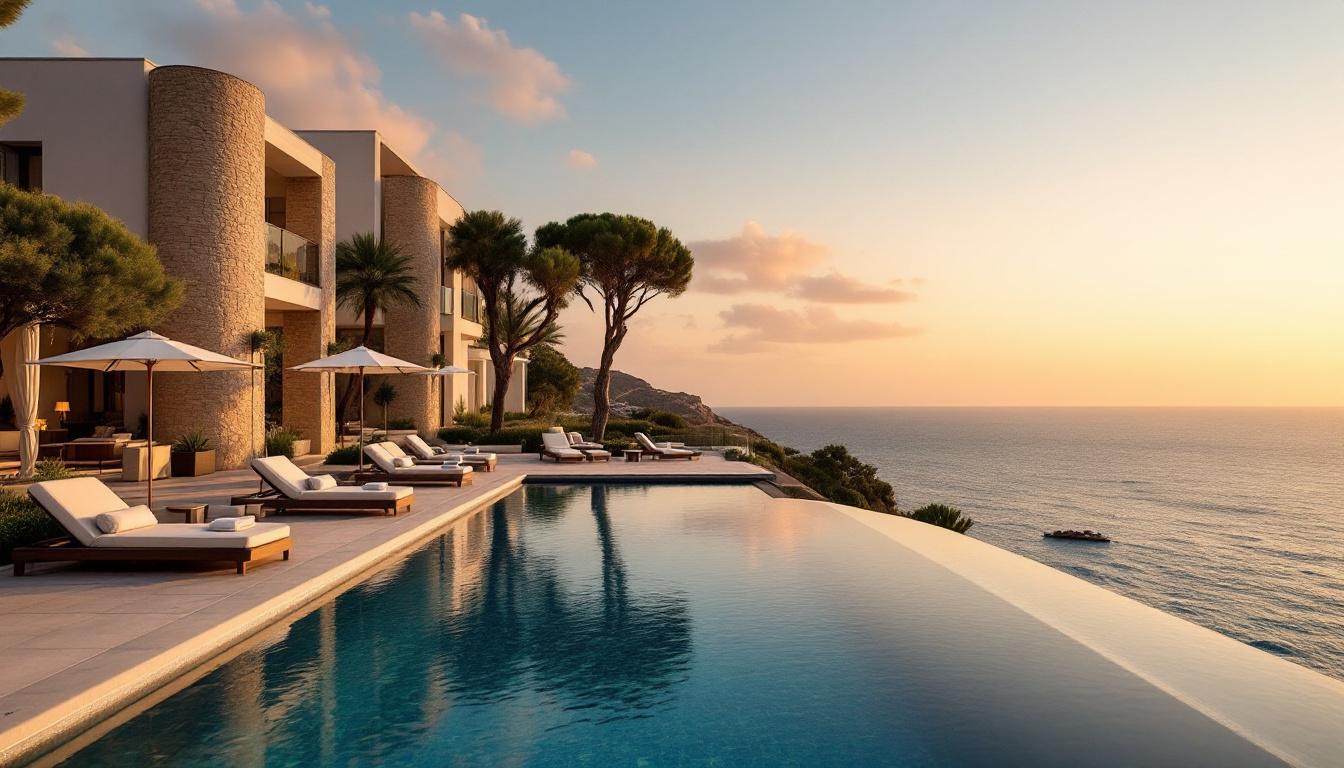
The Hotel Punta Negra, when it opened on the Costa d’en Blanes headland in 1962, was the kind of property that Spanish architectural historians now classify as “Balearic modernist tourism” — a low-slung, white-rendered, terracotta-roofed building that staked out a private peninsula on the Bay of Palma at the precise moment Mallorca was becoming Mallorca. Sean Connery stayed there during the filming of Goldfinger in 1964. The Spanish royal family kept a standing reservation through the early 1980s. By the time the property closed for conversion on 17 April 2025, after 63 years of more or less continuous operation under three successive ownership groups, it had become the last of the original Costa d’en Blanes landmarks still trading.
It reopens on 1 June 2026 as the Mandarin Oriental Punta Negra Mallorca, the group’s first resort in Spain and the 41st property in its global portfolio. The conversion has taken 13 months, cost roughly €185 million according to numbers disclosed by the owner, Spanish family office Grupo Cap Vermell, and added 44 freestanding villas to the original room inventory. The opening, confirmed in writing to Business Travel Today on 21 April by general manager Alessandro Redaelli, will hold to the announced date despite a delivery slip on the spa’s seawater intake that had, briefly, threatened to push the opening into mid-June.
I toured the property on 23 April, three weeks before its soft opening. What follows is what is open, what is delayed, what is priced, and — for the readers who track this segment for reasons of work rather than holiday — what the group’s positioning tells us about the wider corporate-retreat market in southern Europe heading into the 2026 summer.
The site and the conversion
Costa d’en Blanes is a residential and resort enclave on the western shore of the Bay of Palma, in the municipality of Calvià, roughly 15 kilometers west of Palma de Mallorca’s old town and 18 kilometers from Palma de Mallorca Airport (PMI). The Punta Negra peninsula itself — the “black point” of the name, after the dark Buntsandstein rock that forms the headland — extends about 380 meters into the bay and encloses two small, west-facing coves with private beaches. The site is, in physical terms, unusual: a peninsula with its own microclimate, its own approach road, and, since 1962, a single property holding the entire promontory.
Grupo Cap Vermell, the Mallorca-based family office that controls the Park Hyatt Mallorca at Canyamel and a portfolio of other Balearic real-estate assets, acquired the site in March 2023 from a German-Spanish joint venture that had operated the property since 2007. The Mandarin Oriental management agreement was signed in November 2024 — a 30-year deal with two 10-year extension options, structured as a base-and-incentive-fee arrangement on industry-standard terms. Grupo Cap Vermell remains the asset owner and bears the renovation cost; Mandarin Oriental operates under the management contract.
The conversion, designed by the Madrid-based architecture firm OAB (Office of Architecture in Barcelona) with interiors by London-based Bryan O’Sullivan Studio, was deliberately not a teardown. The original 1962 main building, a three-story L-shaped structure that Spain’s Ministry of Culture designated a “protected example of 20th-century Mediterranean tourism architecture” in 2018, has been restored rather than rebuilt. The interiors are new, the systems are new, the bathrooms are new — but the building’s footprint, its proportions, and its distinctive low-pitched terracotta roof have not changed.
The substantive new construction is on the western flank of the peninsula, where 44 freestanding villas have been built into the slope between the main building and the cove. Each villa is set into the terrain to preserve sightlines from the existing property; none rises higher than two stories above grade; and the villa cluster as a whole sits behind a planted screen of mature olive and Aleppo pine that was harvested from elsewhere on the estate and transplanted in late 2025.
The other new structure is the spa, a 2,400-square-meter purpose-built pavilion at the southern end of the peninsula with a seawater hydrotherapy circuit, eight treatment rooms, a 22-meter indoor pool, and a thalassotherapy program developed in partnership with the Saint-Malo-based Thermes Marins. The spa’s seawater intake — the only delivery item that slipped during the project — is now scheduled for commissioning on 14 May, two weeks before the soft opening.
Inventory: rooms, suites, villas
The published key count is 131. The breakdown:
Rooms (56 keys)
Standard rooms range from 42 to 58 square meters, all within the restored 1962 main building. Categories are Bay View, Sea View, and Peninsula View; the last of these, of which there are 14, look directly down the headland toward the western cove. All rooms have private terraces or balconies, and the bathrooms are clad in a single-slab Mallorcan binissalem marble that the owner sourced from a quarry the project re-opened on a 14-month exclusive contract.
Opening rates, confirmed by the reservations director on 24 April, start at €1,180 per night for a Bay View room in shoulder season (June and late September) and €1,650 in high season (July and August). Sea View rooms start at €1,380 / €1,890; Peninsula View at €1,650 / €2,250.
Suites (31 keys)
Suite categories run from the 78-square-meter Bay Suite through the 340-square-meter Punta Negra Suite, the latter occupying the entire third-floor tip of the main building with a 180-square-meter wraparound terrace and direct stair access to a small private cove. Pricing on the Punta Negra Suite is €18,500 per night in shoulder and €28,000 in August; the resort has confirmed it for 47 nights through the end of 2026, with three corporate buyouts driving the high-season concentration.
In between, the 16 Bay Suites are priced from €2,650 to €4,200; the eight Peninsula Suites from €3,400 to €5,400; and the six new Heritage Suites — built into the restored 1962 staff quarters, a one-story stone outbuilding that previously did not accept guests — from €3,900 to €6,200. The Heritage Suites, all single-bedroom and roughly 110 square meters, have private plunge pools fed by the same seawater circuit as the spa.
Villas (44 keys)
The villas are the project’s commercial center of gravity. Categories run:
- 18 one-bedroom villas, 180-210 square meters, from €4,800 / €7,200
- 14 two-bedroom villas, 280-340 square meters, from €7,200 / €11,400
- 8 three-bedroom villas, 420-510 square meters, from €11,400 / €18,800
- 4 four-bedroom villas, 580-720 square meters, from €18,500 / €32,000
All villas have private pools, dedicated arrival drives, electric-vehicle charging, kitchens, dining rooms, and the option of a private chef from the Camí kitchen at €1,400 per service. Each villa has an assigned butler team of two on rotating shifts.
The four-bedroom villas — of which Villa Punta, the southernmost, sits at the headland’s tip with its own beach access — are the inventory the resort is leaning on for full-property corporate buyouts and family-office group bookings. Three of the four are already confirmed for 60+ nights through the end of 2026.
Distance, transfer, and connectivity
For the business traveler, the operational headline is the airport. Palma de Mallorca Airport (PMI) is 18 kilometers from the resort by the MA-1 motorway, a drive of 22 minutes outside the August peak and 35-40 minutes during the high-summer peak hours of Friday and Saturday afternoons. The resort runs a fleet of six BMW i7 sedans and two Mercedes V-Class vans for airport transfers, with one-way pricing at €185 (sedan) and €260 (van). Transfers are not included in any room rate, including suites.
PMI is, by passenger volume, the third-busiest airport in Spain — 33.3 million passengers in 2024, behind Madrid and Barcelona — and the largest non-mainland European airport without a hub carrier. The route map is functionally a list of every meaningful European city: Iberia and Air Europa operate the Madrid and Barcelona shuttles at frequencies of 8-12 daily; Lufthansa Group runs Frankfurt, Munich, Zürich, and Vienna; British Airways and Iberia jointly cover London Heathrow with 4-5 daily; Air France-KLM operates Paris CDG and Amsterdam; and the low-cost incumbents Ryanair and easyJet provide secondary-city coverage across northern Europe.
For private-aviation arrivals, the relevant field is Son Bonet (LESB), an executive-only airport 11 kilometers from the resort, served by Signature Aviation and Universal Aviation FBOs. Mandarin Oriental’s group concierge confirmed on 24 April that the resort is in commercial discussions with both FBOs for preferred-pricing arrangements that will be in place by the formal opening.
Direct seasonal connections from North America are limited. United operates Newark-Palma seasonally (May-October) on a 757-200; Delta has rumored a Boston-Palma route for 2027 but has not announced. The practical North American routing into Costa d’en Blanes remains a connection through Madrid, Barcelona, London, or Frankfurt.
The F&B program
The F&B lineup at opening is five venues, all of them operated in-house rather than under a licensing arrangement with an outside chef brand.
Camí
The headline restaurant, a 64-cover room facing the western cove, is led by Maca de Castro. De Castro is, in the Spanish gastronomic context, a meaningful signing: she holds a Michelin star (since 2012) at her eponymous restaurant in Port d’Alcúdia on the northern coast of Mallorca, was the first woman in the Balearics to hold a star, and has been actively recruited by every major hotel opening on the island for a decade. She signed a five-year exclusive contract with Mandarin Oriental on 12 September 2025, will retain her Port d’Alcúdia restaurant on a reduced operational schedule, and will be on site at Camí four days a week during the high season.
The Camí menu, previewed on 23 April, is a 12-course tasting at €265 per person and a five-course shorter format at €185. The wine list, built by sommelier Iván Martínez (formerly of Diverxo in Madrid), runs to 980 references with a particular emphasis on Balearic and Catalan production.
Sal de Mar
The beach-club venue, with 110 covers split between an indoor dining room and a shaded terrace built directly into the rocks above the western cove. The menu is centered on whole-fish service from the Palma fish market, simply grilled over olive wood, with an a la carte average check at around €140 per person. Sal de Mar is open for lunch and dinner from 1 June and will operate seasonally (June-October) only.
Mandarin Bar
The standard Mandarin Oriental bar program, executed by group beverage director Lorenzo Antinori. The bar room itself, in the restored 1962 main lobby, retains the original Italian travertine flooring and the marble service counter; the cocktail program is a 36-item list that includes seven new specifications developed for the property.
Café Punta Negra
The all-day pool-deck venue, 80 covers, breakfast through late afternoon. Mediterranean small plates, salads, and a wood-fired pizza station added late in the design process at de Castro’s insistence.
Sobremesa
The private dining room, 24 covers, in the restored wine cellar of the original 1962 building. Reservable for groups only at a €380-per-person tasting menu, with a wine pairing at an additional €240. The room has been retained for incentive groups and family-office gatherings; the resort has confirmed 31 Sobremesa bookings through year-end 2026.
A sixth venue — a rooftop bar above the spa pavilion called Mirador, with 40 covers — will open in the second phase, currently scheduled for July 2026 but not guaranteed.
Corporate retreat positioning
The substantive new commercial proposition of the property — the part that distinguishes it from the pre-conversion Hotel Punta Negra — is its meetings and corporate-retreat capacity. The conference floor, built into the lower level of the new spa pavilion and reached by a separate arrival drive, is 980 square meters across a 320-square-meter divisible ballroom and six breakout rooms ranging from 36 to 84 square meters. Ceiling heights are 4.2 meters in the ballroom and 3.4 meters in the breakouts; AV is the current Bose / Crestron / Logitech standard with 4K projection, ceiling-array microphones, and full hybrid-meeting capability in all rooms.
Redaelli, the general manager, was direct about positioning when we spoke on 23 April. “The Bay of Palma has had luxury hotel inventory for decades,” he said. “It has not had purpose-built meetings inventory at this level. The closest comparable in Spain is the Mandarin Oriental Ritz Madrid, and that is a city hotel. The closest resort comparable is probably Marbella, which is a six-hour drive and a different climate window.”
The forecast first-season business mix, he said, is roughly 35% corporate and 65% leisure, with the corporate share expected to grow toward 45% by 2028. The booked corporate base for 2026 includes a 42-person leadership offsite for a European asset manager (4-7 June), a 60-person board retreat for a German automotive supplier (16-19 September), a 28-person partner meeting for a London-based private equity firm (1-3 October), and 14 other confirmed corporate groups of 20-80 people each. Two full-property buyouts — both private family offices — are confirmed for the August dates that the resort has, unusually, agreed to release from its public inventory.
For the corporate group buyer, the practical numbers: full-property buyout pricing starts at €380,000 per night in high season (July, August) and €240,000 per night in shoulder. Partial-property meeting packages, including meeting space, three meals, and 50 contracted rooms, are €185,000 per day in high season and €128,000 in shoulder. The resort’s group sales director, Ana Sánchez, told me on 23 April that the property has held three site inspections per week since 1 March from corporate buyers; conversion to confirmed bookings, she said, has been “ahead of the original underwriting model by a meaningful margin.”
The Mallorca operating context matters here. The Spanish government has, since 2023, been actively encouraging higher-rated luxury inventory on the island as part of a broader effort to shift the tourism mix away from the mass-market segment that has driven the recurring overtourism complaints in Palma’s old town. The Punta Negra conversion sits squarely inside that policy direction. The owner received expedited permitting from the Calvià municipal authority — a 14-month total approval window where the typical timeline is 28-32 months — under a 2023 framework agreement covering luxury-segment renovations on the island.
The leisure side: what the holidaying guest gets
The leisure proposition, for the 65% of first-season nights that are not corporate, is in most respects the standard Mandarin Oriental Mediterranean play, executed at a higher level than the pre-conversion property could support. The two private beaches — Cala Punta (the larger, western cove) and Cala Negra (the smaller, eastern cove) — are kept exclusively for guests, with attendant service, complimentary water-sports equipment (paddleboards, kayaks, single-hand sailing dinghies), and a tender service to the small island of Sa Porrassa, 800 meters offshore, where the resort has built a six-cover lunch pavilion.
The kids’ program, branded as “Little Explorers,” runs daily from 1 June through 30 September and accepts children aged four to twelve. It is included for villa guests and €120 per child per day for room and suite guests.
For the longer-staying leisure guest, the resort has built a structured cultural-immersion program in partnership with the Fundació Miró Mallorca and the Es Baluard Museum of Modern Art in Palma. The program — €380 per person, half-day — includes a private morning at the Miró studios, lunch in the Miró garden, and an afternoon at Es Baluard with a curator. The resort’s concierge confirmed 47 booked sessions through October 2026.
What it means for the segment
The Mallorca luxury market has, until now, run on a barbell. At the top end have been Belmond La Residencia in Deià (94 keys), Castell Son Claret in Es Capdellà (38 keys), and the Park Hyatt at Canyamel (158 keys, also Cap Vermell). At the lower end of the high-rate segment have been the larger five-star resorts of Calvià and the Bay of Palma’s eastern shore. There has not been, in the western bay specifically, a true ultra-luxury property with the meetings and villa inventory to support the corporate-retreat customer.
The Mandarin Oriental Punta Negra fills that specific hole. It will, on opening, be the most expensive hotel on the island by ADR — the published August rack rates on the entry-level Bay View room ($1,890) sit roughly 35% above the equivalent room at Belmond La Residencia and 45% above the Park Hyatt — and the only one with purpose-built meetings space at scale. Whether that pricing holds across the inaugural season is, as always with openings of this kind, the question worth watching.
The broader read is that the Mallorca luxury cycle has further to run. The Aman group has, since November 2025, been confirmed in advanced negotiations for a property on the island’s northern coast near Pollença; the Rosewood group has been openly looking at a Tramuntana site since early 2024; and the Six Senses Ibiza ownership has, according to two separate sources who spoke to Business Travel Today on background in April, been exploring a Mallorca sister property. The Punta Negra is the first of those projects to deliver. It will not be the last.
For the corporate buyer with a Q3 or Q4 2026 offsite to place, the practical recommendation is to inquire early. The peak August dates are effectively sold. September, October, and the second half of June still have meaningful availability across both the meetings calendar and the villa inventory. The Bay of Palma has not had a property of this configuration before, and the operational standard at opening will, if Redaelli’s track record at Lago di Como is any guide, be worth the rate. We will be back in early July, during the property’s first full operating month, to report on whether the soft launch held.